Best Proxies for Web Scraping in 2026: Residential vs Datacenter vs Mobile
 Domas Sakavickas
AI Summary: This guide provides a decision framework for choosing between datacenter, residential, mobile, and ISP proxies in 2026, explaining how each type's IP source and trust level determine success rate, cost per record, and operational risk on protected targets.
Every article about proxy selection eventually says the same thing: it depends on your target. That's true but not particularly useful unless someone explains the framework behind the decision. This one does.
Web scraping without proxies is effectively impossible at scale in 2026. Every major website deploys some form of bot detection, and even small sites use services like Cloudflare that automatically challenge or block repeated requests from a single IP address. Without proxies, a scraper gets blocked after 50–100 requests on most protected sites.
The reason is structural, not arbitrary. When a single IP address makes hundreds of requests in a short period, websites trigger defences that range from CAPTCHAs to permanent IP bans. Proxies distribute that request volume across many IP addresses, making your scraper's behaviour indistinguishable from many different users browsing normally.
But proxy selection in 2026 is more complicated than it was two years ago — for reasons I'll get to shortly. The right proxy type for your use case isn't just a cost decision. It determines your success rate on protected targets, your cost per successful record, and increasingly, your operational risk.
The Four Proxy Types
Four proxy categories exist in 2026, each with a different source for the IP address, a different trust level with anti-bot systems, and a different cost profile.
Datacenter Proxies
Datacenter proxies come from cloud providers — AWS, GCP, OVH, Hetzner. They're fast and cheap, but websites can easily identify them because their IP ranges are publicly known.
The fundamental problem with datacenter proxies against any serious anti-bot system is that the IP ranges are public knowledge. Cloudflare, Imperva, Akamai, DataDome — all of them maintain updated ASN classification databases. An IP in AWS us-east-1's range is flagged before it makes a single request.
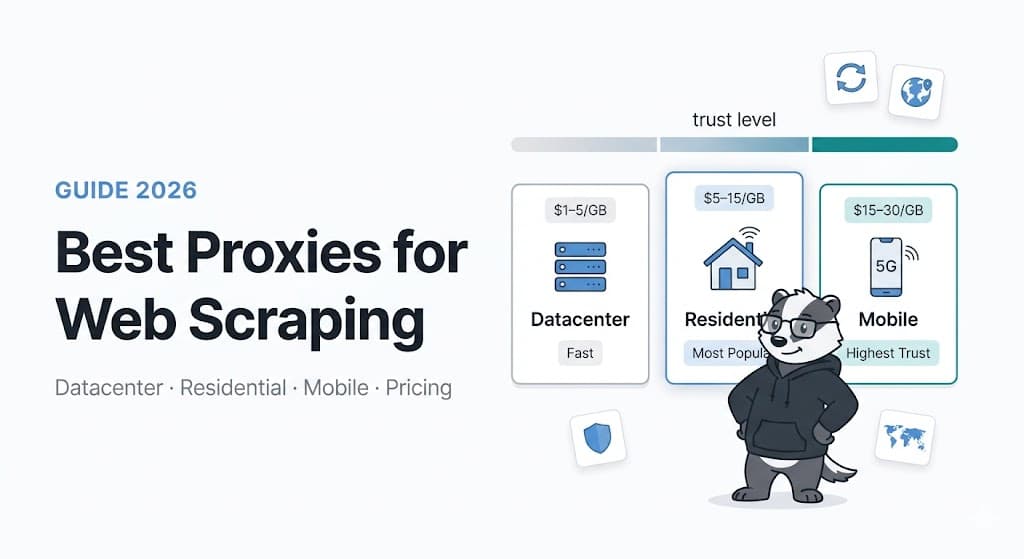
Datacenter proxies are best for high-volume scraping of sites with minimal anti-bot protection. Cost runs $1–5 per GB with 1–10ms latency. Detection risk is high.
This doesn't mean datacenter proxies are useless. Government data portals, academic databases, simple HTML directories, and any site without active bot protection scrape perfectly well with datacenter IPs at a fraction of the cost of residential proxies. The mistake teams make is using datacenter proxies on targets that require residential-level trust, watching the success rate crater, and concluding that scraping is impossible when in fact they're using the wrong tool.
The shared vs dedicated distinction matters here. Shared datacenter proxies are used by many customers simultaneously — their IPs accumulate a scraping history that further degrades trust. Dedicated datacenter proxies are assigned to a single customer, maintaining a cleaner IP reputation, at a higher price per IP.
ISP Proxies (Static Residential)
ISP proxies occupy the middle ground between datacenter and residential — and they're genuinely underused.
ISP proxies are datacenter-hosted servers with IPs assigned by real ISPs. They combine the speed of datacenter proxies with the trust of residential IPs. Ideal for long sessions where you need a stable, trusted IP that doesn't rotate. ScrapeOps
The way they work: rather than using IP ranges that cloud providers own, ISP proxy providers buy IP allocations directly from internet service providers. The IPs appear in ASN databases as belonging to Comcast, BT, or Deutsche Telekom — legitimate residential ISPs — while the actual traffic routes through fast datacenter infrastructure.
ISP proxies handle medium-difficulty anti-bot protection, are good for logged-in session stability, and cost in the medium range per IP.
The key use case is authenticated scraping — workflows covered in the session-based scraping guide on the ScrapeBadger blog. When you need a stable IP that a login session can be associated with over multiple days, ISP proxies deliver datacenter-level speed without triggering the ASN-based blocking that affects pure datacenter IPs.
Residential Proxies
Residential proxies route traffic through real consumer ISP connections. They look like regular users browsing from home, making them much harder to detect. Best for scraping sites with strong anti-bot measures including Amazon, Google, and social media. Cost runs $5–15 per GB with 50–200ms latency. Detection risk is low.
The mechanism behind their trust level is straightforward: these are real IP addresses assigned by ISPs to real households. When a residential IP makes a request, anti-bot systems see what appears to be a real user's home internet connection — which is why their false-positive rate for blocking is high enough that most sites don't block them aggressively.
Residential proxies bypass reputation systems due to high IP turnover, not invisibility. IPs rotate fast enough to evade static blocklists. DataDome research confirms that only 16% of websites successfully detect bots using residential proxies. The remaining 84% remain exposed at the IP layer, forcing target sites to adopt deep behavioural detection instead.
That 16% figure is worth sitting with. It means that on most sites, a scraper with good residential proxies, correct browser headers, and proper timing already bypasses the protection. The sites in the 16% that successfully detect residential proxies are the ones that have invested in behavioural ML — the DataDomes, the Impervas on their highest-security configurations, and the purpose-built anti-scraping systems that the ScrapeBadger anti-bot bypass articles cover in depth.
Residential proxies are the correct general-purpose default for any site with meaningful bot protection.
Mobile Proxies
Mobile proxies use 4G/5G connections from real mobile carriers. IPs are assigned by mobile carriers and shared via CGNAT among thousands of real users. The highest trust level of any proxy type because blocking a mobile IP blocks thousands of legitimate users. Best for the most protected sites and account-related operations. Cost runs $15–30 per GB with 100–500ms latency. Detection risk is very low.
CGNAT — Carrier-Grade Network Address Translation — is the technical mechanism that makes mobile proxies so effective. Mobile carriers run out of IPv4 addresses and share a single public IP across hundreds or thousands of subscribers simultaneously. A website that wants to block a malicious mobile IP has to accept that doing so also blocks hundreds of real customers with the same IP. The false-positive cost is too high. Most sites don't block mobile IPs aggressively.
For heavily protected sites like major e-commerce platforms and social media, mobile proxies deliver the highest success rates. Major e-commerce platforms, social media sites, and any domain that consistently defeats residential IPs deserve the higher per-GB cost. Mobile should be an escalation, not a starting point.
The pricing premium is real — $15–30/GB versus $5–15/GB for residential. If you're monitoring prices across 50 e-commerce stores, maybe 5 of them are aggressive enough to need mobile proxies. The other 45 work fine on residential. Running all 50 through mobile would cost 2–3x more with no benefit on the majority of targets.
Mobile proxies are the right tool for the specific sites where residential proxies fail. They're not the right default for everything.
The Metric That No Longer Works: Pool Size
Until January 2026, one of the primary proxy evaluation metrics was raw pool size — how many IPs does the provider claim? Larger pools meant less IP reuse, slower burn rates, and lower per-IP detection risk. Providers competed on announcing larger and larger IP counts.
On January 28, 2026, Google Cloud dismantled IPIDEA, the world's largest residential proxy network. This takedown wiped out millions of exit nodes and exposed how multiple proxy brands secretly resold the exact same compromised device pools. Buying based on claimed pool size is an obsolete metric.
The IPIDEA takedown was significant for several reasons beyond the immediate disruption. It revealed that many providers claiming to have "50 million+ IPs" were actually reselling access to the same underlying pool with different branding. It demonstrated that large proxy networks operating at grey-market scale are vulnerable to infrastructure-level takedowns. And it showed that the quality of IP sourcing matters more than the quantity.
In 2026, the right proxy evaluation questions are: How are the IPs sourced? Are they genuinely residential consumer connections or datacenter IPs masquerading as residential? What is the actual monthly refresh rate of the pool? What is the measured success rate on protected targets, not the claimed pool size?
The Pricing Reality at Real Scraping Volumes
Pricing comparisons that stop at "residential is $X per GB" obscure the metric that actually matters for scraping: cost per successful request.
A datacenter proxy at $2/GB with a 30% success rate on a target site costs more per successful data record than a residential proxy at $10/GB with an 85% success rate — because you're paying for the bandwidth of failed requests too. At scale, failed requests waste proxy bandwidth, waste server resources, and require retry logic that adds engineering complexity.
Calculate your true cost per successful request, factoring in retries and wasted bandwidth.
A rough framework for cost per successful request by proxy type and target difficulty:
Target difficulty | Proxy type | Success rate | Effective cost |
|---|---|---|---|
No anti-bot | Datacenter | 95%+ | Very low |
Basic Cloudflare | Datacenter | 20–40% | Medium (retries expensive) |
Basic Cloudflare | Residential | 70–85% | Low–Medium |
Imperva / Akamai | Residential | 40–70% | Medium |
Imperva / Akamai | Mobile | 80–90% | Medium–High |
DataDome (Enterprise) | Residential + fingerprint | 50–70% | High |
DataDome (Enterprise) | Mobile + fingerprint | 75–85% | High |
The success rate column is where most proxy cost calculations go wrong. A team that bought the cheapest datacenter proxies and is seeing 25% success on a Cloudflare target is spending four times more on proxy bandwidth per successful record than if they'd bought residential proxies at triple the GB price.
Best Proxy Providers by Type
Best Datacenter Proxy Providers
Webshare — one of the fastest datacenter proxy options with a generous free tier (10 proxies free, no credit card) that makes it practical for testing before scaling. Shared and dedicated options. Best for budget scraping on unprotected or lightly protected targets.
IPRoyal — dedicated datacenter proxies with unlimited bandwidth on dedicated plans. Strong for high-frequency scraping workflows on targets that don't require residential trust. Their pricing model rewards teams running consistent high-volume operations.
Oxylabs Datacenter Proxies — enterprise-grade datacenter infrastructure with strong uptime SLAs. Better fit for teams already using Oxylabs residential infrastructure who want a cost-optimised tier for easy targets.
Best Residential Proxy Providers
Bright Data — the largest IP network with over 150 million IPs, offering multiple proxy types including residential, datacenter, ISP, and mobile with city and ASN-level targeting. Highly reliable for difficult targets. The Web Unblocker tool adds anti-bot bypass logic on top of proxy routing. Priced for enterprises; complex billing.
Oxylabs — 100M+ residential IPs across 195 countries, strong for production workflows that need geographic precision. Pay-per-GB model with enterprise support.
Decodo — the benchmark sweet spot in 2026, offering top-tier speeds under 2.5ms and high success rates at a more competitive price point than enterprise giants. Strong choice for mid-market teams who need residential quality without enterprise pricing. Scrapfly
WeProxies— competitive residential pricing with ethically sourced IPs. A legitimate option for budget-conscious teams who need residential trust.
Best Mobile Proxy Providers
Bright Data Mobile — the strongest mobile proxy network available, covering 4G/5G connections across 195 countries. Expensive but reliable on the most aggressively protected targets.
Oxylabs Mobile Proxies — strong geographic coverage and session control for mobile workflows. Better documented than most mobile providers for developer integration.
Proxidize — hardware-based mobile proxy provider that ships physical SIM-card devices, giving customers full control over their own mobile proxy infrastructure. Unusual model that makes sense for teams with very high mobile proxy volume who want to eliminate per-GB costs.
The Rotation Strategy Question
Having the right proxy type is half the decision. The rotation strategy — how often you change IPs, whether you maintain session stickiness, how you handle blocked IPs — is the other half.
Rotating on every request maximises IP diversity but breaks session-dependent scraping. If a site expects your session to come from a consistent IP (login-protected content, shopping carts, anything with session state), per-request rotation breaks the session.
Sticky sessions maintain the same IP for a configurable window — typically 10–30 minutes — allowing multi-step workflows to complete before rotating. Most residential proxy providers support sticky session configuration. As covered in the ScrapeBadger session-based scraping guide, the right session length depends on the target's session cookie TTL.
IP pool segmentation is a more advanced strategy that dedicates specific IP subsets to specific targets, preventing contamination between scraping campaigns. An IP that's been used aggressively against Target A shouldn't be used against Target B where a fresh reputation matters.
How Scraping APIs Change the Proxy Calculation
This is the argument that most proxy comparison articles skip because it directly undercuts the premise of the article.
For complex extractions, skipping raw proxies altogether for a managed web scraping API is often the smartest engineering choice.
Managing your own proxy infrastructure means: choosing the right provider and tier, configuring rotation logic, handling failures and retries, managing proxy authentication in your codebase, monitoring IP burn rates, swapping providers when success rates degrade, and accounting for bandwidth costs that are difficult to predict in advance.
All of that overhead exists before you've written a single line of parsing logic.
ScrapeBadger includes residential proxy rotation as part of every scraping request — you don't choose a proxy type, configure rotation, or manage sessions. The infrastructure selects the appropriate proxy type based on the target, handles session continuity, and rotates as needed. When Imperva blocks a residential IP, the escalation to mobile happens automatically. When a session cookie expires, it's regenerated. When an IP is flagged, it's rotated out.
The per-request cost is higher than running your own residential proxies on unprotected targets — that's the honest trade-off. Where it pays off is on protected targets where the combination of correct TLS fingerprinting, managed proxy rotation, and anti-bot bypass infrastructure produces success rates that DIY proxy management rarely achieves. As covered across the ScrapeBadger guides to bypassing Cloudflare, Imperva, Akamai, and DataDome — the proxy is one layer of five or six. Getting the proxy right but getting the TLS fingerprint wrong still results in a block.
The practical guide: use your own proxies when scraping simple targets at high volume where cost per GB is the dominant factor. Use a scraping API when targeting sites with active anti-bot protection where the full bypass stack matters more than per-GB cost. Most production scraping operations use both.
The Decision Framework
Use datacenter proxies when
The target has no meaningful bot protection — unprotected HTML sites, government open data portals, basic directories. Speed and cost efficiency are the priorities. You're testing a scraper and don't want to burn residential proxy bandwidth on validation runs.
Use ISP proxies when
You need datacenter-level speed but your target blocks known cloud ASN ranges. You're running authenticated sessions that need a stable, non-rotating IP over multiple hours. You want the trust level of residential without the latency penalty.
Use residential proxies when
The target has active bot protection — Cloudflare, basic Imperva, standard e-commerce anti-bot. This is the correct default for most commercial scraping targets. Geographic precision matters — residential proxies support city-level and ISP-level targeting for geo-specific content.
Use mobile proxies when
The target consistently defeats residential proxies — aggressive DataDome deployments, social media platforms, major e-commerce with enterprise anti-bot configurations. You're scraping mobile-specific content or APIs that apply different access controls to mobile user agents. The higher per-GB cost is justified by the target's value.
Use a scraping API when
The target uses Cloudflare Enterprise, Imperva, Akamai, or DataDome and you don't want to manage the full bypass stack yourself. Your team's engineering time is better spent on the data pipeline than on proxy infrastructure. You need consistent success rates with no maintenance overhead when anti-bot systems update.
Start with ScrapeBadger's free trial — 1,000 credits, no credit card — to test your specific targets before building any proxy infrastructure. If the success rate is acceptable, you have your answer. Full documentation at docs.scrapebadger.com.

Written by
Domas Sakavickas
Dom Sakavickas is Co-founder of ScrapeBadger, building web scraping infrastructure for developers and data teams. He writes about the web data market, tool comparisons, and business use cases for scraping. ScrapeBadger is a web scraping API platform specialising in Twitter/X, Reddit and Google data, with dedicated scrapers also covering TikTok, YouTube, LinkedIn, Amazon, eBay, Zillow and 40+ more: with built-in anti-bot bypass and an MCP server for AI agents.
Ready to get started?
Join thousands of developers using ScrapeBadger for their data needs.