Best Zillow Scraper APIs in 2026: Compared and Ranked
 Domas Sakavickas
AI Summary: With Zillow's public API deprecated and Bridge Interactive gated to licensed brokers, this guide ranks the best Zillow scraper APIs for 2026, explaining why PerimeterX fingerprinting, embedded JSON, and an 820-result cap make reliable property extraction hard.
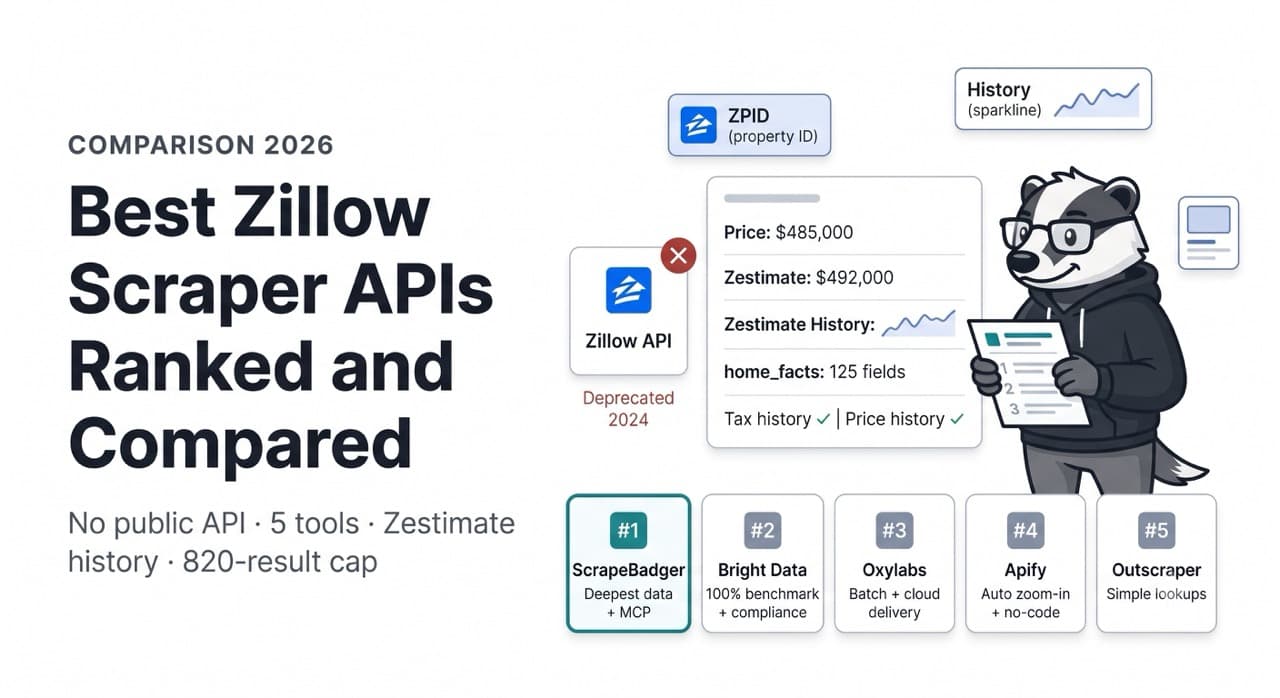
There is no public Zillow API.
That sentence stopped being true in stages. Zillow launched its public API in the mid-2000s and developers built a whole ecosystem around it — Zestimate lookups, listing feeds, neighbourhood analytics. Then Zillow began restricting endpoints, throttling access, and limiting which use cases qualified. By 2024 the deprecation was effectively complete. What replaced it: Bridge Interactive, available to MLS members and licensed brokers only, starting at roughly $500/month, with an approval process that takes weeks and rejects most proptech applicants. The Zestimate API is not available. Listing data requires a Zillow Premier Agent commercial relationship.
If you are a developer, investor, data team, or proptech company that needs Zillow property data in 2026, scraping is not a workaround. It is the only option.
The complication is that Zillow is genuinely hard to scrape. The platform uses PerimeterX/HUMAN fingerprinting, IP-reputation scoring, and TLS/HTTP-2 fingerprint checks. Most of the property data lives inside __NEXT_DATA__ and gdpClientCache — embedded JSON in server-rendered pages rather than accessible HTML — which means basic request libraries return empty results even when they clear the bot detection layer. And Zillow's 820-result cap per search (20 pages of roughly 41 results each) creates a coverage problem for dense metros that requires a map-bound tiling strategy to solve.
The tools that handle all of this correctly are a shorter list than the general scraping market suggests. This guide covers the ones that do — with real data on what each returns, honest pricing, and a clear answer for which tool fits which situation.
What Zillow Data Actually Contains
Before comparing tools, it is worth being precise about what Zillow exposes publicly and what it does not. Several capabilities commonly listed in tool descriptions are not in the server-rendered data Zillow makes scrapable.
What is in the public data:
Zillow's property pages contain an unusually rich field set. The search endpoint returns roughly 50 fields per listing: price, Zestimate (current valuation estimate), beds, baths, square footage, lot size, year built, home type, listing status (for sale, for rent, sold), address with latitude and longitude, days on Zillow, photos, broker name, ZPID (Zillow's stable property identifier), and basic school information.
The property detail endpoint goes significantly deeper. The resoFacts MLS record — distilled into a structured home_facts block — adds approximately 125 additional fields covering heating system, cooling system, appliances, flooring types, parking, pool, HOA details, green certifications, structural features, and parcel information. Beyond the facts block: full price history (every listing price change), tax history (annual assessed value and tax paid), Zestimate history (the time series of Zillow's automated valuation model), current Rent Zestimate, nearby schools with GreatSchools ratings, listing agent attribution, open house schedule, and nearby cities and ZIP codes.
The agent endpoint adds another distinct data layer: agent profile with reviews, past sales, license information, and current listings.
What is not in the scrapable data:
Comparable sales, Walk Score / Transit Score / Bike Score, and climate risk ratings are loaded client-side after the initial page render via lazy JavaScript calls. These fields are intentionally absent from any scraping tool that parses the server-rendered response. Any provider claiming to return these is either running a full browser session per property (expensive) or fabricating them. Good tools document this gap honestly.
Why Zillow Is Hard to Scrape Well
The 820-result search cap is the most common problem teams hit after the initial integration works. A search for "Austin TX" on Zillow returns 20 pages of results and then stops, regardless of how many properties exist in the market. In a dense metro, that means missing thousands of listings.
The correct architecture uses the map_bounds box that Zillow returns with each search — the north, south, east, and west coordinates describing the bounding box of the results. When a search hits 20 pages, you subdivide that bounding box into four quadrants and re-issue the search on each smaller area. Each sub-area gets its own 820-result cap. If any sub-area still hits 20 pages, you subdivide again. This tiling approach can theoretically extract every listing in a market at the cost of proportionally more API calls.
Not all tools support or document this tiling approach. The ones that do — both ScrapeBadger and Apify's Zillow Search Scraper — are meaningfully more useful for market-level coverage than the ones that return 820 results and stop.
The second problem is Zestimate history versus current Zestimate. Most tools return the current Zestimate value. The time series — what the Zestimate was six months ago, a year ago, three years ago — is what matters for investment analysis and AVM training. This is only available on the property detail endpoint, not the search endpoint, and only tools that parse the full detail page rather than just the search results page can return it.
The Providers
ScrapeBadger — Best for Data Depth and Multi-Source Pipelines
ScrapeBadger's Zillow Scraper has five dedicated endpoints: property search, full property detail by ZPID, agent profile, location autocomplete, and a markets list. The architecture is the same as the other ScrapeBadger real estate scrapers — dedicated structured endpoints rather than general HTML scraping — which means you receive normalised JSON without writing parsers.
The data depth is the clearest differentiator in this comparison. The property detail endpoint returns approximately 99 top-level fields plus the full home_facts block of around 125 additional fields distilled from Zillow's resoFacts MLS record. Price history, tax history, and Zestimate history are all present as arrays on the detail endpoint. The Zestimate history — the time series rather than just the current value — is what investment analysts and AVM developers actually need, and it is present here where most tools return only the current figure.
The agent endpoint is unique in this comparison: reviews with star ratings and text, past sales with dates and prices, license information, and the agent's current active listings. Real estate teams building agent prospecting tools or lead generation systems on Zillow data have no equivalent endpoint elsewhere.
The map-bound tiling architecture for breaking the 820-result cap is explicitly documented in ScrapeBadger's Zillow documentation — the map_bounds box returned on each search is designed to be used for geographic subdivision. The docs walk through exactly how to implement this.
Anti-bot handling uses Chrome TLS impersonation on US-pinned residential IPs, which is the correct architecture for Zillow's fingerprinting checks. ScrapeBadger's own benchmarking claims 99%+ success rates on Zillow — a figure consistent with their general anti-bot positioning confirmed in their own published comparison article.
The multi-platform argument applies here exactly as it does to the other ScrapeBadger real estate scrapers. Teams combining Zillow data with Realtor.com data for cross-platform property intelligence, Google Trends for local market demand signals, or Google Maps for neighbourhood amenity analysis can run all of this under one API key. The MCP integration exposes Zillow alongside every other ScrapeBadger data source to AI agents — useful for investment research agents and automated market reporting workflows.
Pricing: 5 credits per search, 5 credits per property detail, 5 credits per agent profile, 2 credits for autocomplete, 0 for the markets list. Zero credits for failed requests.
What ScrapeBadger does not return: Walk/Transit/Bike scores, comparable sales, and climate risk ratings — all lazy-loaded client-side and absent from server-rendered data. Honestly documented in the product documentation.
Best for: Proptech companies and investment teams needing the fullest available Zillow data model; AVM developers who need Zestimate history as a training signal; teams combining Zillow with other data sources; AI agent workflows via MCP.
Bright Data — Best Benchmark Performance
Bright Data's real estate coverage includes a dedicated Zillow scraper within their Web Scraper infrastructure, backed by the largest residential proxy network in the market — 72M+ IPs across 195 countries.
The headline performance figure matters specifically for Zillow: Bright Data achieved 100% success rate on Zillow in Scrape.do's 2026 independent benchmark of multiple providers — the highest result of any tool tested on that specific target. Zillow's PerimeterX/HUMAN protection is among the most aggressive on any real estate platform, and the gap between a 99% and a 92% success rate at 100,000 requests per month is 8,000 missing properties. The proxy network scale that produces this result is Bright Data's genuine technical moat.
The compliance posture is the second differentiator. GDPR, CCPA, ISO 27001, and SOC 2 certification — the most complete compliance documentation of any provider in this comparison. For enterprise real estate data teams in regulated industries, this is a procurement requirement rather than a nice-to-have.
The cost and complexity are the constraints. The Web Scraper IDE starts at $499/month. The data depth and field normalisation in Bright Data's Zillow extractor is strong but focuses on the core fields rather than returning the full resoFacts home_facts block. Billing complexity is the most-cited user complaint in Capterra reviews — the multi-layer pricing between proxy network, Web Scraper, and Datasets can produce invoices that are difficult to predict or explain internally.
Best for: Enterprise teams with formal compliance requirements; high-volume production Zillow pipelines where the 100% benchmark success rate justifies the premium; organisations where billing predictability is less important than reliability.
Oxylabs — Best for Batch Processing
Oxylabs covers Zillow through their Web Scraper API with self-healing parser presets that adapt automatically when Zillow updates its frontend structure. The 98.50% success rate in AIMultiple's independent benchmark of 1,700 URLs positions them alongside Bright Data at the top of the reliability tier.
The distinguishing capability from Bright Data is batch processing: Oxylabs supports large scheduled batch jobs with delivery to cloud storage (S3-compatible, GCS), useful for teams that want to pull the full Zillow inventory for a set of ZIP codes on a weekly schedule and receive output files rather than managing API call loops. OxyCopilot AI code generation reduces integration time for teams new to the platform.
The bandwidth-based pricing model — approximately $9.40/GB on the Web Unblocker — benefits teams processing small numbers of large pages but becomes unpredictable for variable workloads. Property detail pages are large (they carry the full __NEXT_DATA__ state blob including photos), so Zillow is a high-bandwidth target in this model. The $49/month entry tier is accessible, but realistic Zillow production workloads typically require $399/month or above.
Oxylabs does not return the full home_facts resoFacts block or the Zestimate history array. Their Zillow extractor focuses on the core listing fields — price, beds, baths, sqft, status, address — plus the current Zestimate.
Best for: Teams running large scheduled batch Zillow collection jobs with cloud storage delivery; enterprise teams already on Oxylabs for other data sources; high-volume pipelines where the self-healing parser preset reduces maintenance overhead.
Apify — Best for Non-Technical Teams and City-Scale Coverage
Apify's Zillow coverage uses two separate Actors: the Zillow Search Scraper for location-based listing discovery, and the Zillow Details Scraper for full property pages. The split architecture mirrors the data model — search returns the 50-field listing summary, detail returns the richer property data. You pay for both if you need both.
The Apify Zillow Search Scraper's most technically impressive capability is its zoom-in pagination mode: when a search hits the 20-page cap, the Actor automatically subdivides the map area into quadrants, re-issues the search on each, and continues recursively until all sub-areas have less than 20 pages. The practical result is that a single Actor run can extract over 600,000 results from a single search query for a dense metro — a figure documented in their own Actor description. This is the same tiling concept documented in ScrapeBadger's Zillow docs, but implemented automatically within the Actor runtime rather than requiring the caller to manage the subdivision logic.
The pricing is $2 per 1,000 search results (plus compute units), with a separate charge for the Details Scraper runs. The community maintenance model that applies to all Apify Actors applies here — the Actor's update cadence depends on its maintainer's response to Zillow frontend changes. The maxcopell/zillow-scraper Actor has a large user base (meaningful for maintenance motivation), but the maintenance risk remains real. The separate two-Actor architecture also means running both requires stitching together two pipelines, which adds engineering overhead.
The no-code visual interface is the access story for non-technical users: configure search inputs, click run, download data. Marketing analysts and investment teams who need Zillow data without developer involvement have a genuine path through Apify.
Best for: Non-technical teams who need a no-code interface; engineering teams that want the 600K+ zoom-in coverage without writing their own tiling logic; teams already on Apify for other scraping targets.
Outscraper — Best for Simple Lookups at Low Volume
Outscraper offers Zillow property data extraction as part of their broader data services platform. The interface is simpler than most options here — you can provide a list of Zillow URLs or search queries and receive structured output without API integration overhead.
The data depth is shallower than the enterprise-tier options. Core listing fields (price, beds, baths, sqft, address, status) are well-covered. The Zestimate is present. The home_facts block, Zestimate history, tax history, and agent profiles are not in the standard output.
Outscraper is most useful for teams that need occasional Zillow lookups — enriching a spreadsheet of property addresses with current prices and Zestimates, validating a list of listings before adding to a CRM — rather than for continuous production monitoring or bulk market coverage.
Best for: Non-technical users running occasional lookups; small teams enriching property lists without a development budget for API integration.
Chrome Extensions — Useful for One-Off Research, Not Production
A category worth acknowledging because they appear prominently in Zillow data searches: browser extensions like Z Real Estate Scraper (Proptierio), actively maintained through May 2026, extract Zillow listing data directly from the page as you browse. Some extensions handle for-sale, for-rent, sold, and FSBO listings with agent contact extraction.
These are not production data infrastructure. They run on a human browsing session, are limited by manual page-by-page operation, and are not scriptable into automated pipelines. For a real estate agent who needs to pull 50 listings into a spreadsheet once a week, they are a practical tool. For any team that needs programmatic, scheduled, or volume-based Zillow data access, they are the wrong category.
The Comparison Table
ScrapeBadger | Bright Data | Oxylabs | Apify | Outscraper | |
|---|---|---|---|---|---|
Zillow benchmark success rate | 99%+ | 100% (Scrape.do 2026) | 98.50% | ~95% residential | Not published |
Dedicated Zillow endpoints | 5 structured | Pre-built extractor | Parser preset | 2 Actors | Property lookup |
home_facts / resoFacts block | ✅ ~125 fields | Partial | ❌ | Partial | ❌ |
Zestimate history (time series) | ✅ | ❌ | ❌ | ❌ | ❌ |
Tax history | ✅ | Partial | ❌ | Partial | ❌ |
Price history | ✅ | ✅ | Partial | ✅ | ❌ |
Agent profile endpoint | ✅ Reviews + sales + licenses | ❌ | ❌ | ❌ | ❌ |
820-result cap solution | ✅ map_bounds tiling documented | Manual | Manual | ✅ Automatic zoom-in | ❌ |
Walk/Transit scores | ❌ (lazy-loaded) | ❌ | ❌ | ❌ | ❌ |
Comparable sales | ❌ (lazy-loaded) | ❌ | ❌ | ❌ | ❌ |
No-code UI | ❌ | ✅ | ❌ | ✅ | ✅ |
MCP integration | ✅ | ❌ | ❌ | ✅ | ❌ |
Multi-product (Realtor.com, Google) | ✅ | ✅ | ✅ | ✅ 31K+ | ❌ |
Enterprise compliance | ❌ | ✅ SOC 2, ISO 27001 | ✅ ISO 27001 | ❌ | ❌ |
0 credits on failure | ✅ | ✅ | ✅ | ✅ | ✅ |
Entry pricing | Pay-as-you-go from $10 | $499/month | $49/month | $29/month | Varies |
Maintenance model | ScrapeBadger team | Bright Data team | Oxylabs team | Community Actor | Outscraper team |
The Scenarios That Determine Your Choice
"I need the deepest available Zillow data — home facts, Zestimate history, tax history, agent profiles"
ScrapeBadger. The home_facts block of ~125 resoFacts fields plus the Zestimate, tax, and price history arrays are the richest structured Zillow output available. The agent endpoint with reviews and past sales has no equivalent in any other tool. For AVM developers, investment analysts, and proptech companies building data-intensive products, the data depth is the deciding factor.
"I need the most reliable Zillow scraping at very high volume"
Bright Data. A 100% success rate in independent 2026 benchmarking on Zillow specifically is the headline number. At 100,000+ daily requests, the gap between 100% and 99% matters. The compliance certification also matters if your enterprise procurement requires it. Accept the cost and billing complexity as the price of this reliability tier.
"I need to extract all listings for an entire metro area"
Apify's Zillow Search Scraper with the automatic zoom-in mode. The ability to extract 600,000+ results from a single search query by automatically subdividing the map removes the engineering overhead of building your own tiling logic. At $2 per 1,000 results the cost is predictable. Accept the community maintenance risk and the need for a separate Actor run for property detail.
"My team doesn't write code and needs Zillow data for market research"
Apify for structured data with a visual interface, or Outscraper for simple property lookups. Chrome extensions for very occasional one-off needs. None of these scale to production monitoring, but they provide access without engineering.
"I need Zillow data alongside Realtor.com, Google Trends, and neighborhood data in one pipeline"
ScrapeBadger. The Realtor.com scraper, Google Trends API, and Google Maps API all run under the same key alongside the Zillow scraper. For teams where Zillow is one source in a broader real estate intelligence stack — rather than the only source — the single-integration architecture simplifies both engineering and billing.
"My enterprise procurement requires SOC 2 certification"
Bright Data. It is the only option in this comparison with both SOC 2 and ISO 27001. No other provider clears this gate.
FAQ
Does Zillow have an official public API in 2026?
No. Zillow's public API was deprecated gradually and is effectively unavailable for most use cases. Bridge Interactive, the only remaining official data access path, is restricted to MLS members and licensed brokers, costs approximately $500/month minimum, and requires an application process that takes weeks. The Zestimate API is not publicly accessible. For developers and data teams without an MLS membership, scraping is the only path to Zillow property data at any meaningful scale.
What makes Zillow harder to scrape than Realtor.com?
Both use aggressive bot protection, but the layers differ. Zillow uses PerimeterX/HUMAN fingerprinting alongside TLS and HTTP-2 fingerprint checks and IP reputation scoring — a combination that degrades tools relying on static headers or datacenter IPs even when they initially appear to work. The 820-result cap adds an architectural challenge that does not exist on Realtor.com. Zillow's __NEXT_DATA__ embedding of property data is similar to Realtor.com's __NEXT_DATA__ pattern, but the surrounding fingerprinting layer is more aggressive.
Can I get Walk Score, Bike Score, and climate risk data from Zillow?
Not through any standard scraping tool. These data points are loaded via client-side JavaScript calls after the initial page render — they are not present in the server-rendered HTML or the embedded __NEXT_DATA__ JSON. Honest tools document this gap. Walk, Transit, and Bike scores are available directly from Walk Score's own API if you need them; climate risk data is available from providers like First Street.
Is the Zestimate accurate enough for investment decisions?
The Zestimate has a published median error rate of approximately 1.9% for on-market properties and approximately 7% for off-market properties. It is useful as a directional screening signal — filtering a large universe of properties to identify those trading significantly above or below Zillow's automated valuation — but should not be treated as a substitute for appraisal or independent comparable sales analysis. The Zestimate history is more useful than the current figure for many investment applications, as it reveals valuation trend direction over time.
What is the ZPID and why does it matter?
The ZPID (Zillow Property ID) is Zillow's stable identifier for each property. Unlike addresses (which can be formatted inconsistently) or MLS IDs (which change with each new listing), the ZPID persists for a property regardless of how many times it has been listed or relisted. Building a property database around ZPIDs enables reliable deduplication, price history tracking, and cross-referencing across data pulls. Any production Zillow pipeline should store and key on the ZPID rather than address strings.

Written by
Domas Sakavickas
Dom Sakavickas is Co-founder of ScrapeBadger, building web scraping infrastructure for developers and data teams. He writes about the web data market, tool comparisons, and business use cases for scraping. ScrapeBadger is a web scraping API platform specialising in Twitter/X, Reddit and Google data, with dedicated scrapers also covering TikTok, YouTube, LinkedIn, Amazon, eBay, Zillow and 40+ more: with built-in anti-bot bypass and an MCP server for AI agents.
Ready to get started?
Join thousands of developers using ScrapeBadger for their data needs.