How Competitors Are Using Web Scraping Against You Right Now
 Domas Sakavickas
AI Summary: Because rivals already scrape your public pricing, job postings, catalogue, and reviews daily to feed repricing and intelligence engines, this article details what competitive scraping captures and argues you should be collecting the same data on them to compete.
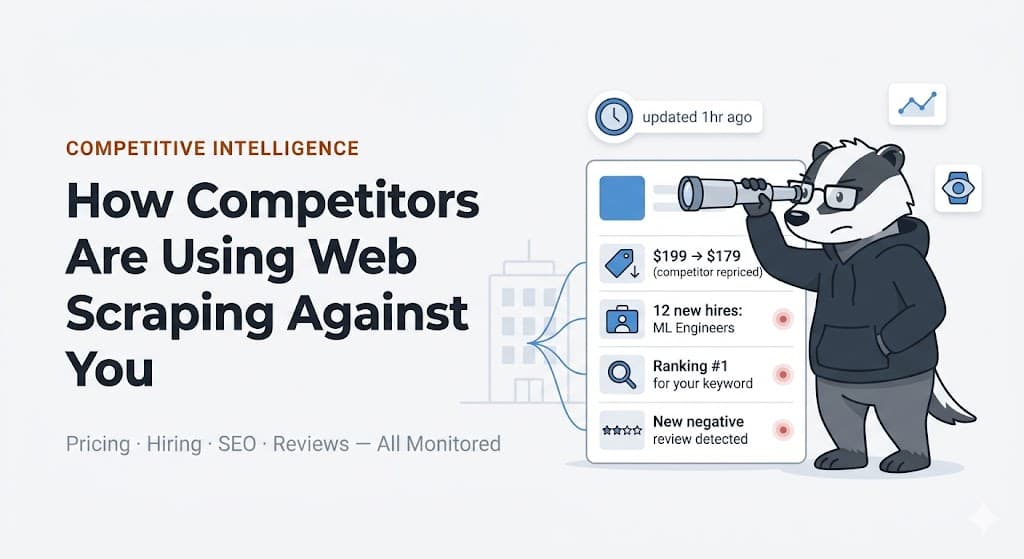
There is a version of your business that exists in your competitors' databases. It's updated daily. It contains your pricing, your job postings, your product catalogue, your customer reviews, the keywords you're targeting, the content you're publishing, and the changes you've made to all of the above over the past twelve months.
You didn't give them any of this. But every piece of it is publicly visible — on your website, your job board listings, your app store page, your Google Business Profile. And if your competitors are serious about data, they're collecting it automatically.
This is not a hypothetical. 73% of enterprises now rely on automated data extraction for business intelligence. The companies investing in competitive intelligence infrastructure aren't doing it for the novelty. They're doing it because it works — because acting on current, structured data faster than competitors produces measurable commercial outcomes.
The question isn't whether your competitors are scraping your public data. The question is what they're doing with it, and what you should be doing with theirs.
Your Pricing Page Is a Live Feed Into Their Repricing Engine
The most mature and widespread application of competitive web scraping is price monitoring. 81% of US retailers now use automated price scraping for dynamic repricing, up from 34% in 2020. If you operate in retail, e-commerce, SaaS, travel, or any market where pricing is visible and adjustable, this number should get your attention.
Here's how it works in practice. A competitor sets up a scraping pipeline that checks your pricing page — or your product listings on Amazon, or your software pricing table — on a schedule. Hourly, in some cases. Daily at minimum. Every change you make is captured with a timestamp. Over weeks, they have a picture of your pricing strategy: when you discount, how deeply, for how long, whether you A/B test different price points, and how quickly you respond to market changes.
A marketplace with 12,000 SKUs moved from weekly price adjustments to micro-adjustments every four hours using scraped competitor data, resulting in $756,000 in annual margin improvement on a $22,000 scraping investment — a 34x return.
The same dynamic applies in reverse. If your competitor has a real-time view of your pricing and you're checking theirs weekly in a spreadsheet, they can consistently undercut you on price-sensitive segments while you're still looking at last week's data.
The defence is the same as the offence: build your own price monitoring pipeline. The ScrapeBadger guide to building a price tracking bot covers the full architecture for production price monitoring — including multi-platform scraping, change detection, and alert delivery. And the e-commerce scraping guide covers the specific technical approaches for every major e-commerce platform.
Your Job Postings Are Telling Them Your Strategy
Most executives don't think of job postings as competitive intelligence. They should. A job posting is a strategic document that most companies publish without considering what it reveals.
A competitor who tracks your hiring patterns knows:
Where you're expanding. New job postings for sales roles in a specific region signal a geographic push before any press release announces it.
What you're building. Engineering job descriptions contain technology choices, product priorities, and architectural decisions. A company that starts posting multiple machine learning roles is building an ML product. A company that starts posting API-focused backend roles is building an integration layer.
How you're positioned. The seniority mix of your hiring tells a story about organisational maturity and growth stage. The skills listed in your product team's job descriptions tell a story about what problems you think you're solving.
When you're scaling. A sudden surge in hiring across multiple departments signals a funding event, a new product launch, or a major contract win before it becomes public.
A cybersecurity SaaS company automated scraping of companies hiring security engineers. In 72 hours it generated 2,300 qualified leads and a $1.8 million pipeline. That's not a company monitoring competitors — it's a company using job posting scraping to identify sales prospects. The same logic works as competitive intelligence: if you can identify when competitors start hiring certain types of engineers, you're seeing their product roadmap before they announce it.
The ScrapeBadger article on web scraping use cases covers how to build job posting intelligence pipelines that flag competitor hiring changes in real time.
Your Content Strategy Is Being Reverse-Engineered
Your content team works hard to find keywords that rank, create content that earns backlinks, and build topical authority in your space. All of that work is visible.
A competitor with a systematic SERP monitoring setup — checking which of your pages rank for which keywords, when your rankings move, what content you're publishing, and how your backlink profile changes — has a map of your entire content strategy. They can see:
Which pages are gaining traffic before you see it in your own analytics. Which keywords you're targeting before you've announced the strategy. Which content formats are working for you — so they can replicate them. When your rankings drop — which could signal a technical issue or a penalty before you've identified it internally.
Teams using scraped SEO intelligence identify competitor content gaps and emerging keyword opportunities weeks faster than manual audits allow. Regular SERP scraping enables same-day responses to ranking drops, instead of discovering them weeks later in a monthly report.
The inverse is the more urgent point: while you're doing quarterly content audits on your competitors, they may be checking your SERP positions weekly. Your new content goes live, it starts ranking, and within days your competitor has published something targeting the same keyword with more depth. This happens too regularly to be coincidence in competitive markets.
The ScrapeBadger Google SERP API and the second article in the SERP data series cover the specific use cases for SERP intelligence — including AI Overview monitoring, which represents a new competitive dynamic where Google's AI-generated answers can displace your organic traffic without your ranking changing at all.
Your Reviews Are Their Product Research
Every review your customers leave is publicly visible on Google, Trustpilot, G2, Capterra, the App Store. Your competitors know this. The sophisticated ones are processing it systematically.
Sentiment analysis at scale across your customer reviews surfaces specific complaints, recurring praise, and emerging issues faster than any manual process. A competitor monitoring your reviews in real time will know about a product quality issue before your own support team flags it as a pattern. They'll know which features customers consistently praise — informing their own product roadmap decisions.
Brand monitoring via scraping allows businesses to detect emerging crises in hours instead of weeks. One documented case showed a retail client went from detecting and responding to promotional sentiment shifts within hours to a 300% improvement in campaign ROI.
More concerning: they'll know which of your customers are unhappy. A negative review mentioning a specific pain point is an outreach opportunity for a competitor with the right sales process. "I saw you mentioned on G2 that you've had issues with X — that's exactly the problem we built our product to solve."
The ScrapeBadger guide on Google Maps review scraping covers the technical foundation for multi-location review intelligence — the same patterns apply to any review platform.
Your AI Is Trained on Your Content
This is the newest and least understood dimension of competitive web scraping. Since 2023, AI teams have been among the most aggressive scrapers on the internet — collecting training data for language models, fine-tuning datasets, and retrieval-augmented generation pipelines.
AI-related data projects at leading scraping providers are now growing at 400% year-over-year, with average deal values three times higher than standard scraping projects.
What does this mean for your business? Your product documentation, your marketing copy, your blog posts, your customer communication templates — all of this is public web content that AI teams are collecting. If a competitor is training a model on public web data that includes your proprietary frameworks, methodologies, or communication styles, they're building internal tools that benefit from your intellectual work.
The more immediate concern is retrieval systems. A competitor building an internal research tool that pulls from public web sources — including your website — is giving their team instant access to your published knowledge base. Your case studies, your technical documentation, your thought leadership: all of it becomes part of their AI's context window.
What Your Google Trends Profile Reveals
When people search for your brand or product category on Google, that search data is aggregated into Google Trends signals that anyone can access. A competitor monitoring your brand's Trends trajectory alongside their own has a continuous gauge of relative brand momentum.
Share of Search — the relative search interest for a brand versus competitors — is one of the most robust leading indicators of market share change. Research has demonstrated that Share of Search predicts market share with a six to twelve month lead time. Apify
Competitors running Share of Search tracking against your brand are watching your brand health in near real-time. They'll see the signal before the market share data confirms it. The ScrapeBadger Google Trends guide covers how to build this kind of monitoring for your own competitive intelligence purposes.
The Asymmetry Is the Real Problem
None of what's described above is secret or illegal. It's systematic collection and analysis of data you've chosen to make public. The uncomfortable reality is that the companies doing this effectively are operating with a fundamentally different information advantage than those who aren't.
Consider the information asymmetry from a competitor's perspective. They know:
How your pricing has changed over the past six months
What roles you're hiring for and where
Which content is earning you traffic
What your customers are complaining about publicly
How your brand search interest trends against theirs
And you know the same about them — if you're running equivalent intelligence operations. If you're not, that information gap is one-directional. They're making decisions informed by your public data. You're making decisions based on less.
The companies that close this gap consistently do two things. They systematically collect public data about competitors and markets. And they treat their own public data as an asset worth protecting — auditing what signals they're broadcasting before competitors can act on them.
What You Can Actually Do About It
Build Your Own Competitive Intelligence Pipeline
The most direct response to competitive intelligence gathering is doing it yourself. Price monitoring, SERP tracking, review sentiment, hiring signal analysis — all of these are available through the same infrastructure your competitors are using.
The ScrapeBadger Google Scraper covers SERP intelligence, Google Trends, Google News, and Google Maps in a single integration. The price tracking infrastructure covers multi-platform competitive pricing. The web scraping for business guide covers the use cases with documented ROI figures.
Start with the highest-stakes data type for your business. For most companies, that's pricing or SERP rankings. Build one pipeline, measure its impact on one decision, and expand from there.
Audit What You're Publicly Broadcasting
Most companies never think about what signals their public web presence emits to systematic scrapers. A few worth auditing:
Your job postings. What do your current open roles tell a sophisticated competitor about your roadmap? Are there ways to describe roles that reveal less strategic intent without reducing candidate quality?
Your pricing page. How frequently do you change prices? If the answer is often, does that pricing history tell a competitor something you'd rather they didn't know?
Your content cadence. Are you publishing content that signals SEO strategy before you've fully executed it? Some teams publish content before it's properly linked and indexed, creating a window where competitors can see the target before the content has traction.
Your review response patterns. Companies that respond quickly to negative reviews are signalling the criticisms that matter. Competitors read these responses.
None of this means locking down public information to the point of reducing customer value. It means being thoughtful about the intelligence your public presence provides.
Use Real-Time Intelligence for Time-Sensitive Decisions
The advantage of automated competitive intelligence isn't just volume — it's speed. A price change you can respond to in hours beats one you respond to in a week. A competitor's hiring surge you detect in March informs your sales motion in April.
Companies using scraped market data for assortment planning consistently hit forecast accuracy of 85%+ in documented case studies. The improvement isn't from having more data — it's from having current data at the moment decisions are made.
The ScrapeBadger MCP integration connects live web data directly to AI agent workflows — an agent doing competitive analysis can pull current pricing, recent news, and search trend signals as part of a single reasoning workflow rather than assembling stale data from quarterly reports.
The Bottom Line
Web scraping is not a niche developer tool. It is business intelligence infrastructure that determines who in your market has the most current picture of the competitive landscape.
The web scraping market reached $1.03 billion in 2025 and is growing at 14.2% annually. That growth is not driven by developers building hobby projects. It's driven by business teams who've recognised that systematically collected public data is a competitive asset — and that not collecting it is a choice to operate with a worse information set than your competitors. GitHub
The data about your business exists publicly. Your competitors can access it. The only question is whether you're using the same infrastructure to understand theirs.
ScrapeBadger provides the infrastructure. Start with the free trial — 1,000 credits, no credit card — and run your first competitive data pull today.

Written by
Domas Sakavickas
Dom Sakavickas is Co-founder of ScrapeBadger, building web scraping infrastructure for developers and data teams. He writes about the web data market, tool comparisons, and business use cases for scraping. ScrapeBadger is a web scraping API platform specialising in Twitter/X, Reddit and Google data, with dedicated scrapers also covering TikTok, YouTube, LinkedIn, Amazon, eBay, Zillow and 40+ more: with built-in anti-bot bypass and an MCP server for AI agents.
Ready to get started?
Join thousands of developers using ScrapeBadger for their data needs.