How Much Does Web Scraping Cost? The Complete 2026 Pricing Guide
 Thomas Shultz
AI Summary: This guide breaks down real web scraping costs across DIY code, scraping APIs, and managed services at every volume tier, factoring in the engineering time most comparisons ignore, so readers can estimate what their specific situation actually costs.
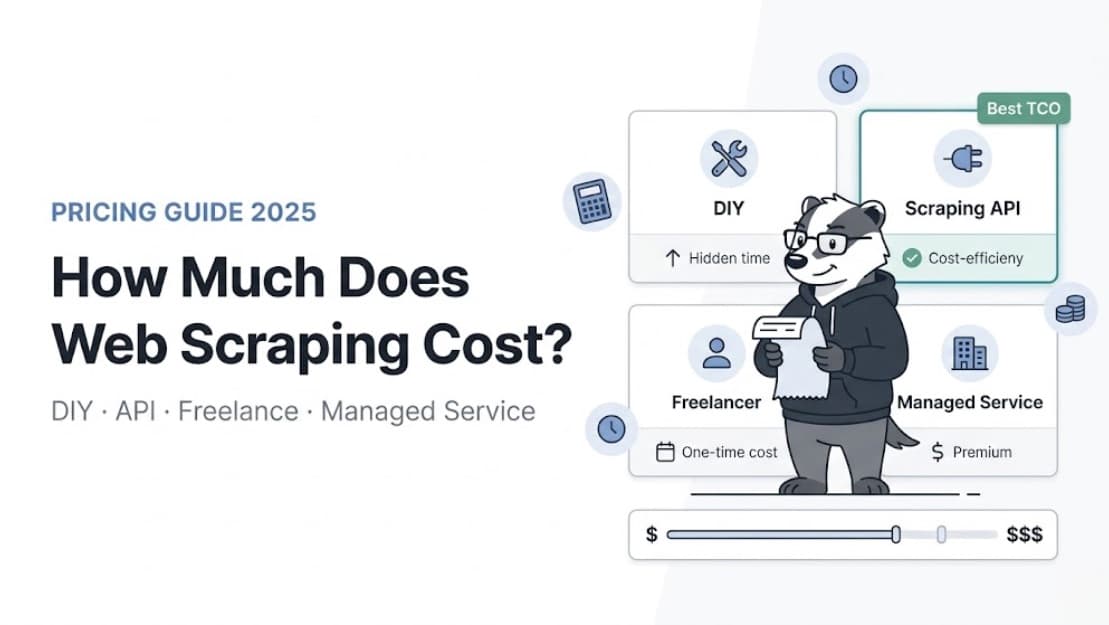
The answer most people want is a number. The honest answer is: it depends on four things, and getting any of them wrong by an order of magnitude is easy.
Web scraping cost depends on what you're scraping (simple HTML vs. JavaScript-heavy sites protected by Imperva), how much you're scraping (10,000 pages per month vs. 10 million), how you're doing it (DIY code vs. scraping API vs. managed service), and how you account for engineering time — which is the cost category most comparisons ignore entirely.
This guide breaks down real costs across every approach, every volume tier, and every hidden cost category. At the end, you'll know what web scraping actually costs for your specific situation — not a range wide enough to be useless.
The Four Approaches and Their Cost Profiles
Before any numbers, establish which category you're in. Each has a fundamentally different cost structure.
Approach 1: DIY scraping — You write the code, manage the infrastructure, handle proxies and anti-bot bypass yourself. Low direct cost, high engineering time cost.
Approach 2: Scraping API — You call a third-party API that handles proxies, JavaScript rendering, and anti-bot bypass. You pay per request. Predictable direct cost, minimal engineering overhead after initial integration.
Approach 3: Freelance or agency — You pay someone to build a scraper or deliver a dataset. One-off cost, variable quality, no ongoing engineering investment from your side.
Approach 4: Managed data service — You buy the dataset from a provider who handles everything end-to-end. Highest direct cost, zero engineering cost.
Most teams start with Approach 1, discover the hidden costs, and move toward Approach 2. Most enterprises start with Approach 4. The right answer depends on volume, target complexity, and what your engineering time is actually worth.
Approach 1: DIY Scraping — What It Actually Costs
The apparent cost of DIY scraping is low. Python is free. BeautifulSoup is free. Requests is free. The real cost is in the four infrastructure layers every production scraper needs.
The DIY Infrastructure Stack
A production scraping stack is not just a script. The full inventory includes: a request layer (HTTP client with proper TLS fingerprinting, header management, cookie handling), a proxy layer (pool management, rotation logic, health checks, cost tracking, failover between proxy types), a browser layer (headless Chrome/Playwright instances, memory management, crash recovery, stealth patches, session isolation), and an anti-bot layer. Apify
Here's what that costs in practice:
Residential proxies: $50–$400/month at typical usage volumes
Datacenter IPs are blacklisted on most commercially important sites — Amazon, Zillow, LinkedIn, Google. Residential proxies are mandatory for any serious scraping target. Pricing runs approximately $3–10 per GB of bandwidth, with pages averaging 100–500KB. At 100,000 page requests per month, you're looking at 10–50GB of proxy bandwidth: $30–$500/month depending on provider and target site.
Server infrastructure: $20–$200/month
Scrapers need to run somewhere. A lightweight VPS running scheduled scraping jobs costs $20–50/month. A server running concurrent browser instances (Playwright/Puppeteer) for JavaScript-heavy sites needs more resources — $100–200/month for a machine capable of running 10–20 concurrent browser sessions without performance degradation.
CAPTCHA solving: $0.50–$3 per 1,000 CAPTCHAs
Sites that serve CAPTCHAs on suspicious sessions require either a CAPTCHA solving service (2captcha, Anti-Captcha) or sophisticated browser fingerprinting to avoid triggering them. At production volume, CAPTCHA solving costs add up. A pipeline hitting 500 CAPTCHAs per day spends $7–45/month just on solving.
Development time: the number everyone underestimates
A basic web scraper might take 2–4 weeks for a junior developer, but this only gets you a working prototype. A production-grade scraper with error handling, logging, and basic features requires 8–12 weeks.
The real cost of DIY tools is your time. Learning the platform, building scrapers, handling errors, and cleaning data can consume 10–20 hours per week for ongoing projects. If your time is worth $50 per hour, that adds $2,000–$4,000 monthly in opportunity cost.
Ongoing maintenance is the most consistently underestimated cost. Sites update their HTML structure, anti-bot systems push updates, proxy IPs get flagged. A production scraper requires active maintenance — realistically 4–8 hours per month minimum for a simple target, 20+ hours per month for heavily protected sites. At a $75/hour developer rate, that's $300–$1,500/month in maintenance labour before the scraper collects a single record.
DIY Total Cost of Ownership at Three Volume Tiers
Volume | Proxies | Server | Dev time (initial) | Maintenance/mo | Monthly TCO |
|---|---|---|---|---|---|
10K pages/mo | $15 | $20 | $5,000–15,000 one-off | $300–600 | $335–635/mo (+amortised dev) |
100K pages/mo | $50–150 | $50 | $10,000–25,000 one-off | $600–1,500 | $700–1,650/mo |
1M pages/mo | $300–800 | $100–200 | $25,000–50,000 one-off | $2,000–5,000 | $2,400–6,000/mo |
These numbers include engineering time at a $75/hour blended rate. They don't include the ramp-up cost of your developer learning proxy management and anti-bot bypass — which can add weeks to any initial estimate.
The DIY path makes economic sense when: you're scraping simple, unprotected sites; you have a developer who already knows this space; or scraping infrastructure is genuinely core to your product rather than a means to an end. For everything else, the comparison to a scraping API often surprises people.
Approach 2: Scraping APIs — Direct Costs
A scraping API handles proxies, JavaScript rendering, TLS fingerprinting, and anti-bot bypass as part of the service. You pay per request. The engineering cost is minimal — a one-time integration that rarely needs maintenance.
Cost varies dramatically at scale — from $0.002 to $0.008+ per page depending on provider and volume. The range exists because different request types cost different amounts — a simple HTML page costs less than a JavaScript-rendered page through a residential proxy on a protected site. Apify
What Drives Per-Request Cost
JavaScript rendering multiplies cost. A static HTML request is cheap. A request that requires a full headless browser to render JavaScript costs 3–10x more on most platforms. If your target site loads content dynamically (React, Vue, Next.js frontends — which includes most major e-commerce, real estate, and social platforms), you're paying for JavaScript rendering on every request.
Anti-bot protection level affects pricing on some platforms. Heavily protected targets (Amazon, Google, LinkedIn) require residential proxies and sophisticated fingerprinting. Some providers charge a premium for requests to "hard" targets; others use flat pricing across all difficulty levels.
Structured vs. raw output is the newest cost dimension. APIs that return clean, parsed JSON (no HTML for you to process) cost more per request than those returning raw HTML. But when you factor in the developer time to write and maintain parsers, structured output APIs often have lower total cost of ownership. HTML-only services hide costs — you still need to build and maintain parsers on top. Apify
Scraping API Pricing Comparison at Real Volumes
Provider | Entry plan | Per-request cost (JS rendering) | 100K requests/mo | 1M requests/mo |
|---|---|---|---|---|
ScrapeBadger | Free trial, 1,000 credits | Competitive flat rate | Credits never expire | |
ScrapingBee | $49/mo (250K standard credits) | ~$0.0034 (75 credits at stealth) | ~$49 (simple) / ~$170+ (protected) | ~$350+ |
ScraperAPI | $49/mo (100K credits) | ~$0.002–0.025 | $49–250 | $249–2,490 |
Bright Data | $499+/mo (enterprise) | ~$0.001–0.005 | $499 minimum | $499–2,000 |
Apify | $39/mo + compute | $0.001–0.10 (varies by Actor) | $39–150 | $250–1,500 |
Oxylabs | $49/mo (Micro) | Per-result billing | $49+ | $499+ |
The credit multiplier trap affects several providers significantly. ScrapingBee's 250,000 credits at $49/month sounds generous — until you discover that stealth proxy requests (required for protected sites) cost 75 credits each, giving you just 3,333 requests for $49 on sites with meaningful bot protection. Always calculate effective cost per request at your actual target difficulty, not the headline credits.
ScrapeBadger's pricing model is deliberately different: flat per-request credits across endpoint types, credits that never expire, no monthly subscription required, and no success-rate-hidden costs — you're never charged for failed requests. The full pricing details are on the Google Scraper page, and the ScrapeBadger documentation shows per-endpoint credit costs before you commit.
Scraping API Total Cost of Ownership
The critical advantage of scraping APIs over DIY isn't just direct cost — it's the elimination of maintenance overhead. One integration, no ongoing developer time, no infrastructure to manage. For everyone building scraping as a means rather than an end — AI training pipelines, price monitoring tools, lead generation systems — the scraping is a component, not the product, and the maintenance overhead of proxies, browser stealth, and anti-bot updates outweighs the cost of an API. Apify
Volume | API direct cost | Engineering (one-time integration) | Ongoing maintenance | Monthly TCO |
|---|---|---|---|---|
10K requests/mo | $10–50 | $500–2,000 (amortised) | Near zero | $50–100/mo |
100K requests/mo | $50–250 | $500–2,000 (amortised) | Near zero | $50–300/mo |
1M requests/mo | $300–2,000 | $1,000–5,000 (amortised) | Near zero | $300–2,500/mo |
At 100,000 requests per month, the TCO comparison between DIY and a scraping API is often $700–1,650/month vs. $50–300/month — with the scraping API coming out ahead while requiring a fraction of the engineering investment.
Approach 3: Freelancers and Agencies
When you need a specific dataset without building ongoing infrastructure, hiring a freelancer or agency to deliver it makes sense. Costs vary enormously by complexity and quality.
Freelance rates on Upwork/Fiverr:
Simple scraping job (clean HTML, no anti-bot, one-time): $50–300
Moderate complexity (JavaScript rendering, basic anti-bot): $300–1,500
Complex scraping (aggressive anti-bot, authenticated sessions, ongoing): $1,500–5,000+
What actually happens: Choose freelancers when you have a one-time project with clear requirements, budget is constrained and you can manage quality oversight, and you have technical knowledge to evaluate deliverables. The project does not require ongoing maintenance. Apify
The last point is critical. Freelance scrapers break. Sites update, anti-bot systems evolve, the scraper stops working. If you're paying a freelancer $500 for a scraper that needs to run for a year, budget for multiple maintenance calls. Many teams that start with a freelancer scraper spend more on maintenance than on the initial build.
Data quality is the other freelancer risk. A scraper that runs and completes a job without any visible errors can still be collecting wrong data — partial records, HTML entities not decoded, currency fields as strings, timestamps in inconsistent formats. Without a technical reviewer who knows what correct data should look like, quality issues surface after the data is already in use.
When the freelancer route makes sense: One-off research projects. Datasets you need once. Situations where you have the technical skill to validate the output and write a clear specification. For anything recurring or business-critical, the economics shift toward an API.
Approach 4: Managed Data Services
Managed services deliver structured datasets on a schedule — you specify what you want, they handle everything from scraping to cleaning to delivery. No engineering required.
Starter plans run $50–$300/month for small operations. Professional plans run $300–$2,000/month for mid-sized needs. Enterprise plans run $2,000–$10,000+/month with custom SLAs. For a mid-market company running 1 million scraping requests monthly across multiple websites, expect $1,000–$3,000/month. ScraperAPI
The premium over DIY and API approaches is real. What you're paying for is:
Zero engineering time
Guaranteed delivery SLAs
Data cleaning and normalisation included
Legal compliance documentation
Dedicated account management
For regulated industries or enterprises where data engineer time is the binding constraint, this premium is worth it. For most other situations, a scraping API gets you 90% of the way there at 20% of the cost.
The Hidden Costs Nobody Puts in Their Comparison
Every "web scraping cost" comparison covers direct costs. The costs that cause real budget surprises are almost never mentioned.
Data Storage and Processing
Scraped data needs to live somewhere and be processed into usable form. A pipeline scraping 1 million product pages per month generates 100GB–500GB of raw data. Database storage, ETL processing, and schema validation add $50–500/month depending on data volume and how much processing is required. For most teams this is negligible; for high-volume pipelines, it's a real line item.
Failure Rate and Retry Costs
A 90% success rate sounds high. At 100,000 requests per month, it means 10,000 failed requests — and depending on the provider's billing model, you may be paying for those failures. Providers that charge only on successful responses (ScrapeBadger charges only for successful data-containing results) have a meaningfully different effective cost at scale than those billing on every request regardless of outcome.
Validation and Quality Assurance
Data Quality Assurance: Scraped data is often messy. You'll need to invest in validation, cleaning, and deduplication processes. This could be 20–30% of your scraping infrastructure effort.
A price monitoring pipeline that feeds incorrect prices into a repricer causes real revenue damage. A lead generation tool that includes stale or duplicated records reduces sales team productivity. Building validation logic — schema checks, outlier detection, completeness checks — is engineering work that doesn't show up in scraping cost estimates but is mandatory for production-quality data pipelines.
If you're building these from scratch, the ScrapeBadger trusted data article covers the specific validation framework that separates trusted scraped data from noise — the same framework we use internally.
Compliance and Legal
Legal review of scraping practices costs $5,000–$15,000 for an initial consultation in the US, according to multiple legal advisory firms. GDPR compliance for pipelines that collect personal data (names, contact details, user-generated content) requires ongoing attention and potentially a Data Protection Officer. For most small-scale scraping of public business data, this is not a relevant cost. For enterprise-scale pipelines or any collection of personal data, it's a real budget item.
What Your Specific Use Case Costs
Rather than a generic range, here are real cost estimates for the most common use cases. These assume a scraping API approach (the most cost-effective for most non-trivial use cases) plus minimal engineering overhead.
E-commerce price monitoring, 10,000 SKUs, daily: 300,000 requests/month. JavaScript rendering required for most major platforms. At ScrapeBadger's pricing: see current rates. For context, this replaces a manual monitoring process that would cost $2,000–4,000/month in analyst time.
Our e-commerce scraping guide covers the full pipeline architecture — Shopify JSON API shortcuts, WooCommerce schema.org parsing, and when direct internal API calls cut your request volume in half.
Rank tracking, 1,000 keywords, daily across desktop and mobile: 60,000 SERP requests/month. For organic-only rank tracking, ScrapeBadger's Google Light Search endpoint costs 1 credit vs. 2 for the full SERP — halving the cost of this specific use case versus a full SERP API. ScrapeBadger blog post on SERP data use cases has the implementation patterns.
Real estate monitoring, 500 searches, daily: 15,000 requests/month across Zillow, Redfin, Rightmove. These are among the most heavily protected scraping targets — Imperva on Zillow, Cloudflare on Rightmove. DIY approach is genuinely difficult and expensive to maintain. ScrapeBadger's dedicated real estate infrastructure handles these automatically. Full architecture in the real estate scraping guide.
Lead generation, 5,000 Google Maps listings, monthly: 5,000 Maps API requests. One-time research project, not recurring. At 1 credit per Maps request, this is a very low-cost project — well within the free trial credits. See the ScrapeBadger Google Maps guide for implementation.
Google Trends monitoring, 200 keywords, weekly: 800 Trends requests/month. Light volume. The ScrapeBadger Google Trends endpoint covers this at minimal cost. The full Trends guide explains how to get the most analytical value per request.
The Build vs. Buy Decision Framework
The right answer for your situation comes down to five questions:
1. Is scraping core to your product or a means to an end? If you're building a scraping product or platform, own the infrastructure. If you're building a price monitor, lead tool, or analytics dashboard that uses scraped data as an input, use an API. Scraping is a means, not the end — you are building an AI training pipeline, a price monitoring tool, a lead gen system. The scraping is a component, not the product. Apify
2. What are your targets? Simple static HTML sites — DIY is viable. JavaScript-rendered sites with Cloudflare — API is more efficient. Sites protected by Imperva, DataDome, or PerimeterX — either a scraping API built for these targets or significant custom engineering investment. Our complete guide to scraping without getting blocked covers exactly what each protection system requires.
3. What's your developer's time actually worth? If your time is worth $50 per hour, 10–20 hours per week on scraping maintenance adds $2,000–$4,000 monthly in opportunity cost. At a $100/hour senior developer rate, even 8 hours/month of maintenance is $800/month — often exceeding the direct cost of a scraping API that handles everything. Apify
4. How predictable does your monthly cost need to be? Subscription scraping APIs give you predictable monthly costs. DIY infrastructure costs (proxy bandwidth, server resources, developer time) vary with usage. For teams with variable scraping volumes, credit-based pricing with no expiry — like ScrapeBadger's model — is structurally better than subscriptions you pay whether you use them or not.
5. What happens when something breaks? DIY breakages are your engineering problem. A scraping API with support means someone else resolves infrastructure failures. For business-critical pipelines where downtime has commercial consequences, this risk transfer has real value.
Quick Reference: Cost Summary
Approach | Typical monthly cost | Engineering time | Best for |
|---|---|---|---|
DIY (simple targets) | $50–500/mo direct | High (20–40hrs initial, 4–8hrs ongoing) | Simple static sites, internal tools |
DIY (protected targets) | $200–1,500/mo direct | Very high (40–80hrs initial, 20+hrs ongoing) | Core scraping products |
Scraping API | $10–2,000/mo depending on volume | Low (4–8hrs integration, near-zero ongoing) | Most business use cases |
Freelancer (one-off) | $50–5,000 per project | Low (spec writing, validation) | One-time datasets |
Managed service | $300–10,000+/mo | Zero | Enterprise, compliance-critical |
Web scraping costs what your specific combination of targets, volume, and approach requires — not a number anyone can give you without knowing those three things. The range from $50/month (simple API-based pipeline at low volume) to $10,000+/month (enterprise managed data service) is real, and both ends can be the right answer for different situations.
For most teams building data-driven products or processes, a scraping API is the correct default: lower total cost of ownership than DIY once engineering time is properly valued, higher quality and reliability than freelancers for recurring needs, and significantly cheaper than managed services. ScrapeBadger's free trial includes 1,000 credits with no credit card required — enough to test against your actual targets and calculate real cost at your actual volume before committing to anything.
The ScrapeBadger documentation shows per-endpoint credit costs for every endpoint across Search, Maps, Trends, Shopping, and all other supported targets. If you're connecting a scraping pipeline to an AI agent, the MCP integration and MCP docs cover the setup that gets live web data into any MCP-compatible agent in under ten minutes.

Written by
Thomas Shultz
Thomas Shultz is the Head of Data at ScrapeBadger, working on public web data, scraping infrastructure, and data reliability. He writes about real-world scraping, data pipelines, and turning unstructured web data into usable signals. ScrapeBadger is a web scraping API platform specialising in Twitter/X, Reddit and Google data, with dedicated scrapers also covering TikTok, YouTube, LinkedIn, Amazon, eBay, Zillow and 40+ more: with built-in anti-bot bypass and an MCP server for AI agents.
Ready to get started?
Join thousands of developers using ScrapeBadger for their data needs.