How to Bypass Kasada Anti-Bot: Complete 2026 Guide
 Thomas Shultz
AI Summary: This guide explains why Kasada is harder than other anti-bot systems, its cryptographic proof-of-work challenge that must be continuously re-solved with no visible CAPTCHA, blocking outright with 403 or 429, and details the techniques and tooling needed to bypass it.
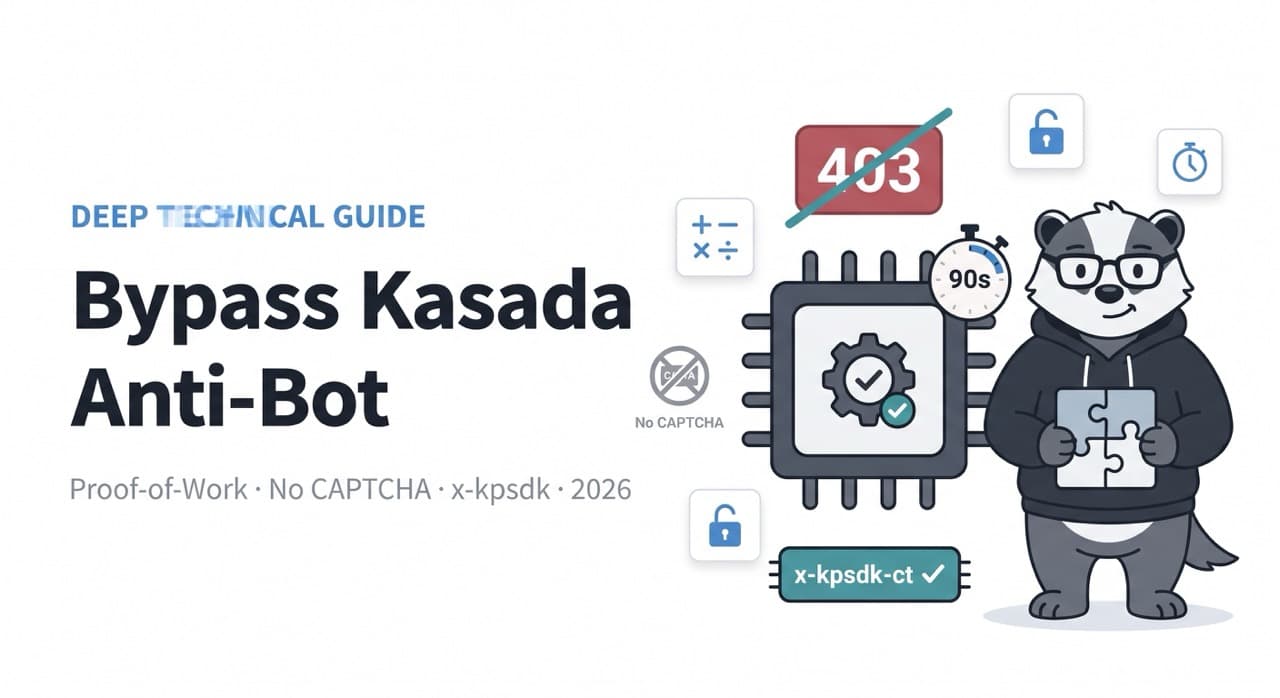
Every anti-bot system in this series so far — Cloudflare, Akamai, DataDome, Imperva, PerimeterX — uses some combination of fingerprinting, behavioral analysis, and JavaScript challenges to distinguish humans from bots. Kasada does all of those things too. But it has one additional layer that none of the others have, and it's the layer that breaks the most bypass attempts.
Kasada requires you to solve a cryptographic proof-of-work challenge.
Kasada uses TLS fingerprinting, JavaScript challenges, and behavioral analysis to block automated requests without displaying CAPTCHAs. Unlike systems that rely on CAPTCHAs, Kasada blocks suspicious requests outright, often with 403 or 429 errors, making bypass attempts more technically challenging.
The no-CAPTCHA approach is significant. Every other system gives you some visible signal that you're blocked — a challenge page, a verification widget, a wait screen. Kasada returns a clean 403 or 429 with no visible challenge. You're blocked. You don't get the opportunity to solve anything. The proof-of-work must be completed correctly before any access is granted — and it must be re-solved on a continuous basis throughout the session.
Kasada treats all incoming requests with suspicion rather than selectively challenging suspicious request groups. The system examines and analyzes behavioral patterns and configuration differences that distinguish automated bots from legitimate human users.
This is the architectural distinction that makes Kasada the final and hardest system in the anti-bot bypass series. This guide covers everything you need to know — how it works, what the detection layers are, what bypass approaches actually work in 2026, and how ScrapeBadger's Kasada bypass infrastructure handles it automatically.
Identifying Kasada on a Target Site
Before examining bypass techniques, confirm whether your target uses Kasada. The identification is definitive.
Several technical indicators signal that a website is protected by Kasada. One of the most prominent is the presence of specific HTTP request or response headers prefixed with x-kpsdk-.
Open DevTools → Network tab on any page of the target site. Filter requests and look for:
Response headers containing x-kpsdk-* — the full set includes x-kpsdk-ct (challenge token), x-kpsdk-dv (device validation), x-kpsdk-cd (challenge data), and x-kpsdk-v (version). The presence of any of these confirms Kasada.
Requests to */.k or */_ato* paths — Kasada's internal challenge endpoints. Your browser makes POST requests to these paths as part of the proof-of-work cycle.
Script loads from *.kpsdk.io — Kasada's CDN where the challenge JavaScript is served.
Sites that return 403 or 429 immediately without any visible challenge page, and which carry x-kpsdk-* headers, are Kasada-protected. The absence of a CAPTCHA or challenge page is itself an identification signal — if you're blocked with no visible challenge and no Cloudflare, Imperva, or DataDome identifiers, Kasada is the likely candidate.
The Detection Pipeline
Kasada acts as a gatekeeper proxy that inspects every request before it reaches the server, using TLS fingerprinting, IP reputation scoring, and JavaScript execution analysis simultaneously.
The pipeline runs in this sequence:
Request arrives at Kasada edge
     ↓
Layer 1: TLS + HTTP/2 fingerprint check
     ↓ fail → 403 immediately (no challenge offered)
     ↓ pass
Layer 2: IP reputation check
     ↓ fail → 403
     ↓ pass
Layer 3: Cryptographic proof-of-work challenge
     (JavaScript executes, solves computation puzzle)
     ↓ fail → 403 / 429
     ↓ pass
Layer 4: Browser and JavaScript environment fingerprinting
     ↓ fail → 403
     ↓ pass
Layer 5: Behavioral analysis and trust score accumulation
     ↓ low score → silent degradation or block
     ↓ sufficient score → x-kpsdk-ct token issued → access granted
Every layer feeds a composite trust score. Kasada uses a trust score system based on weighted scores from various fingerprinting techniques. A session must accumulate sufficient trust across all layers to receive an x-kpsdk-ct token that grants access to protected content.
Layer 1: TLS Fingerprinting and HTTP/2 Analysis
Kasada uses TLS fingerprinting to differentiate legitimate users from bots. Apify
Python's requests library cannot bypass Kasada — it doesn't support HTTP/2, generates a detectable TLS fingerprint, and cannot execute JavaScript challenges.
The three specific failures with raw Python requests:
No HTTP/2 support — modern browsers negotiate HTTP/2 by default. A request that falls back to HTTP/1.1 is immediately identifiable as non-browser traffic. Kasada's edge rejects HTTP/1.1 connections before any application-level processing.
Detectable JA3/JA4 fingerprint — the requests library's TLS cipher suite ordering and extension list produce a fingerprint that appears in every major anti-bot blocklist. As covered across this series — Cloudflare, Imperva, Akamai — the requests JA3 hash is flagged before application data is exchanged.
Missing x-kpsdk-* request headers — Kasada's challenge JavaScript generates specific request headers that must accompany every subsequent request after the initial challenge. A request that lacks these headers was not generated by a browser that completed the challenge.
The baseline fix for Layer 1 is curl_cffi with browser impersonation — the same approach that handles TLS fingerprinting for other systems. But unlike Cloudflare standard deployments where TLS fingerprinting plus residential proxies is sometimes sufficient, Kasada's cryptographic challenge layer means correct TLS fingerprinting is a prerequisite but far from a complete solution.
Layer 2: IP Reputation
Kasada assesses the reputation of an IP address to determine its trustworthiness. If your IP address has been involved in scraping activities or triggered anti-bot mechanisms in the past, Kasada is likely to block it. Even if you rotate multiple IP addresses, datacenter IPs are particularly vulnerable to detection since regular users don't use them.
Switching to high-quality residential proxies or mobile IPs can help bypass Kasada's IP detection, as these IPs appear more like those of genuine users and have good trust scores. However, rotating the IPs too frequently or predictably could raise suspicion.
Kasada's IP reputation system is network-wide — it shares intelligence across all customers. An IP that scraped a Ticketmaster-protected endpoint carries a degraded reputation when it subsequently hits a Kasada-protected fashion retailer, even though it's never been seen on that site before.
Mobile proxies offer the highest trust level against Kasada specifically because the proof-of-work challenge is calibrated against real browser computational environments. Mobile IP + mobile user agent + mobile browser environment creates a consistent signal. As covered in the ScrapeBadger proxy guide, mobile proxies cost more per GB but the success rate improvement on systems like Kasada justifies the premium for high-value targets.
Layer 3: The Cryptographic Proof-of-Work Challenge
This is Kasada's defining feature and the layer that differentiates it from every other system in this series.
When Kasada's JavaScript loads in a browser, it executes a proof-of-work computation — a cryptographic puzzle that requires genuine CPU computation to solve. The puzzle is designed to be:
Computationally non-trivial — it takes a real browser a small but measurable amount of time to solve (typically 50–500ms)
Verifiable in microseconds — the server can check the solution instantly
Session-specific — each challenge generates a unique puzzle that cannot be reused
Time-bound — solutions expire; the challenge must be re-solved on a cadence
The challenge output — the solution to the computational puzzle — is encoded into the x-kpsdk-ct token that must accompany every protected request. A request with a missing or expired token returns 403. A request with an invalid token (one where the solution doesn't verify correctly server-side) returns 429.
The detection algorithm learns from requests and analyzes patterns constantly. The trust score can decrease over time even if initial requests pass.
The continuous re-challenge requirement is the most operationally significant aspect of Kasada for production scrapers. The x-kpsdk-ct token is not a one-time clearance like Akamai's _abck cookie or PerimeterX's _px3. It requires ongoing renewal as the computational challenge is re-issued throughout the session. A pipeline that solves the challenge once and reuses the token will start returning 403s as soon as the token expires.
The token expiry cadence varies by site configuration — typically every 60–180 seconds on high-security deployments like ticketing platforms. Production pipelines must include continuous challenge re-solving, not one-time clearance generation.
Layer 4: Browser and JavaScript Environment Fingerprinting
Beyond the proof-of-work challenge, Kasada's JavaScript collects the same category of browser environment signals as other enterprise anti-bot systems:
Canvas and WebGL rendering — GPU-matched pixel output from hardware rendering versus the known software-renderer hash from headless Chrome. Every system in this series checks this; Kasada is no exception.
Navigator properties — navigator.webdriver is the most obvious headless indicator. Kasada analyzes JavaScript fingerprints including hardware details, JavaScript runtime, browser, and OS.
HTTP/2 header ordering and HPACK compression — Kasada specifically checks the ordering of HTTP/2 pseudo-headers (:method, :path, :scheme, :authority) and the HPACK compression settings. Browsers produce a consistent ordering that automated HTTP clients often don't replicate correctly.
Entropy measurements — Kasada runs timing-based entropy measurements on JavaScript execution. Real hardware produces natural timing variations. Headless browsers running on uniform server hardware produce timing distributions that fall outside the range of any real device.
Kasada's platform emphasizes its ability to understand the "human minds behind the bots," allowing its defenses to evolve quickly and present a constantly changing attack surface. The changing attack surface is the practical reason static bypass implementations fail — the challenge parameters, entropy measurements, and token generation algorithms update continuously.
Layer 5: Behavioural Analysis and Trust Score
Kasada uses behavioral analysis to detect anomalous request patterns over time, even if initial requests pass. Apify
Session-level signals that accumulate into the trust score:
Request cadence — machine-regular intervals between requests produce timing distributions impossible for humans. Natural browsing has variable pacing with reading pauses, scroll events, and occasional extended dwell times.
Navigation coherence — sessions that access high-value pages directly without contextual navigation history produce graphs that don't match real user behaviour for that site type. On a ticketing platform, real users search, browse events, check dates — they don't land directly on a checkout page.
Interaction completeness — real sessions generate a full suite of browser events: mousemove, scroll, focus, blur, resize. Sessions that generate only click and navigation events look non-human regardless of how good their fingerprinting is.
DIY Approaches: What Works and What Doesn't
Python requests — Does Not Work
Python's requests library alone cannot bypass Kasada. HTTP/1.1, detectable TLS fingerprint, no JavaScript execution. Block at Layer 1 before the challenge is even presented.
curl_cffi — Partial Success
curl_cffi with chrome120 impersonation correctly handles TLS and HTTP/2 fingerprinting. It passes Layer 1. It fails at Layer 3 because it cannot execute the JavaScript proof-of-work challenge. You need browser execution for Kasada regardless of how good your TLS fingerprinting is.
python
from curl_cffi import requests as cf_requests

session = cf_requests.Session(impersonate="chrome120")
session.headers.update({
    "Accept-Language": "en-US,en;q=0.9",
    "Sec-Ch-Ua": '"Google Chrome";v="120", "Chromium";v="120"',
    "Sec-Ch-Ua-Platform": '"Windows"',
})

response = session.get(
    "https://kasada-protected-site.com/",
    proxies={"https": "http://user:pass@residential-proxy:8080"}
)

# Check for Kasada block
if response.status_code in (403, 429):
    print("Kasada block — browser execution required for proof-of-work")
elif "x-kpsdk-ct" not in response.headers:
    print("Proof-of-work token not issued — challenge not completed")
else:
    print(f"Success: token issued, {len(response.text)} bytes")
Nodriver — Best Open-Source Option for Kasada
Nodriver and SeleniumBase UC Mode are recommended for browser-level Kasada bypass. Use professional tools that handle Kasada's complex detection mechanisms.
Nodriver communicates directly with Chrome via CDP (Chrome DevTools Protocol) without going through WebDriver, eliminating the WebDriver footprint that most anti-bot systems detect. For Kasada specifically, Nodriver's approach means:
python
import asyncio
import nodriver as uc
import time
import random


async def get_kasada_clearance(
    url: str,
    proxy_url: str = None,
) -> tuple[str, dict]:
    """
    Use Nodriver to complete Kasada's proof-of-work challenge.
    Returns (html_content, all_headers_including_x_kpsdk)
    """
    browser_args = [
        "--no-sandbox",
        "--disable-dev-shm-usage",
        "--window-size=1920,1080",
    ]

    if proxy_url:
        browser_args.append(f"--proxy-server={proxy_url}")

    browser = await uc.start(
        browser_args=browser_args,
        headless=True,
    )

    try:
        # Session warm-up — visit a low-value page first
        # Kasada tracks navigation history; cold sessions on high-value pages fail
        domain = "/".join(url.split("/")[:3])
        tab = await browser.get(domain)
        await asyncio.sleep(random.uniform(2, 4))

        # Navigate to target
        await tab.get(url)
        await asyncio.sleep(random.uniform(4, 8))  # Allow proof-of-work to complete

        # Verify clearance was issued
        cookies = {
            c["name"]: c["value"]
            for c in await tab.browser.cookies.get_all()
        }

        # Check for Kasada token in response
        html = await tab.get_content()

        return html, cookies

    finally:
        browser.stop()


html, cookies = asyncio.run(
    get_kasada_clearance(
        "https://kasada-protected-site.com/product",
        proxy_url="http://user:pass@residential-proxy:8080"
    )
)

print(f"Got {len(html)} bytes of content")
The session warm-up step before navigating to the target is particularly important for Kasada. The detection algorithm analyzes patterns constantly and the trust score can decrease over time. Sessions that arrive cold on high-value pages produce navigation graphs that Kasada's trust model scores poorly.
The Continuous Re-Challenge Problem
Even when Nodriver successfully completes the initial proof-of-work challenge, the 60–180 second token expiry means any pipeline scraping more than a handful of pages needs to handle re-challenge automatically:
python
import asyncio
import time
import nodriver as uc
import random


class KasadaSession:
    """
    Manages Kasada proof-of-work token lifecycle.
    Automatically re-solves challenge before token expiry.
    """

    def __init__(
        self,
        target_domain: str,
        proxy_url: str = None,
        token_ttl_seconds: int = 90,  # Conservative — Kasada tokens last 60–180s
    ):
        self.target_domain = target_domain
        self.proxy_url = proxy_url
        self.token_ttl = token_ttl_seconds
        self._browser = None
        self._tab = None
        self._token_obtained_at = None

    def _token_is_expired(self) -> bool:
        if not self._token_obtained_at:
            return True
        return (time.time() - self._token_obtained_at) > self._token_ttl

    async def _initialize_browser(self):
        args = [
            "--no-sandbox",
            "--disable-dev-shm-usage",
            "--window-size=1920,1080",
        ]
        if self.proxy_url:
            args.append(f"--proxy-server={self.proxy_url}")

        self._browser = await uc.start(browser_args=args, headless=True)

    async def _solve_challenge(self):
        """Navigate through site to complete proof-of-work and warm session."""
        if not self._browser:
            await self._initialize_browser()

        # Session warm-up
        self._tab = await self._browser.get(f"https://{self.target_domain}")
        await asyncio.sleep(random.uniform(3, 6))

        # Simulate light browsing to build trust
        await self._tab.scroll_down(200)
        await asyncio.sleep(random.uniform(1, 2))
        await self._tab.scroll_down(200)
        await asyncio.sleep(random.uniform(2, 4))

        self._token_obtained_at = time.time()
        print(f"Kasada challenge solved at {time.strftime('%H:%M:%S')}")

    async def get(self, url: str) -> str:
        """Fetch a URL, automatically refreshing challenge when expired."""
        if self._token_is_expired():
            await self._solve_challenge()

        await self._tab.get(url)
        await asyncio.sleep(random.uniform(1, 3))

        content = await self._tab.get_content()

        # Detect challenge re-trigger
        if "kasada" in content.lower() and len(content) < 5000:
            print("Challenge re-triggered — re-solving")
            self._token_obtained_at = None
            await self._solve_challenge()
            await self._tab.get(url)
            content = await self._tab.get_content()

        return content

    async def close(self):
        if self._browser:
            self._browser.stop()


# Usage
async def scrape_kasada_site(urls: list[str], proxy: str):
    session = KasadaSession(
        target_domain="kasada-protected-site.com",
        proxy_url=proxy,
        token_ttl_seconds=90,
    )

    results = []
    try:
        for url in urls:
            html = await session.get(url)
            results.append({"url": url, "html": html})
            await asyncio.sleep(random.uniform(2, 5))  # Natural browsing pace
    finally:
        await session.close()

    return results
Where Even Nodriver Fails
While following the previous steps and implementing best practices, Kasada can still detect and block web scraping requests. The detection algorithm learns from requests and analyzes patterns constantly, meaning the trust score can be decreased over time.
High-security Kasada deployments — Ticketmaster being the canonical example — run the most aggressive configurations. On these targets:
The proof-of-work puzzle complexity increases dynamically when Kasada detects suspicious traffic patterns. A session that's been scraped from is issued harder puzzles that take longer to solve, degrading throughput.
Entropy measurements on JavaScript execution timing detect the uniformity of headless browser environments even when Nodriver eliminates the WebDriver footprint. Server hardware runs hot and consistently; real devices have thermal throttling, background processes, and genuine timing variance.
The trust score accumulation model means clean initial sessions become suspect as they request more high-value pages at frequencies that exceed real browsing behaviour.
For these targets, infrastructure-level bypass — where the full browser execution, proxy management, and token lifecycle are handled by purpose-built systems — is the only reliable approach at production scale.
How ScrapeBadger Handles Kasada
ScrapeBadger's Kasada bypass handles the complete detection pipeline using the same engine-level approach that powers the Cloudflare bypass, Akamai bypass, DataDome bypass, Imperva bypass, and PerimeterX bypass.
The proof-of-work challenge is handled at the infrastructure level. Rather than attempting to replicate the JavaScript computation in Python or Node.js — which is detectable because the execution environment differs from real hardware — ScrapeBadger executes the Kasada challenge in patched Chromium instances with authentic hardware-matched timing profiles. The entropy measurements that detect headless environments on aggressive Kasada targets see genuine hardware variance rather than the uniform timing of server infrastructure.
The continuous token re-challenge cycle is managed transparently. Sessions maintain valid x-kpsdk-ct tokens throughout scraping runs without any configuration or lifecycle management on your side.
python
import requests

API_KEY = "your_scrapebadger_key"

# All five Kasada detection layers handled automatically
response = requests.get(
    "https://api.scrapebadger.com/v1/scrape",
    headers={"X-API-Key": API_KEY},
    params={
        "url": "https://kasada-protected-site.com/products",
        "render_js": True,
        "wait_for": "networkidle",
    },
    timeout=30
)

data = response.json()
print(data["html"][:500])
The same endpoint handles Cloudflare, Akamai, DataDome, Imperva, PerimeterX, and Kasada — automatic system detection, automatic routing to the correct bypass approach. Full documentation at docs.scrapebadger.com.
Sites Commonly Protected by Kasada
Kasada protects ticketing, luxury retail, and financial accounts — with Ticketmaster being among the most prominently protected targets.
Ticketing platforms — Ticketmaster is the canonical Kasada deployment. The business case is identical to PerimeterX's use in ticketing: scalper bot traffic is direct revenue damage, and Kasada's aggressive stance (block everything, no CAPTCHA) aligns with an operator who'd rather lose a few legitimate users to false positives than allow bots through.
Sportswear and limited-release retail — Foot Locker and similar retailers protecting limited-inventory releases from bot-driven purchases. The same scalper economics apply: a bot that buys 500 pairs of limited sneakers in the first minute of a drop requires a system that blocks before the purchase, not after.
Fashion and apparel — Shein and major apparel platforms deploy Kasada for competitive intelligence protection and inventory management.
Financial services — trading platforms, fintech applications, and financial account portals. Kasada's proof-of-work approach is well-suited to financial security contexts where the cost of a false negative (a bot getting through) exceeds the cost of a false positive (a real user being challenged).
The identifying pattern across all Kasada targets: high-value inventory or data where the cost of automated access materially exceeds the cost of aggressive false-positive rates. Sites that would rather block some legitimate users than allow any automated access are Kasada's natural customers.
Kasada vs The Other Systems: The Complete Picture
With all five major anti-bot systems now covered in this series, the comparative view is complete:
System | Hardest layer | Token expiry | No-CAPTCHA mode | Proof-of-work |
|---|---|---|---|---|
Cloudflare | TLS + JS challenge | Hours | Standard tier: no | ❌ |
Akamai | sensor_data obfuscation | 30–120 min | ✅ | ❌ |
DataDome | Behavioural ML | Session | ✅ | ❌ |
Imperva | reese84 + 700 dimensions | 15–120 min | Sometimes | ❌ |
PerimeterX | Biometric + Code Defender | ~60 seconds | ✅ | ❌ |
Kasada | Cryptographic PoW | 60–180 seconds | ✅ always | ✅ |
Kasada's combination of the shortest token expiry, no-CAPTCHA mode, and cryptographic proof-of-work places it at the top of the difficulty ranking for production scraping at scale. For teams scraping across multiple systems — common when collecting data from diverse targets — ScrapeBadger's single endpoint with automatic system detection removes the need to track which system protects which target.
Getting Started
ScrapeBadger's Kasada bypass is available on all plans with 1,000 free credits — no credit card required. Test against your specific Kasada-protected targets before committing.
The quickest validation: identify a Kasada-protected URL you need to scrape, call it through ScrapeBadger with render_js=true, and check whether the response contains your target data or a block. If it contains data, the bypass is working. If blocked, ScrapeBadger surfaces an error — you never receive silent block pages billed as successes.
Full documentation at docs.scrapebadger.com. For teams working through the complete anti-bot bypass series — Kasada rounds out coverage of every major enterprise system.

Written by
Thomas Shultz
Thomas Shultz is the Head of Data at ScrapeBadger, working on public web data, scraping infrastructure, and data reliability. He writes about real-world scraping, data pipelines, and turning unstructured web data into usable signals. ScrapeBadger is a web scraping API platform specialising in Twitter/X, Reddit and Google data, with dedicated scrapers also covering TikTok, YouTube, LinkedIn, Amazon, eBay, Zillow and 40+ more: with built-in anti-bot bypass and an MCP server for AI agents.
Ready to get started?
Join thousands of developers using ScrapeBadger for their data needs.