How to Use Google Maps Data for B2B Lead Generation
 Domas Sakavickas
AI Summary: Using ScrapeBadger's Google Maps API, this guide shows how to prospect the 'hidden middle' of logistics, manufacturing, clinics, and local service businesses that LinkedIn misses, so sales teams reach physical-presence decision-makers whose data lives on the Map rather than corporate profiles.
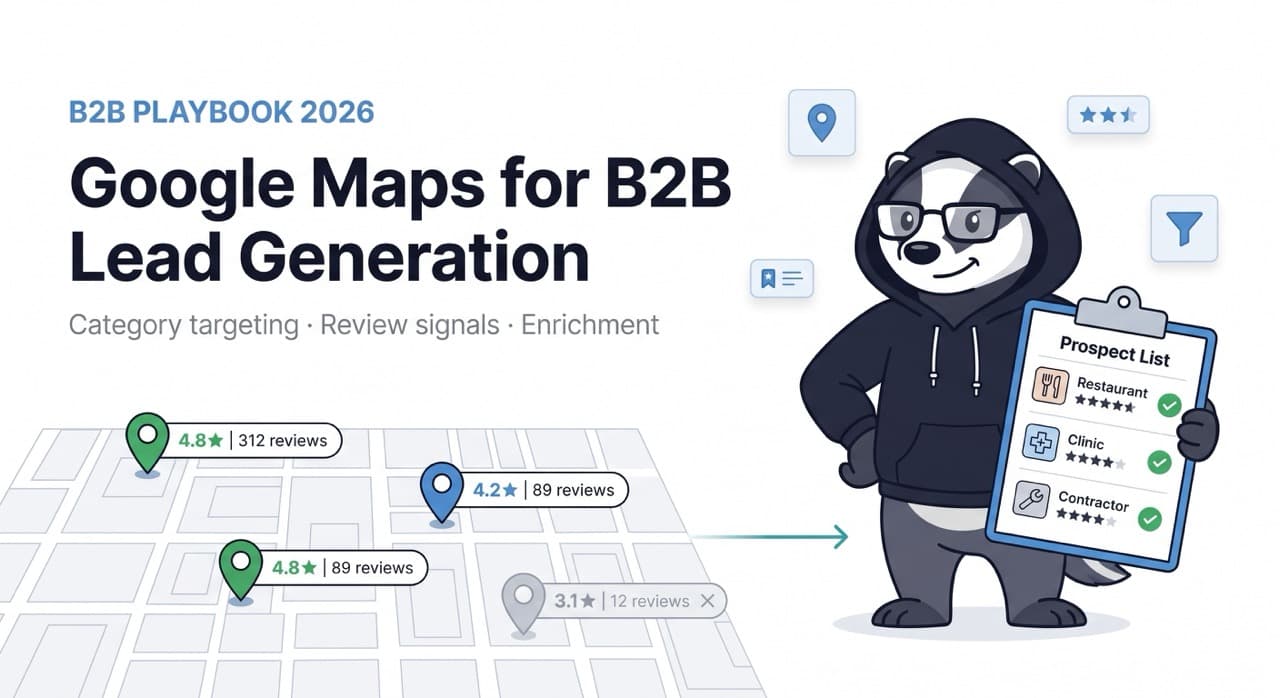
LinkedIn is where B2B salespeople go by default. It makes sense — professional profiles, company pages, decision-maker titles, a platform designed for business networking. But LinkedIn has a significant coverage gap that every sales team eventually hits: the businesses that matter most for many B2B verticals don't have polished LinkedIn company pages.
While LinkedIn is the go-to for corporate white-collar prospecting, Google Maps is the undisputed king for reaching the "hidden middle" of the economy: logistics hubs, manufacturing plants, specialized medical clinics, and service-based enterprises. These are businesses that prioritize their physical presence and local visibility over a polished LinkedIn company page. If your target is a decision-maker who wears steel-toed boots or scrubs rather than a tie, the data you need lives on the Map. WebScraping.AI
Think about which businesses you want to sell to. Restaurants needing POS systems. HVAC companies needing fleet management software. Dental practices needing patient scheduling tools. Auto repair shops needing inventory management. Salons needing booking software. None of these show up reliably in standard B2B databases. Every single one of them has a Google Maps listing with their name, phone number, website, hours, category, rating, and years of customer reviews — publicly visible, structured, and accessible at scale.
Google Maps is a repository of high-quality point of interest data that can equip your business with a powerful way to make better decisions. If you're looking to sell to businesses in specific geographical areas, it supplies you with hot leads, their contact info, and locations. ScrapingLab
This guide covers how to turn that data into a systematic B2B lead generation operation using ScrapeBadger's Google Maps API — the qualification signals that matter, the targeting approaches that work, and how to combine Maps intelligence with complementary data sources for outreach that converts.
Why Google Maps Is a Better Lead Source Than Most Teams Realise
With 42% of users searching for local queries clicking on results in the Google Map Pack, the visibility and engagement offered by Google Maps data are paramount for local businesses and those targeting specific geographic areas.
The size of the database is the starting point. Google Maps has become the world's largest database of local business information. With over 2 billion monthly active users across 220+ countries and territories, the platform contains detailed listings for millions of businesses including names, addresses, phone numbers, websites, and operating information.
But scale isn't the differentiator — the combination of contact data and qualification signals in the same place is. Standard B2B databases give you a company name and a phone number. Google Maps gives you all of that plus:
Review count as a proxy for business maturity. A restaurant with 1,200 reviews has been operating long enough to build a customer base. A law firm with 85 reviews is established but not enormous. These signals filter for businesses at the right stage of growth for your product without any additional research.
Star rating as an operational health signal. A business with a 3.1 average rating has a customer satisfaction problem — which might make them a better prospect for CX software, or a worse prospect for a partnership, depending on your product. A business maintaining 4.7 stars across 300+ reviews has an operational culture worth selling into.
Review recency as an activity signal. A business with reviews from this month is actively trading and actively visible to new customers. A business whose last review is from 18 months ago might be closed, dormant, or struggling. Review recency filters your list before you dial a single number.
Category specificity. Google Maps categories are more granular than SIC or NAICS codes. "Orthodontist" is a more useful target category than "Medical Practice." "Commercial Cleaning Service" is more useful than "Janitorial Services." The category granularity lets you build vertically precise prospect lists that generic business databases can't match.
Physical presence confirmed. A Google Maps listing with a physical address, visible in Street View, with regular recent reviews, is a confirmed operating business. B2B databases include inactive businesses, shell companies, and outdated records. Maps listings are self-correcting — businesses that close lose their reviews, get marked as permanently closed, and filter out naturally.
The Four Lead Generation Workflows
Workflow 1: Category + Geography Targeting
The most straightforward approach and the one that scales most cleanly. Define a target business category, define your target geography, and extract every business matching both criteria.
ScrapeBadger's Google Maps place search endpoint takes a category and location parameter and returns structured business records — name, address, phone, website URL, rating, review count, hours, and business type. Run the same search across multiple cities or ZIP codes to build a national list in the same format.
Google Maps is a goldmine for B2B SaaS companies targeting niche small businesses. A few examples of businesses that benefit from this process include restaurant tech — point of sale, inventory management, online ordering, and payment solutions for cafes and eateries.
The practical application for a B2B SaaS selling restaurant technology: search "restaurant" across every city above 50,000 population in your target region. ScrapeBadger returns structured records for every restaurant on Maps in that geography. Apply minimum review count filter (say, 50+ reviews) to target established operators rather than new openings. Apply rating filter (4.0+) to target operators whose quality standards suggest they invest in their operations. The resulting list contains qualified prospects with contact data, without a single manual lookup.
The same pattern applies to any service-business vertical: "auto repair shop," "dental clinic," "hair salon," "accounting firm," "commercial contractor." The category taxonomy on Google Maps is rich enough to target at the sub-vertical level — "pediatric dentist" rather than just "dentist" — which matters significantly for product-market fit signals.
Workflow 2: Review Signal Qualification
Reviews tell you things no database field can. Claygent can scrape and summarize recent Google reviews for each prospect, giving you a ready-made personalisation signal for cold outreach.
The review signal qualification approach uses ScrapeBadger's Maps reviews endpoint — covered in detail in the Google Maps reviews scraping guide — to pull recent reviews for a prospect list and flag businesses based on what their customers are saying.
The specific signals worth extracting:
Complaint themes as product fit indicators. A restaurant with multiple recent reviews mentioning "long wait times" and "disorganised service" is a candidate for operations management software. A retail shop with reviews complaining about "website never updated" or "hard to find their hours" needs digital presence tools. The complaint themes in reviews are a direct window into the operational problems your product might solve.
Owner response rate and quality. Businesses that respond to every review — especially negative ones — have engaged ownership that invests in their reputation. This is a proxy for willingness to invest in tools that improve the customer experience. A restaurant that never responds to reviews has an operator who's either too busy or not engaged enough to see the value in customer-facing improvements.
Review velocity as growth signal. A business collecting 20 reviews per month is growing their customer base. A business collecting 2 per month has stable but not expanding traffic. If your product helps businesses grow, target businesses already showing growth signals — they're more likely to be investing in growth tools.
Sentiment shift detection. A business that had a 4.6 average six months ago and now has a 4.1 average — with recent reviews mentioning specific operational problems — has a live pain point you can address in outreach. The timing of the problem makes the conversation relevant.
Workflow 3: Competitive Density Mapping
Before entering a new geographic market, building a new product vertical, or planning a regional sales push, mapping the competitive density in a category gives you a data-driven answer to "where should we focus?"
Searching "accounting firm" across every major city in a region and mapping the results by density, average rating, and review volume tells you:
Underserved markets — geographies where businesses in your target category have fewer established options, lower competition, and potentially more price sensitivity.
Premium concentrations — geographies where the category is dominated by high-rated, high-review businesses that clearly invest in their operations and are more likely to adopt new software.
Market saturation — geographies where the category is crowded with established, well-reviewed operations that may have entrenched vendor relationships and lower propensity to switch.
This is the kind of market entry intelligence that consultants charge six figures to produce. With ScrapeBadger's Google Maps API, it's an afternoon of data collection and an hour of analysis.
Workflow 4: Trigger-Based Outreach From New Openings
New businesses are among the most qualified B2B leads for software and service providers. They're making vendor decisions for the first time, they don't have entrenched relationships to displace, and they're actively spending on the infrastructure needed to operate.
Google Maps new business detection works by comparing Maps listings over time: places that appear in this month's search results but didn't exist in last month's results are recent openings. Combined with the ScrapeBadger Reddit Scraper and Google News API, you can build a system that alerts you when a new business in your target category opens in a target geography — triggering outreach while the decision-making window is still open.
The Data Points That Drive Qualified Outreach
Standard Google Maps lead generation extracts name, phone, and address and stops there. The higher-conversion approach extracts the full data model and uses it to build prospect profiles that support personalised, contextually relevant outreach.
Business name + category + location — the baseline. Who they are, what they do, where they are.
Website URL — the starting point for enrichment. Website presence, technology stack signals (what software they're already using), content quality indicators. A business with no website is a different conversation from one with a professionally built site.
Phone number — direct dial for the business. For small businesses, this often reaches the owner directly rather than a gatekeeper.
Star rating + review count — qualification tier. Set your own thresholds based on your ICP — for enterprise-grade software, target the top quartile of ratings; for tools that help struggling businesses improve, target the segment with known operational problems.
Review themes — personalisation signal. Mentioning a specific operational challenge visible in their public reviews in the opening line of outreach is one of the most effective personalisation approaches available. It's not generic ("I noticed you're in the restaurant industry") — it's specific ("several of your recent reviewers mentioned wait time issues, which is exactly the problem our kitchen management system addresses").
Hours of operation — timing signal for outreach. A restaurant open 7 days until midnight is a different business to reach than one open weekday lunches only.
Photos and recent activity — business freshness indicator. A listing with recent photos and active review responses belongs to an engaged owner. A listing with no photos and three-year-old reviews might be unmaintained or semi-active.
Combining Maps Data With Other Signals
Google Maps data is a powerful starting point. The most effective B2B lead generation operations combine it with complementary data sources that are available through the same ScrapeBadger API key.
Maps + Google Search — once you have a prospect list from Maps, running their business name through ScrapeBadger's Google SERP API shows you how they appear in organic search. A business that doesn't rank for their own category in their own city has an SEO problem — a relevant signal if you sell marketing services or website development.
Maps + Google Trends — combining the geographic density of businesses in a category with Google Trends regional interest data reveals where demand for a category is growing faster than supply. A region where "HVAC repair" searches are up 40% year-on-year but the Maps business count hasn't grown proportionally has underserved demand — a signal for timing an outreach push.
Maps + Google News — when a business or business category appears in local news coverage, they're more likely to be in an active growth or change moment. Combining Maps business data with Google News monitoring for the same business names surfaces outreach timing signals that no standard database provides.
For AI agent workflows connecting these data sources, ScrapeBadger's MCP integration exposes Maps, SERP, Trends, and News endpoints as native tool calls to any MCP-compatible agent. An agent given a sales territory can map the prospect landscape, identify high-priority targets by qualification signal, and produce a ranked outreach list — with personalisation hooks derived from review analysis — as a single reasoning workflow. Setup at docs.scrapebadger.com/mcp/overview.
Building a Repeatable System, Not a One-Off List
The difference between a sales team that uses Maps data once and one that builds a systematic advantage from it is operationalisation.
A one-off Maps scrape produces a spreadsheet. A repeatable Maps system produces a continuously updated prospect pipeline with:
Scheduled refreshes — the Maps data for a given category and geography updates as businesses open, close, and change. A list collected in January is stale by June. Scheduling regular refresh cycles against the same category and geography parameters keeps your pipeline current without manual effort.
Tiering by qualification score — not all Maps prospects are equal. A business with 300+ reviews, a 4.5 average, an active website, and owner responses to reviews is a different tier of prospect from one with 12 reviews, no website URL, and a 3.8 average. Build a simple scoring framework using the available data fields and tier your outreach effort accordingly.
Enrichment workflows — Maps data gives you the business entity. Enrichment adds the decision-maker contact. Website URL from Maps → LinkedIn company page search for the owner → direct contact data. The Maps data is the starting point; the enrichment workflow is what makes it dialable.
Change detection alerts — as covered in the ScrapeBadger data quality article, comparing new observations against previous ones and alerting on meaningful changes is where monitoring becomes intelligence. A prospect business that drops from 4.3 to 3.8 stars in 30 days has a live operational crisis — exactly the right moment to offer a solution.
There are basically two layers here, and the difference between them is the difference between "nice spreadsheet" and "actual sales weapon." The spreadsheet is the list. The sales weapon is the system that keeps the list current, scores it for prioritisation, and surfaces the right prospect at the right moment with the right personalisation signal.
Getting Started
ScrapeBadger's Google Maps API covers place search, place details, reviews, photos, and business posts across 250+ countries. The same API key that powers your Maps lead generation also covers Google Search, Trends, News, and Shopping — every data source in the workflow above.
Free trial at scrapebadger.com/google-scraper-api/maps — 1,000 credits, no credit card, no subscription. Test against your target category and geography before building any pipeline infrastructure. Full API documentation at docs.scrapebadger.com.

Written by
Domas Sakavickas
Dom Sakavickas is Co-founder of ScrapeBadger, building web scraping infrastructure for developers and data teams. He writes about the web data market, tool comparisons, and business use cases for scraping. ScrapeBadger is a web scraping API platform specialising in Twitter/X, Reddit and Google data, with dedicated scrapers also covering TikTok, YouTube, LinkedIn, Amazon, eBay, Zillow and 40+ more: with built-in anti-bot bypass and an MCP server for AI agents.
Ready to get started?
Join thousands of developers using ScrapeBadger for their data needs.