How to Use YouTube Data for Competitor Content Intelligence
 Domas Sakavickas
AI Summary: Using ScrapeBadger's YouTube API to pull transcripts and performance data, this guide shows how to read competitor videos rather than just watch them, extracting hook structures, retention phrases, and calls to action so brands reverse-engineer what actually drives their rivals' best-performing content.
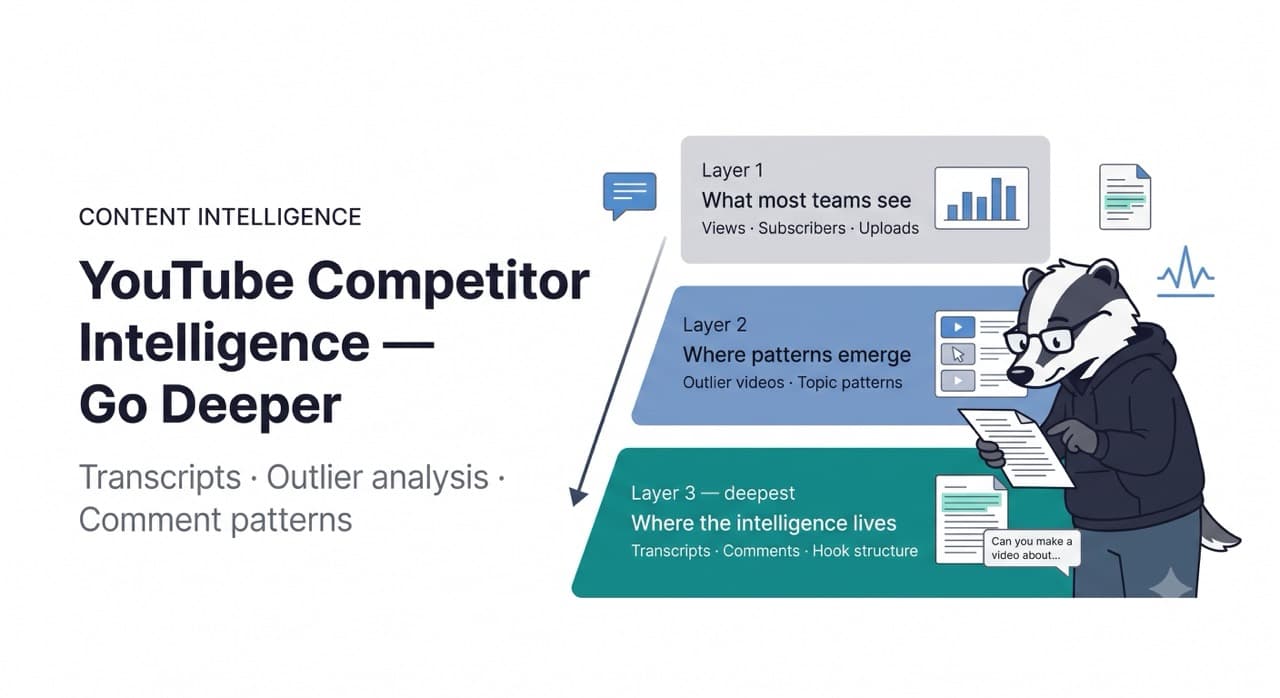
Most brands doing YouTube competitor analysis are watching videos. The ones pulling ahead are reading them.
The difference sounds trivial. It is not. Watching a competitor's top-performing video tells you the topic, roughly the format, and whether the production quality is high. Reading the transcript tells you the exact hook structure they used in the first 30 seconds, the specific phrases that appear in chapters that retain viewers through the middle third, the precise calls to action they deploy, and the language patterns that recur across every video that outperforms their average.
YouTube has 70 billion views per day. It functions as a search engine, a discovery platform, and an audience development system simultaneously. A competitor's successful video from 18 months ago may still be generating thousands of views per month through search and suggested placements — compounding returns that most social platforms do not produce. Understanding what made that video work — not just that it got views — is the intelligence that changes your content strategy.
This guide covers how to extract that intelligence systematically using ScrapeBadger's YouTube Scraper, working through three layers of competitor data that most teams never reach.
Why Surface-Level YouTube Intelligence Is Not Enough
The default YouTube competitor intelligence stack — subscriber count, view averages, upload frequency — answers one question: how is this channel performing? It does not answer the question that actually drives content decisions: why is this channel performing?
A competitor channel with 80,000 subscribers averaging 45,000 views per video is producing well. Knowing that does not tell you whether their success comes from search optimisation, browse-feed algorithmic push, or a loyal audience that gets email notifications. It does not tell you which specific topics are generating disproportionate views. It does not tell you what they are saying in their scripts that keeps viewers watching. And it does not tell you what their audience is asking for in the comments that the channel is not yet providing — the literal demand signal sitting right in the open, visible to anyone who looks.
The tools most commonly used for YouTube competitor intelligence — TubeBuddy, vidIQ, Social Blade — provide the surface metrics well. As one analysis of these tools noted directly: vidIQ "offers no transcript-level analysis, meaning it can identify which keywords are trending but cannot explain the structural elements that make a competitor's video successful." That gap between knowing what a competitor is doing and understanding why it works is exactly where the strategic opportunity lives.
ScrapeBadger's YouTube Scraper returns 39 endpoints across the full YouTube data model — video detail, full channel analytics, comments and replies, transcripts, captions, related videos, Shorts, trending feeds, and search. This is the raw material that makes the deep analysis possible. The analysis itself is the work.
The Three Layers of YouTube Competitive Intelligence
Layer 1: Channel and Video Performance (The Surface)
This is where most analyses stop. It is still necessary as the starting foundation.
For each competitor channel you are tracking, the baseline intelligence package covers:
Channel-level metrics: Subscriber count, total view count, upload frequency, average views per video across the last 20 uploads. The average per video matters more than the most recent viral result. A channel averaging 40,000 views per video across 20 recent uploads is a fundamentally different competitive threat than a channel averaging 5,000 views that had one video hit 500,000.
Upload cadence and consistency: How many videos per week, and has that cadence changed? A competitor who moved from one video per week to three is making a significant investment signal. The algorithm rewards consistent publishing, and a competitor who has changed their upload frequency is either accelerating their strategy or rationalising from a position that was not sustainable.
Subscriber growth trajectory: A channel with 80,000 subscribers gaining 2,000 per week is in a different competitive position than one with 80,000 subscribers that has been flat for six months. The trajectory is the intelligence; the absolute number is just context. Subscriber growth velocity is available through ScrapeBadger's channel subscriber count endpoint — calling this weekly and storing the observations builds the time series that reveals trajectory.
First 48-hour view performance: Views in the first 48 to 72 hours after publication are crucial for determining immediate audience demand. This is the metric that reveals whether a channel has a strong existing audience base that shows up for new content, or whether the channel is primarily discovery-driven through search and browse. Search-driven channels often see slow initial views that build over weeks. Audience-driven channels spike immediately. The pattern tells you which mode a competitor is operating in.
This layer is the foundation, not the destination. Build it, track it weekly, and use it to identify which channels are worth the deeper analysis investment.
Layer 2: The Outlier Analysis (The Middle)
This is where the real intelligence begins.
An outlier video is one that performs significantly above a channel's baseline average — typically three to ten times what that channel normally generates. These videos are the single most informative data point in YouTube competitor intelligence. When YouTube pushes a video that hard, something worked. The topic, the title, the hook structure, or all three combined to produce a viewer response that the platform's algorithm amplified into a performance outlier.
The key insight, noted consistently across 2026 YouTube intelligence research: looking at a channel's most popular videos is misleading if you are looking at absolute view counts. The most popular videos on any large channel might simply reflect the channel's large audience. The outlier ratio — how far a video outperformed the channel's own normal baseline — is the metric that reveals genuine resonance.
A 100,000-view video on a channel that normally generates 5,000 views (a 20x outlier) is more strategically important than a 1,000,000-view video on a channel that normally generates 3,000,000 views (a 0.3x underperformer). The outlier reveals a specific topic-format-hook combination that resonated more powerfully than the channel's usual output. That specific combination is your intelligence target.
To calculate this, you need the full video library for each competitor channel — not just the most popular or most recent videos. ScrapeBadger's channel videos endpoint returns the complete paginated video list with view counts, like counts, comment counts, publication dates, and video durations. With the complete list, you can calculate each channel's baseline average and identify every video that materially exceeded it.
Once outliers are identified, document the pattern. What topic did these outliers cover? Was it a specific subcategory within their usual content area, or a completely different format? Did they cluster around a certain time period — suggesting they were responding to an external event or trend — or are they distributed across the channel's history, suggesting the topic has sustained demand? Are the outliers concentrated in search-driven content (tutorials, how-tos, explainers) or browse-driven content (opinion, entertainment, personal stories)?
Cross-channel pattern matching is where this analysis scales. If the same hook structure or topic cluster produces outliers across three or four competing channels in the same niche, that pattern has demonstrated demand across audiences, not just one creator's subscriber base. A single channel's outlier could be noise. Multiple channels' outliers sharing a theme or structure is a confirmed signal.
Layer 3: Transcript and Comment Intelligence (The Deep)
This is where the analysis becomes genuinely proprietary — intelligence your competitors cannot access through the standard tool stack because it requires data most tools do not provide.
Transcript analysis: what the winning videos are actually saying
The first 30 seconds of a YouTube video determine whether 60% or more of viewers stay or leave. This is the most important creative real estate on the platform. The hook architecture — the specific language structure, the promise made, the curiosity gap opened or the problem-first framing used — is what drives that initial retention.
Knowing that a competitor's video got 200,000 views tells you it worked. Reading the transcript of the first 30 seconds tells you exactly how it worked:
Did they open with a bold claim ("Most people get this completely wrong...") or an empathy signal ("If you've been struggling with X, this video is for you")? Did they establish credibility immediately or defer it? Did they tease the outcome explicitly ("By the end of this video you'll know exactly how to...") or withhold it as a curiosity mechanism? How many words did they use before making their first value statement?
These structural questions cannot be answered by watching even dozens of videos at full speed. They can be answered by reading transcripts systematically — identifying the first sentence, the hook type, the credibility signal placement, and the value promise across every outlier video in a competitor's catalogue.
The same analysis applies to the middle third of top-performing videos. Where do competitors place their first chapter change or pattern interrupt? At what point do they introduce their core argument? Where is the emotional peak — the moment of maximum tension, surprise, or resolution that drives viewers to complete the video? These structural patterns, when identified across multiple outlier videos from multiple competitors, reveal what format architecture the algorithm is currently rewarding in your category.
ScrapeBadger's YouTube Scraper transcript endpoint returns the full ASR voice-to-text transcript for any public YouTube video, with timestamp segmentation. Running this across the top 10 to 20 outlier videos from a competitor set produces the raw material for the structural analysis above. Combining it with ScrapeBadger's MCP integration enables an AI agent to perform the structural analysis automatically — identifying hook types, pattern interrupt placement, and CTA positioning across a complete competitor transcript library without manual review.
Comment intelligence: the audience telling you what to make
Comments on high-performing competitor videos are among the most commercially valuable unstructured data available to any content marketer. They are direct audience feedback on a video that has already demonstrated demand — with the filter of engagement already applied. Low-engagement videos have low-quality comments. High-performing videos attract high-quality comments from the people most invested in the topic.
The specific signal pattern to look for is the explicit content request: viewers commenting "Can you make a video about..." or "What about [adjacent topic]?" or "Does this work for [specific scenario] as well?" These are literal demand signals. An audience member taking the time to comment a content request on a competitor's video has demonstrated interest strong enough to result in action. They want content that does not yet exist. That is your opportunity.
ScrapeBadger's comment and reply endpoints return the full comment thread for any video, including reply chains. The comment content on a competitor's five most-viewed videos in a topic area is a direct market research signal about what that audience wants next — intelligence that would cost significant money to collect through traditional research methods, but is sitting publicly available on the platform.
The secondary comment signal is the recurring complaint or limitation: viewers describing what the video did not answer, where the advice did not apply to their situation, or what follow-up information they need. Every unsatisfied viewer comment is a content brief for a video that addresses the gap.
YouTube as a Search Engine — and What That Means for Competitor Intelligence
49% of US consumers now use YouTube as a search engine. That number changes the strategic context of competitor content analysis fundamentally.
On most social platforms, competitor intelligence is about understanding what content performs well in a feed. On YouTube, it is simultaneously about that and about which keywords and search intents your competitors are owning in search results — and which ones they are leaving open.
A competitor's top-performing search-driven video is not just evidence that their audience liked the topic. It is evidence that the topic has sustainable organic search demand that will continue generating views for months or years after publication. A YouTube video's long shelf life — already noted — means that a competitor's successful search video represents an ongoing competitive position in search, not just a one-time content win.
The gap analysis question for search-driven competitor content: which related search queries does a competitor not have videos for, despite having videos in adjacent topics? ScrapeBadger's YouTube search endpoint returns search results for any keyword, showing which channels are currently ranking for it. Searching for variations of topics your competitor covers reveals where they have gaps — high-demand search queries where the top results are either old, low-quality, or from channels that are not your direct competitors.
ScrapeBadger's Google Trends API adds the complementary layer: search interest over time for the same keywords in YouTube's topic area, but across the broader web. A keyword that is trending upward in Google Trends but where your competitor has no recent YouTube content is a confirmed demand signal with a clear competitive opening.
The combination — YouTube search results analysis showing an open field, plus Google Trends confirming rising search interest — is the highest-confidence content opportunity signal available from public data.
The Comment Pattern That Predicts Your Competitor's Next Video
There is a specific pattern in YouTube comments that signals what a channel is likely to produce next, before they produce it.
When a creator's comment section fills with requests for a specific follow-on topic, the creator typically responds — either in a follow-up video or in a comment reply signalling an upcoming video. The creator is getting the same signal you are getting from reading the comments. If you see that signal and respond to it faster than they do, you produce the follow-on content that the audience is asking for before your competitor gets there.
This is only possible if you are monitoring comment sections systematically — not manually reading every comment on every competitor video, but collecting comment data programmatically and filtering for the patterns (explicit requests, repeated phrases, questions about adjacent topics) that signal demand.
A practical approach: collect comments from the five most-viewed videos in your category's topic area, across your top five competitor channels. That is 25 videos, each potentially with thousands of comments. Manual review of 25,000+ comments is not feasible. Systematic collection and pattern extraction is straightforward with the right data infrastructure — and the intelligence it produces is not available to any competitor doing manual research.
The Shorts Layer: A Separate Competitive Signal
YouTube decoupled the Shorts algorithm from long-form recommendations in 2026. This means Shorts and long-form videos are now competing in separate algorithmic systems with separate recommendation engines.
The competitive intelligence implication: your competitor's Shorts performance and your competitor's long-form performance are distinct strategic signals. A competitor who is dominating in long-form but experimenting with Shorts may be testing whether their audience follows them to the format. A competitor who has built a significant Shorts audience but minimal long-form presence has a very different strategic profile.
ScrapeBadger's Shorts-specific endpoint returns Shorts data separately from long-form video data, allowing you to track competitor Shorts performance as a distinct intelligence stream. The engagement metrics on Shorts (views, like count, comment count) and the topics being covered in Shorts vs. long-form can reveal whether a competitor is using Shorts as a top-of-funnel discovery mechanism or as a standalone content strategy.
Building a Systematic Competitor Intelligence Operation
Doing this analysis once is useful. Running it on a schedule is what makes it a competitive advantage.
The practical workflow:
Weekly: Collect new video data from your tracked competitor channels. Identify any videos published in the past seven days that have already generated views above the channel's recent average. These early outperformers are candidates for transcript review — the algorithm has signalled they are resonating before the full view count has accumulated.
Monthly: Calculate updated outlier ratios across your competitor catalogue. Are the topics generating outliers changing? Is there a new format type appearing in the outlier set that was not there 90 days ago? Cross-reference outlier topics against your own content calendar — are there confirmed outlier topics you have not addressed?
Quarterly: Pull full channel video lists for all tracked competitors. Identify any channels that have significantly changed their average views per video, their upload frequency, or their topic distribution. A competitor who was averaging 15,000 views per video six months ago and is now averaging 50,000 has made significant strategic changes worth understanding.
On a competitor's major new launch: Pull the video detail, transcript, and comments as soon as a high-engagement video is published. The 48-72 hour view performance window is the signal that tells you whether the platform is amplifying it. If it is, transcript and comment analysis within the first week — before the comment section fills with spam — produces the highest-quality intelligence.
ScrapeBadger's MCP server connects the YouTube data layer to Claude and any other MCP-compatible AI agent, enabling this workflow to run on a defined schedule with AI analysis of transcripts and comment patterns automated between the data collection and the human review stage. The intelligence that would require a full-time analyst to produce manually runs as a background operation, surfacing findings on a defined cadence.
Combined with Google Trends monitoring for topic search interest and Reddit community monitoring for organic audience discussion of the same topics — both available under the same ScrapeBadger API key — the result is a multi-platform content intelligence system that produces validated opportunities, not just interesting observations.
What to Do With the Intelligence
Competitor content intelligence that does not change content decisions is just expensive data collection.
The specific outputs worth building from the analysis above:
The opportunity list. Topics that are confirmed as high-demand through competitor outlier performance but that you have not yet covered — or where competitor coverage is thin, old, or low-quality. This is your content calendar foundation. Every video on this list has demonstrated demand and a clear positioning angle relative to existing content.
The structural playbook. The hook types, chapter structures, and CTA patterns that appear consistently in competitor outlier videos. These are not things to copy — they are patterns to understand and then apply in your own voice. The first 30 seconds is the most important creative real estate; knowing what hook structures are working in your category right now is the research input to making yours better.
The comment gap brief. Audience requests and unanswered questions extracted from competitor comment sections. These are validated, real content requests from people actively engaged with your topic area. Every brief on this list has a built-in audience because someone already asked for it.
The search opportunity map. Keywords and queries where your competitor has gaps in coverage, confirmed by low-quality or outdated search results and validated by Google Trends interest. These are the SEO opportunities where producing better content than what currently exists produces sustainable organic views.
The brands consistently building YouTube audiences in 2026 are not guessing what to make. They have built the infrastructure to read what their audience wants before spending budget producing it. The 95% of YouTube videos that generate fewer than 1,000 views are largely the result of making content without this foundation. The infrastructure — transcript access, comment collection, systematic outlier analysis — is what ScrapeBadger's YouTube Scraper makes practical at scale.
Free trial at scrapebadger.com — 1,000 credits, no credit card required.
FAQ
What data from competitors is publicly accessible on YouTube?
Video view counts, like counts, comment counts, publication dates, video titles, descriptions, tags, chapter names, and thumbnail images are all publicly visible. Channel subscriber counts, total video counts, and total channel view counts are public. Comments and replies on public videos are public. Transcripts and auto-generated captions are publicly available for any video where the creator has not disabled them. Competitor analytics like watch time, click-through rate, audience retention curves, and traffic source breakdowns are internal to each channel and not publicly accessible to outside parties.
How is ScrapeBadger's YouTube Scraper different from TubeBuddy or vidIQ?
TubeBuddy and vidIQ are browser extensions and dashboards built for optimising your own channel — they provide keyword research, tag suggestions, and basic competitor tracking. Neither provides programmatic API access to competitor video libraries at scale, and as noted, vidIQ specifically does not provide transcript-level analysis. ScrapeBadger returns structured JSON data from 39 YouTube endpoints via REST API — enabling automated, at-scale collection of video details, full channel catalogues, transcripts, comment threads, and trending data that feeds into your own analysis systems or AI agent workflows via MCP.
How often should you update your competitor YouTube intelligence?
Weekly collection of new video data from tracked competitor channels is sufficient for most content strategy use cases. The first 48–72 hours after a competitor publishes a high-performing video is when early view signals are most valuable for determining whether to prioritise transcript analysis. Comment data tends to be highest quality in the first two to four weeks after publication, before the comment section is dominated by late-arriving viewers. Monthly is the right cadence for outlier ratio recalculation and quarterly for full channel video catalogue reviews.
Can I use this approach for YouTube channels in different languages?
Yes. ScrapeBadger's transcript and captions endpoint returns subtitles in all available languages for any video. Competitor channels producing content in Spanish, German, French, or any other major language can be analysed using the same methodology — transcript collection, comment extraction, outlier ratio calculation — with the transcript data in the original language. For cross-language content gap analysis, ScrapeBadger's Google Trends API supports geographic and language filtering to validate whether topic demand exists in your target market.
What's the relationship between YouTube competitor intelligence and SEO?
YouTube is the second-largest search engine in the world, and its search algorithm weights relevance, engagement, and quality of viewer satisfaction separately from the browse algorithm. Competitor videos that rank in YouTube search for high-volume queries represent ongoing competitive positions — not one-time content wins. Identifying which search queries your competitors rank for, which they do not rank for despite having related content, and which queries have strong demand but poor current coverage is the SEO layer of YouTube competitor intelligence. This analysis combines ScrapeBadger's YouTube search endpoint with Google Trends data for the same keyword set.

Written by
Domas Sakavickas
Dom Sakavickas is Co-founder of ScrapeBadger, building web scraping infrastructure for developers and data teams. He writes about the web data market, tool comparisons, and business use cases for scraping. ScrapeBadger is a web scraping API platform specialising in Twitter/X, Reddit and Google data, with dedicated scrapers also covering TikTok, YouTube, LinkedIn, Amazon, eBay, Zillow and 40+ more: with built-in anti-bot bypass and an MCP server for AI agents.
Ready to get started?
Join thousands of developers using ScrapeBadger for their data needs.