SerpAPI Alternatives in 2026: Cheaper Options That Actually Work
 Domas Sakavickas
AI Summary: This guide reframes SerpAPI's $15-per-thousand pricing as a brand premium, then reviews seven cheaper 2026 alternatives, including ScrapeBadger, that deliver equivalent SERP data quality from around $0.50 per thousand, so teams cut cost without sacrificing reliability.
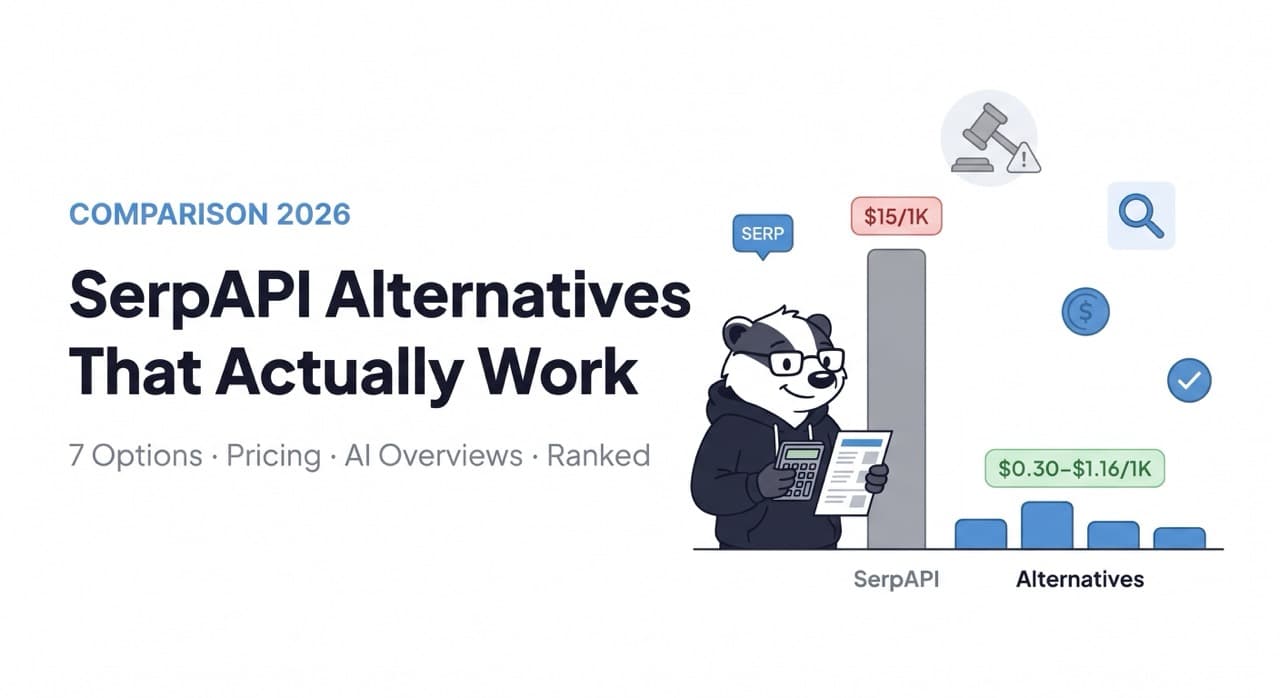
SerpAPI's Developer plan runs $75 per month for 5,000 searches — that's $15 per thousand. For a tool that returns JSON SERP data, that math stings once you're pulling more than a few thousand SERPs a day.
Most teams who've been on SerpAPI for a while don't notice the cost creeping up. They started on a starter plan, scaled up as their product grew, and somewhere along the way accepted that SERP data costs what it costs. Then someone does the annual budget review, looks at the number, and starts asking questions.
In 2026, with alternatives offering equivalent data quality starting at $0.50 per thousand searches, SerpAPI's pricing reflects brand premium rather than technical superiority.
This article is the honest version of that budget review. What SerpAPI actually costs, what you're really paying for, the vendor risk that emerged in December 2025, and the seven alternatives that work — including when each one is the right call and when SerpAPI is still worth paying for.
What SerpAPI Actually Costs in 2026
The headline pricing is straightforward. SerpAPI plans start at $25 per month for 1,000 searches on the Starter tier, scale to $75 per month for 5,000 on the Developer plan, and reach $275 per month for 30,000 on the Big Data tier. At 1 million searches per month, the effective cost is still $3.75 per thousand.
The headline number is only part of the story. The structure of the pricing creates hidden costs that don't show up in the plan comparison table.
The Subscription Expiry Problem
SerpAPI uses monthly subscriptions that expire unused credits, inflating effective costs by 30–50% for variable workloads.
Most products that use SERP data don't use it at constant volume. A rank tracking tool sees higher usage when a customer onboards, lower usage mid-month when nothing changes, and a spike at the end of the month for reporting. An AI agent's SERP usage depends on what tasks users are running. A competitive intelligence tool runs heavily during campaign planning and lightly otherwise.
A subscription model forces you to buy for your peak rather than your average. An average month at 15,000 searches with a 30,000-search peak means you're on the Big Data plan ($275) for 12 months, effectively paying $275 even in months you use half the allotment. Pay-as-you-go pricing at the alternatives' rates would cost significantly less for that exact workload.
The "80+ engines" Value Proposition — Who Actually Needs It
SerpAPI supports 80+ search engine APIs, and the structured JSON covers organic results, knowledge graphs, shopping carousels, ads, local packs, plus a lot of the weird edge-case SERP blocks that cheaper APIs skip entirely. Most teams don't need SerpAPI's 80+ engine coverage. If you're honest about which SERP elements you actually use, you can cut your bill by 80%+ with DataForSEO or Serper and never notice the difference. The honest question to ask before evaluating alternatives: which engines do you actually query? If the answer is Google only, or Google plus occasionally Bing, SerpAPI's multi-engine breadth is a feature you're paying for and not using.
The Vendor Risk Factor: Google vs. SerpAPI
This is the conversation that wasn't happening a year ago. As covered in the ScrapeBadger Google Maps comparison article, Google filed a DMCA lawsuit against SerpAPI in December 2025, alleging it circumvented SearchGuard — Google's anti-scraping infrastructure — to access and resell search results at massive scale.
SerpAPI filed a motion to dismiss in February 2026, making substantive legal arguments. The hearing is scheduled for May 2026. The motion to dismiss arguments are credible — the legal question is genuinely contested.
What this means for your infrastructure decision: SerpAPI is operational today, and the lawsuit outcome is uncertain. But if your product depends on SerpAPI for a core data feed, you need a tested fallback regardless of how the legal situation resolves. No team should be in a position where a court order or operational disruption causes their product to fail because they have no migration path.
Evaluating alternatives now — and having one integration-ready — takes a few days of engineering. Being forced to migrate under pressure because SerpAPI has an unexpected service disruption is a far worse situation. The time to test alternatives is while you don't urgently need them.
The 7 Best SerpAPI Alternatives in 2026
1. ScrapeBadger — Best for Google-Specific Intelligence at Scale
ScrapeBadger's Google Scraper covers 18 Google products across 19 endpoints — Search, Maps, News, Shopping, Trends, Flights, Hotels, Finance, Jobs, Patents, Scholar, and more — under one API key with flat per-request credit pricing and no subscription.
Why It's the Right Alternative for Most Teams
The multi-product platform is the primary differentiator. Most teams using SerpAPI for SERP data also need news monitoring, Trends signals for content timing, Maps data for local intelligence, or Shopping prices for competitive research. Under SerpAPI's model, each of these requires either a separate integration or SerpAPI's own cross-product pricing. Under ScrapeBadger, every Google surface is one integration with one billing relationship.
The AI Overview capture is worth specific mention. AI Overview support matters more in 2026 than it did a year ago. Google's AI Overviews now appear in approximately 48% of all searches and directly affect CTR for organic results. As detailed in the ScrapeBadger SERP data article, ScrapeBadger captures the full AI Overview text and citation references — not just a detection flag. For teams building SEO tools or rank trackers in 2026, AI Overview data is a first-class field, not a nice-to-have.
Credit pricing with no expiry means variable-volume workloads don't waste money. Credits purchased in January remain valid in September. For AI agent workflows specifically, where SERP query volume is inherently unpredictable, this pricing model is structurally correct. The MCP integration exposes all Google endpoints as native tool calls to Claude, Cursor, and Windsurf — agents pay per query without any pre-purchased credits sitting idle.
Best for
Teams needing Google SERP alongside other Google data sources; AI agent developers; any workflow where subscription expiry wastes budget; teams wanting a clean migration path away from SerpAPI.
2. Serpent API
If the primary reason you're leaving SerpAPI is cost, Serpent API is where the math gets serious. At $0.03 per thousand searches on the Scale tier, it is the cheapest SERP API available in 2026 — 125x cheaper than SerpAPI's Developer plan rate and 20x cheaper than DataForSEO's Standard Queue. There is no subscription, no monthly minimum, and credits never expire.
What it covers
Serpent API returns structured JSON for Google, Bing, Yahoo, DuckDuckGo, and Brave — five engines under one API key, with no per-engine surcharge. The response includes organic results, AI Overview with cited sources, People Also Ask, featured snippets, ads, knowledge graphs, and local pack data. Country and language targeting is supported across 50+ countries.
The standout technical feature is the Pixel Position API — unique to Serpent API among providers on this list. Rather than returning only a 1-indexed ordinal rank, it returns the exact pixel coordinates (x, y, width, height) of every element on the SERP. In 2026, where AI Overviews, featured snippets, and local packs push organic results below the fold, ordinal position #1 does not equal visibility. Pixel position data answers the question that rank alone cannot: is this result actually seen?
Pricing
Billing is pay-as-you-go — no subscription, no monthly minimum, and credits never expire. The rate is set by a one-time deposit rather than a plan: $0.30 per thousand searches by default, $0.06 per thousand at Growth after a one-time $100 deposit, and $0.03 per thousand at Scale after $500. The deposit unlocks the tier permanently, so Scale pricing holds regardless of how low the balance drops, and rate limits scale with live balance rather than tier. The free trial is 10 searches, no credit card.
The deposit unlocks the tier permanently — it is not a subscription. A $500 one-time deposit at Scale tier gives you $0.03/1K pricing forever, regardless of how low your balance drops. Rate limits scale with live balance, not tier.
Free trial: 10 free searches, no credit card required.
Limitation
Serpent API is the right pick when cost and engine breadth are the primary requirements. Teams needing deep Google multi-product coverage (Maps, Trends, Flights, Scholar as dedicated endpoints) may want to combine Serpent API for SERP data with a specialist provider for other Google surfaces.
Best for: Cost-sensitive teams running high daily volume on multiple engines; developers building rank trackers, SEO dashboards, and AI agents who need raw position data at the lowest available price; any workflow that benefits from pixel-level SERP geometry.
Comparison table row to add:
3. cloro — Best for Rank and AI Answers From One API
Most alternatives on this list solve the same problem SerpAPI solved: get Google results as JSON, cheaper. cloro answers a different question. It returns Google Search and Google News alongside the AI surfaces that now answer the same query, ChatGPT, Perplexity, Gemini, Copilot, Grok, Google AI Overview and Google AI Mode, through one endpoint family with the same request shape.
Adding a surface is a parameter change, not a second integration. That matters if you are tracking visibility rather than only rank. Every AI response comes back with its cited source URLs parsed out, so you can ask which domains an engine actually used to answer a query, not just what it said.
The Google payload carries the full envelope: organic results, ads, People Also Ask, related searches, and AI Overview with its source list and citation positions. Requests support Google's canonical location names or a pre-encoded uule for city-level targeting, desktop and mobile, multi-page, and async delivery with webhooks so batch jobs do not compete with interactive traffic for concurrency.
Billing is credits, charged only on success, from one pool shared across every surface. A Google search is 3 credits, AI Overview adds 2, and a Google News call is 3 with 2 per extra page. There is a free tier at 500 credits a month that refreshes, then Lite at $30, Hobby at $100 for 250,000 credits, Growth at $500 for 1,350,000, and Business at $1,000. The rate per 1,000 credits falls from $0.80 to about $0.31 across the self-serve range.
Limitation: plans are monthly rather than pay-as-you-go, so a spiky or very low-volume workload can be cheaper metered elsewhere. cloro does not scrape Bing, so if Bing SERP data is a requirement, SerpAPI or DataForSEO fit better.
Best for: teams that need Google rank data and AI-assistant answers from the same pipeline, AI visibility and GEO tracking, and RAG or agent pipelines that need live grounding with sources.
4. Serper — Best for Speed and Pure Cost Efficiency
Serper sells credit packs with volume discounts: Starter at $50 for 50,000 credits ($1.00 per thousand), Standard at $375 for 500,000 ($0.75 per thousand), Scale at $1,250 for 2.5 million ($0.50 per thousand), and Ultimate at $3,750 for 12.5 million ($0.30 per thousand). Credits last 6 months.
On pure cost-per-query, Serper is compelling. At scale, $0.30 per thousand versus SerpAPI's $3.75 per thousand is a 12.5x cost reduction on the same data. The 6-month credit validity eliminates the subscription waste problem.
Serper typically responds in under 1 second. SerpAPI response times vary by engine but are generally 1–3 seconds. For latency-sensitive agent workflows where search is in the critical path, Serper's speed is an advantage.
The data model covers organic results, People Also Ask, featured snippets, knowledge graphs, news, images, and local results. It doesn't fetch page content — it returns SERP data only. For teams building rank trackers, SEO dashboards, and AI research agents, that's the right scope.
Limitation
Google coverage only. No Bing, Yahoo, or other engines. No multi-product Google data beyond SERP. If your use case needs Maps, Trends, or Flights data in addition to SERP, Serper requires a second integration.
Best for
Teams running pure Google SERP at high volume where cost is the primary constraint; AI agents doing web research where response latency matters.
5. DataForSEO — Best for Bulk Volume at Lowest Cost
At 10,000 searches per month, DataForSEO costs $6. At 1 million searches per month, DataForSEO at $600 is significantly cheaper than SerpAPI at $7,000.
DataForSEO uses an asynchronous task-based architecture — you submit search tasks, and results are available to fetch within a window. This is different from the synchronous request-response model of SerpAPI and Serper. For real-time applications where you need a result in under a second, DataForSEO's architecture doesn't work. For bulk data collection, rank tracking, and any workflow that can tolerate processing delays, it's the cheapest option by a significant margin at scale.
DataForSEO is the pick for cheapest at scale, delivering SERP data at $0.60 per thousand on the Standard Queue.
DataForSEO's data coverage is comprehensive — organic results, featured snippets, knowledge graphs, PAA, local results, news, shopping, and Maps. The API surface is extensive and somewhat complex compared to simpler alternatives, but the documentation is thorough.
Limitation
The async architecture makes it unsuitable for latency-sensitive applications. Real-time AI agent queries or user-facing search features that need sub-second response times need a different provider.
Best for
SEO agencies running bulk rank tracking jobs; data teams building large SERP datasets; any workflow where asynchronous processing is acceptable and cost at volume is the dominant factor.
6. Scrapingdog — Budget Option With Solid AI Overview Coverage
Scrapingdog offers a budget-friendly SERP API with 48% AI Overview detection at $2.00 per 1,000 requests — 12.5x cheaper than SerpAPI. Credits don't expire.
Scrapingdog: $10 buys 25,000 credits, no expiry. A strong pay-as-you-go option for teams with sporadic or unpredictable usage patterns.
For small teams or solo developers who need SERP data occasionally without paying monthly minimums, Scrapingdog's no-expiry credit model is genuinely user-friendly. The $10 entry point with 25,000 credits is the lowest-commitment option on this list.
Data coverage includes organic results, PAA, featured snippets, ads, and knowledge graphs. The 48% AI Overview detection rate is meaningful — not the highest on this list, but at this price point it's a reasonable trade-off.
Best for
Individual developers, small agencies, and side projects that need SERP data without monthly commitment; teams validating a product idea before committing to production infrastructure.
7. Scrape.do — Strongest AI Overview Coverage Among Alternatives
Scrape.do comes out as the strongest overall replacement among the alternatives tested: faster response times, 60% AI Overview detection, and the richest output among alternatives at $1.16 per thousand.
For teams running monitoring across multiple Google surfaces, switching from per-engine SerpAPI pricing to one Scrape.do bucket means fewer line items and lower per-request cost across the board. Free tier: 1,000 free credits monthly, translating to 100 Google SERP requests at 10 credits each — enough for testing and low-volume projects.
The 60% AI Overview detection rate — the highest among the alternatives in published benchmarks — is the headline differentiator. For SEO tools where AI Overview monitoring is a core feature, this matters significantly.
Best for
Teams where AI Overview coverage is a primary requirement; developers who want a focused SERP API with a meaningful free tier.
8. ScrapingBee — Best for Teams Already in the Ecosystem
ScrapingBee matches SerpAPI's organic detail depth for Google searches.
For teams already using ScrapingBee for general web scraping — where SERP data is an extension of an existing workflow rather than a primary product — ScrapingBee's Google Search endpoint adds coverage without adding a vendor relationship. The data quality is comparable to SerpAPI on organic results and SERP features.
The credit multiplier consideration applies: ScrapingBee's stealth proxy tier consumes 75 credits per request. Calculate your effective per-query cost at your actual configuration before comparing the headline price to alternatives.
Best for
Teams already using ScrapingBee's general scraping infrastructure who want to add SERP data without a second vendor.
9. ValueSERP / SearchAPI.io — Clean APIs, Competitive Pricing
Both ValueSERP and SearchAPI.io offer straightforward Google SERP APIs at price points significantly below SerpAPI, with clean documentation and simple JSON response structures. Neither has the ecosystem depth of the larger players, but both deliver accurate organic result data reliably.
Pricing for both is in the $1–$3 per thousand range depending on volume and tier. Free tiers are available for evaluation.
Best for
Developers who want a simple, well-documented SERP API without the complexity of larger platforms.
The Honest Comparison Table
ScrapeBadger | Serpent API | cloro | Serper | DataForSEO | Scrapingdog | SerpAPI | ||
Price per 1K searches | Competitive flat rate | $0.03 (Scale) | $2.40–$1.11 | $0.30–$1.00 | $0.60 | $2.00 | $1.16 | $3.75–$15 |
Credit expiry | Never | Never | Monthly | 6 months | None | Never | Monthly | Monthly |
Subscription required | ❌ | ❌ | ✅ | ❌ | ❌ | ❌ | ❌ | ✅ |
AI Overview capture | ✅ Full text | ✅ Full text + cited sources | ✅ 50% | ⚠️ Basic | ⚠️ | ✅ 48% | ✅ 60% | ✅ |
Multi-product Google | ✅ 18 endpoints | ✅ 5 engines incl. Brave | ✅ | ❌ | ✅ | ❌ | ✅ | ✅ 80+ engines |
Response time | Fast | Fast (sync) | Sync | Sub-second | Async | Fast | Fast | 1–3s |
MCP integration | ✅ | ❌ | ✅ | ❌ | ❌ | ❌ | ❌ | ❌ |
Legal situation (2026) | ✅ Clean | ✅ Clean | ✅ | ✅ | ✅ | ✅ | ✅ | ⚠️ Google lawsuit |
Free trial | ✅ 1,000 credits | ✅ 500 credits | ✅ 2,500/mo | ✅ | ✅ | ✅ | 100 searches | |
Best for | Multi-product teams | Cheapest at scale, 5 engines | Rank plus AI answers | Speed + cost | Bulk async | Budget / PAYG | AI Overview | Multi-engine |
When SerpAPI Is Still Worth Paying For
This article exists because most teams are overpaying for SerpAPI. But there are genuine cases where SerpAPI's premium is justified:
You need multi-engine coverage beyond Google. If your product queries Bing, Yahoo, DuckDuckGo, YouTube, Amazon, and Google in a single workflow, SerpAPI's 80+ engine support is a real differentiator. No alternative covers that breadth without multiple integrations.
You need very specific niche SERP blocks. Google Flights widget, Google Events, Google Certifications, Google Scholar snippets — some of these highly specific SERP features that only SerpAPI documents comprehensively. If your use case depends on one of these edge-case blocks, check that your chosen alternative covers it before migrating.
Your team has heavy SerpAPI integration that would cost more to migrate than to keep. A scraping API migration typically takes one to two days of engineering. If your codebase has deep SerpAPI dependency built over years, the calculation changes. Be honest about the actual migration cost before assuming it's worth it.
Outside these three cases, the pricing gap is hard to justify. In 2026, the pricing reflects brand premium rather than technical superiority.
How to Migrate Away from SerpAPI
The migration path is straightforward for any alternative on this list. Every provider returns structured JSON that covers the same core SERP fields. The main differences are parameter naming and response schema structure — both of which take an afternoon to map.
The practical migration checklist:
Audit your actual SerpAPI usage. Which endpoints do you call? Which response fields do you actually consume in your application? Most teams discover they use fewer fields than they thought. This shapes which alternative is the right fit.
Test on your real queries. Run 100 representative queries through your candidate alternative and compare output field-by-field against SerpAPI responses. Check AI Overview detection on the queries where you know AI Overviews appear. Check local result coverage if you use local SERP data.
Run parallel for one week. Keep SerpAPI running on your current integration while testing the alternative on the same queries. Compare outputs. This gives you confidence before cutting over.
Cut over and monitor. Flip the integration, monitor for data quality issues for 48 hours, and cancel the SerpAPI subscription before the next billing cycle.
ScrapeBadger's Google SERP API follows the same JSON structure as SerpAPI's core response for organic results, PAA, and SERP features — most migrations complete in under a day. The documentation at docs.scrapebadger.com covers every parameter and response field. Free trial includes 1,000 credits with no credit card required — enough to validate against your specific queries before committing.

Written by
Domas Sakavickas
Dom Sakavickas is Co-founder of ScrapeBadger, building web scraping infrastructure for developers and data teams. He writes about the web data market, tool comparisons, and business use cases for scraping. ScrapeBadger is a web scraping API platform specialising in Twitter/X, Reddit and Google data, with dedicated scrapers also covering TikTok, YouTube, LinkedIn, Amazon, eBay, Zillow and 40+ more: with built-in anti-bot bypass and an MCP server for AI agents.
Ready to get started?
Join thousands of developers using ScrapeBadger for their data needs.