The Real Cost of Bad Data: What Happens When Your Scraper Returns Garbage
 Domas Sakavickas
AI Summary: This guide explains why bad scraping data is so costly, arguing its damage hides behind 200 status codes and surfaces downstream as wrong pricing and market decisions, and shows how validation and reliable infrastructure like ScrapeBadger prevent silent data corruption.
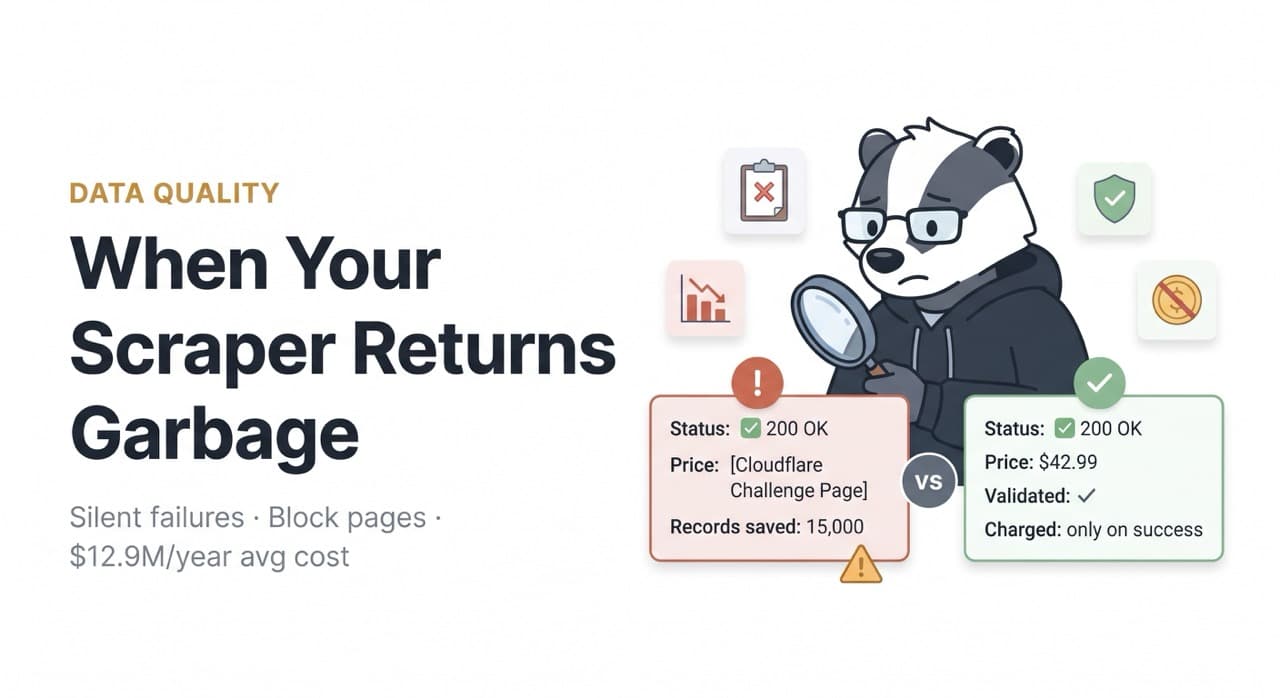
Over a quarter of organisations estimate they lose more than $5 million annually due to poor data quality, with 7% reporting losses of $25 million or more. Yet poor data quality often goes unnoticed because its impact rarely appears at the point of failure. Instead, it surfaces downstream as lost revenue, inefficiencies, compliance risks, and missed opportunities.
That last sentence is the one that matters for anyone running a web scraping pipeline. The impact rarely appears at the point of failure. Your scraper runs. It returns a response. The status code says 200. The pipeline logs say success. And somewhere downstream, someone makes a pricing decision, a market entry call, or a competitive analysis based on data that was wrong before it ever reached them.
This is the specific failure mode that makes bad scraping data particularly dangerous. It's not the scraper that crashes and sends an alert. It's the scraper that silently succeeds at collecting the wrong thing.
Why Scraping Data Fails Differently From Other Data Sources
When a database query fails, you get an error. When an API returns bad data, there's usually a documented error schema that lets you detect the problem. When a scraper silently collects garbage, you often get a perfectly formatted JSON object with the wrong values inside it.
The mechanics of why this happens are specific to web scraping. Anti-bot systems are the biggest cause. When Cloudflare, Imperva, DataDome, or PerimeterX challenges a request, they don't necessarily return a 403 Forbidden. They frequently return a 200 OK with a challenge page — a block page with perfect HTTP headers that looks, to any status-code-checking pipeline, like a successful response.
The scraper that checks if response.status_code == 200: save_data() is saving Cloudflare challenge pages to your database. The downstream system that reads those records finds empty price fields, null product names, and missing availability data. By the time anyone notices, the corrupt records may have been sitting in production for weeks.
43% of chief operations officers identify data quality issues as their most significant data priority. In the scraping context, this problem is worse than most because the failure mode is inherently invisible.
The Five Silent Failure Modes
1. The Block Page Masquerading as a Success
As detailed in the ScrapeBadger guide to bypassing Imperva, Imperva frequently returns 200 OK responses that are actually block pages containing "Powered By Incapsula" text. The same pattern applies to Cloudflare's managed challenge responses, DataDome's interstitial pages, and PerimeterX's challenge screens.
A pipeline that doesn't validate the content of successful responses — only checks the status code — is storing block pages as data. The field that should contain a competitor's product price contains Imperva's challenge HTML instead.
At scale, this is worse than no data. No data produces empty dashboards that people notice. Block pages produce dashboards that look populated with plausible-looking numbers until someone checks a specific record and discovers it contains challenge page text.
2. Schema Drift
A scraper is configured to extract a product price from a div.product-price element. The target site redesigns and renames the class to div.price-current. The scraper keeps running. It returns empty strings where prices should be. The records look complete — all fields present, no errors logged — but the price field is blank.
Gartner research reveals poor data quality costs organisations an average of $12.9 million per year across all industries. Schema drift is one of the most common causes specifically in scraped data. Unlike a database schema which you control, a website's HTML structure is controlled by someone else and changes without notice. The scraper that worked perfectly last month has a 10% silent failure rate this month because three product pages have new HTML structure.
The damage compounds over time. A price monitoring dashboard that worked well for six months develops gradual gaps. An analyst looking at competitor pricing trends sees a downward trend in prices that's actually a downward trend in successful field extraction. The wrong business decision follows from the right-looking chart.
3. A/B Test Contamination
Large e-commerce sites and retailers run simultaneous A/B tests that serve different prices, different product configurations, and different promotional messaging to different sessions. A scraper hitting the same page ten times might receive the control variant seven times and the test variant three times — returning two different prices for the same product, both technically accurate, neither representative of the price a typical customer sees.
This is the data quality problem that's hardest to detect because the data isn't wrong in any detectable sense. Both prices exist. The scraper isn't collecting block pages or empty fields. It's collecting valid data from different experimental variants — and the price variance looks indistinguishable from genuine price fluctuation until someone investigates closely.
For competitive price monitoring specifically, A/B test contamination produces false signals. A competitor's price appears to fluctuate more than it actually does, suggesting a dynamic pricing strategy that may not exist.
4. Geographic and Session Personalisation
E-commerce sites, real estate portals, and travel platforms serve different prices based on the geographic origin of the request, the session's cookie history, and device type. A scraper collecting "the price" of a product from a UK residential proxy might collect the UK price. The same scraper collecting from a US datacenter IP gets the US price. Both are accurate; neither is representative without the geographic context attached to every record.
As covered in the ScrapeBadger real estate scraping guide, Zillow specifically serves different price estimates and listing information based on the geographic IP of the requesting session. A real estate intelligence platform that doesn't geo-tag its scraped records has data that's accurate in isolation and meaningless in aggregate.
5. Stale Data Served as Fresh
Scraping APIs and proxy networks that cache responses for performance serve old data to new requests. A request for a product page hits a cached response from six hours ago. The price changed four hours ago. The scraper's timestamp says the data was collected now; the actual price reflects a state that no longer exists.
For use cases where data freshness is the primary value — price monitoring, stock availability, breaking news aggregation — stale cached data is worse than no data. It creates false confidence that the current state is known when it isn't.
Employees spend up to 27% of their time correcting bad data, slowing decision-making and increasing operational costs. In the context of a scraped data pipeline, that time is spent debugging field extraction failures, investigating unexpected data patterns, and manually verifying records that the automated system reported as successful.
The Downstream Multiplication Effect
The reason bad scraping data is disproportionately costly is what happens after it enters a pipeline. Data doesn't stay in a database — it gets used.
A competitor price that's wrong because the scraper collected a block page feeds into a repricing engine. The repricing engine makes a decision. That decision affects margin on thousands of transactions before anyone notices the input was corrupted. According to Gartner research, the average financial impact of poor data quality on organisations is $9.7 million per year. IBM also discovered that in the US alone, businesses lose $3.1 trillion annually due to poor data quality.
The multiplication factor in scraping is particularly acute because scraped data often drives automated decisions. A repricer that acts on bad price data makes bad pricing decisions at machine speed. A lead generation tool that pulls contacts from block pages creates outreach sequences to nonexistent people. A market intelligence dashboard that populates from contaminated scraped records produces the wrong strategic picture for every executive who reads it.
60% of customers abandon a brand after just one bad data experience. In a B2B context with enterprise accounts, one decision made on corrupted competitive intelligence data can cost more than any scraping infrastructure budget.
The Compounding Cost Nobody Calculates: Paying for Bad Data Twice
There's a financial layer to bad scraping data that most teams never add up explicitly: you pay for the request that returned garbage, and then you pay again for the decision made on that garbage.
Most scraping APIs charge per request regardless of whether the response contained useful data. A request that returns a Cloudflare block page costs the same as a request that returns complete structured data. At production volumes — 100,000 requests per month — a 15% block rate means you're paying for 15,000 worthless requests every month. You're not just getting bad data; you're buying it.
A 2025 report found that 43% of chief operations officers identify data quality issues as their most significant data priority. The cost of data quality failures in most organisations is calculated on the downstream decision impact. The upstream procurement cost — paying for data that wasn't usable — is often invisible in the analysis because it's buried in API billing rather than labelled as a data quality cost. Apify
This is a specific problem ScrapeBadger has addressed directly: we do not charge for failed or blocked requests. If ScrapeBadger's infrastructure can't successfully retrieve the target content — whether because of anti-bot challenges, network failures, or any other reason — you don't pay for that request. Every credit you spend returns data that passed our content validation layer.
This isn't a minor pricing detail. It's a structural alignment of incentives. When a scraping API charges for failed requests, they have no financial motivation to maintain high success rates. When ScrapeBadger only charges for successful retrievals, our infrastructure investment — in bypass quality, proxy pool health, and content validation — is directly connected to our revenue. Your cost per successful record is predictable. The free trial at scrapebadger.com gives you 1,000 credits that are used only on successful results.
What Content Validation Actually Means
Most scraping tools validate HTTP status codes. ScrapeBadger validates actual page content before marking a request as successful and billing a credit.
The distinction matters enormously for the failure modes described above. A Cloudflare challenge page returns 200 OK — status code validation passes, the request gets billed, the block page enters your pipeline. Content validation catches "Powered By Incapsula" text, PerimeterX challenge screens, and DataDome interstitials before they reach your pipeline or your bill.
As covered in the Imperva bypass article, Imperva's silent block pages are one of the most insidious failure modes in production scraping — the scraper believes it succeeded because the HTTP status was 200. Content validation at the infrastructure level is the only reliable way to detect and suppress this class of failure.
The same validation approach applies to empty responses, partial page loads where JavaScript didn't render completely, and responses that are technically valid HTML but contain none of the structured data your pipeline expects.
The Framework for Evaluating Your Own Pipeline's Data Quality
Most teams running scraping pipelines don't have explicit data quality monitoring. They find out about failures when someone notices a wrong number on a dashboard. By then, the wrong number has already informed decisions.
A practical quality monitoring framework for scraped data has four components:
Schema validation on every record. Every field you extract should be validated against expected type, format, and plausible range before the record is stored. A price field that returns a string instead of a float, a date field that returns HTML, a numeric field that returns zero when zero is implausible — all of these should trigger alerts, not silent storage. The ScrapeBadger article on building a price tracking bot covers Pydantic-based schema validation patterns that catch type failures at extraction time.
Distribution monitoring over time. If your scraper collected prices averaging £45 yesterday and £4.50 today, something is wrong. Statistical process control applied to scraped data distributions catches schema drift before it produces weeks of bad data. A sudden shift in average field length, value range, or completion rate is a signal worth investigating immediately.
Content spot-checking on a sample. Automated validation catches known failure patterns. Manual spot-checks catch the unknown ones — the A/B test variant you hadn't anticipated, the new page layout that your selectors partially parse, the regional price variation you didn't account for. A weekly 1% sample review of scraped records takes less time than recovering from a month of corrupted data.
Cross-source verification on critical fields. When a data point will drive a significant decision, verify it against a second independent source. A competitor price that appears unusually low should be verified against another data source before it triggers an automatic reprice. The ScrapeBadger trusted data article covers the full quality framework in detail, including the specific validation steps that separate production-quality data pipelines from prototype scrapers.
The Bottom Line
Poor data quality costs companies approximately $15 million per year on average, according to IBM. MIT Sloan notes that it can consume 15% to 25% of a company's revenue.
The scraping-specific version of this cost is usually smaller in absolute terms — most teams aren't making decisions that expose $15 million to a single data quality failure. But the structural problem is the same: the failure doesn't appear where the data was collected. It appears in a repricing decision, a market entry analysis, a competitive positioning call, or a lead generation campaign. By the time it's visible, the investment in collecting the bad data, storing it, and acting on it has already been made.
The preventable part is the upstream procurement cost: paying for requests that returned garbage. ScrapeBadger's content validation and no-charge-for-failures policy removes that specific cost entirely. What you can't prevent through infrastructure is the validation, monitoring, and cross-checking work on your side — and that's where the framework above matters.
The data quality problem in web scraping is solvable. The first step is acknowledging that a green status code on a scraping run isn't the same as good data in your pipeline.

Written by
Domas Sakavickas
Dom Sakavickas is Co-founder of ScrapeBadger, building web scraping infrastructure for developers and data teams. He writes about the web data market, tool comparisons, and business use cases for scraping. ScrapeBadger is a web scraping API platform specialising in Twitter/X, Reddit and Google data, with dedicated scrapers also covering TikTok, YouTube, LinkedIn, Amazon, eBay, Zillow and 40+ more: with built-in anti-bot bypass and an MCP server for AI agents.
Ready to get started?
Join thousands of developers using ScrapeBadger for their data needs.