How Brands Use Google Shopping Data for Competitive Intelligence
 Domas Sakavickas
AI Summary: This article shows how brands use Google Shopping data for competitive intelligence, using a pricing decision to demonstrate that a ten-minute data pull revealing real competitor prices, ratings, and review counts can replace weeks of internal debate and reshape positioning.
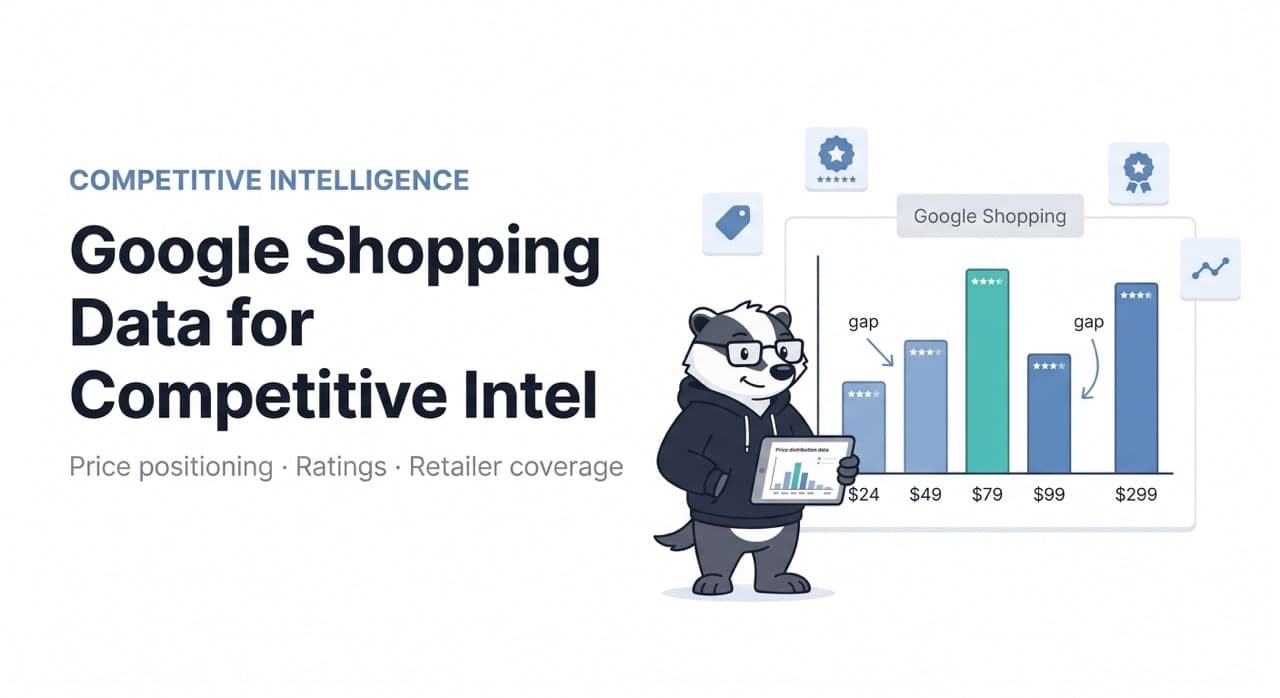
Here is the question a pricing manager at a consumer electronics brand asked last quarter: should we drop the price on our wireless earbuds from $79 to $69?
The internal debate ran for two weeks. Marketing said yes — lower price drives conversion. Finance said no — margin erosion sets a precedent. Neither team had looked at what the actual competitive landscape on Google Shopping showed for that product category.
When someone ran the query, the picture was immediate. JLab was at $24.99 with 16,000 reviews and 4.1 stars on Walmart. Sony was at $49.99 with 4.7 stars and 6,900 reviews. Anker Soundcore Liberty 5 was at $99.99 with 4.8 stars. Bose QuietComfort Ultra sat at $299. The $69–$80 range was thin — one Beats product with a 3.9 star average, one JLab sport variant. The brand's $79 product was not competing against a $69 product from a direct competitor. It was competing against a $24.99 product from below and a $99 product from above, both with stronger review profiles.
The decision changed. Not just the price point — the entire positioning strategy, the product page messaging, and the paid search bidding approach. Two weeks of internal debate was replaced by a ten-minute data pull.
That is what Google Shopping data does for competitive intelligence. It answers the questions that internal data cannot.
What Google Shopping Data Contains
Google Shopping aggregates product listings from thousands of merchants and displays them in a structured format — title, price, seller, rating, review count, delivery terms, and sale indicators — all indexed and searchable. For competitive intelligence purposes, the fields that matter most are:
Price and price history. The current price from every seller carrying a product, plus sale status and original price when a promotion is active. Tracking these across time reveals repricing patterns, seasonal discount strategies, and how quickly competitors respond to market pricing events.
Rating and review count. Star ratings and total review counts are displayed on Google Shopping tiles. A competitor with a 4.7 average and 6,000 reviews has a social proof advantage that is difficult to compete with on price alone. A competitor with a 3.9 average at a competitive price point has a customer satisfaction problem that represents an opportunity.
Seller and retailer coverage. Which retailers are carrying a competitor's product, and what price variance exists across channels? A product sold at $79 on the brand's own site but at $64 on Amazon through third-party sellers has a channel pricing problem. Google Shopping surfaces this across all distribution points simultaneously.
On-sale signals. When a competitor activates a promotion, Google Shopping reflects it immediately. Monitoring sale signals across a category gives you advance warning of competitive pricing moves that would otherwise take days to detect through manual monitoring.
Position and visibility. Which products Google chooses to surface in Shopping results — and in what position — reflects a combination of bid strength, product data quality, and relevance signals. Tracking position over time for your own products and competitors reveals where organic Shopping visibility is being won or lost.
ScrapeBadger's Google Shopping API returns all of these fields in structured JSON from a single endpoint call. The data the query above returned in seconds is available programmatically for any category, any geography, any page depth.
Four Competitive Intelligence Use Cases
Price Positioning Analysis
The most direct application. Pull Google Shopping results for your product category and build a price distribution map. Where is the market concentrated? Where are the gaps? Where is your product positioned relative to the actual competitive set?
The wireless earbuds example above illustrates the value: the relevant competitive context was not "what are our direct competitors charging" — it was "what does the full price distribution on Google Shopping look like for this query, and where do we sit within it."
This analysis should run on a schedule, not as a one-off. Price distributions shift. New products enter. Promotions run. A snapshot taken in January is not representative of March. Weekly monitoring with stored observations builds the time series you need to understand how the competitive price landscape moves.
Retailer and Channel Intelligence
Google Shopping aggregates pricing across every retailer that has a product data feed. For brand owners, this surfaces unauthorized resellers, MAP policy violations, and channel pricing inconsistencies that internal monitoring rarely catches in time.
A brand running a MAP policy of $79 can pull Google Shopping results for their product name weekly and immediately see every retailer who is undercutting. A distributor selling at $64 on a third-party marketplace appears in Shopping results alongside the brand's own listings. Without systematic monitoring, these violations persist for weeks before anyone notices.
For competitive intelligence on competitor brands, retailer coverage tells you about distribution strategy. A competitor appearing on Walmart, Target, Best Buy, and Amazon simultaneously has broad retail distribution. A competitor appearing only on their own site and Amazon is either direct-to-consumer focused or struggling to get retail placement.
Rating Trajectory Monitoring
A competitor's star rating on Google Shopping reflects aggregated reviews across multiple platforms. Tracking this weekly reveals when a competitor's product quality is improving or declining before the market fully reprices the signal.
A competitor whose average rating drops from 4.3 to 3.8 over 90 days has a product quality or fulfillment problem that your sales team should know about. Their churn rate is likely increasing. Their NPS is likely falling. Customers evaluating alternatives are more persuadable than they were 90 days ago.
Combined with ScrapeBadger's Google Maps review data for local retail context and Reddit monitoring for community sentiment, the rating trajectory becomes part of a multi-source competitor health signal — not just a number on a product tile.
Launch and Promotion Detection
New product launches and promotional campaigns appear in Google Shopping results as soon as merchants activate their data feeds. Monitoring your category for new product tiles — products that were not present in last week's results — gives you early warning of competitor launches before press coverage or paid advertising campaigns begin.
The same logic applies to promotional activity. A competitor activating a 30% sale across their catalog shows up in Shopping results as sale-price items with strikethrough original prices. Detecting this within hours allows a reactive promotional response if your strategy warrants it, rather than discovering the campaign from a customer asking why the competitor is cheaper.
Building the Monitoring Workflow
A production Google Shopping competitive intelligence workflow covers three components:
Category-level scanning runs weekly across every relevant search query in your product category. The output is a structured snapshot of the competitive landscape — who is present, at what prices, with what ratings. Stored weekly, this becomes the baseline for change detection.
Change detection compares this week's snapshot against last week's. New products, price changes above a threshold, rating changes, and sale activations all trigger notifications. The threshold for what constitutes a meaningful change is configurable — a 5% price move is meaningful in some categories, irrelevant in others.
Deep dives on flagged products use ScrapeBadger's product detail endpoint to pull full specifications, all merchant offers, and variant pricing when a product has been flagged by the change detection layer. This gives the full competitive picture on a specific product rather than the summary view from the search tile.
ScrapeBadger's Google Shopping endpoint and the Amazon Scraper together cover the two most commercially significant product search surfaces. Teams monitoring both simultaneously — with the same API key and unified billing — catch price intelligence gaps that single-platform monitoring misses. A competitor who drops their Amazon price without touching their Google Shopping price is running a channel-specific promotion that only shows up if you are monitoring both.
As covered in the ScrapeBadger blog on competitive intelligence use cases, the multi-source approach transforms reactive price monitoring into proactive market positioning. Full documentation at docs.scrapebadger.com. Free trial at scrapebadger.com — 1,000 credits, no credit card.

Written by
Domas Sakavickas
Dom Sakavickas is Co-founder of ScrapeBadger, building web scraping infrastructure for developers and data teams. He writes about the web data market, tool comparisons, and business use cases for scraping. ScrapeBadger is a web scraping API platform specialising in Twitter/X, Reddit and Google data, with dedicated scrapers also covering TikTok, YouTube, LinkedIn, Amazon, eBay, Zillow and 40+ more: with built-in anti-bot bypass and an MCP server for AI agents.
Ready to get started?
Join thousands of developers using ScrapeBadger for their data needs.