The 7 Best Web Scraping APIs in 2026: Ranked & Tested
 Thomas Shultz
AI Summary: This guide ranks and tests the seven best web scraping APIs of 2026 against heavily protected domains, comparing real-world success rates, pricing, and how each handles JavaScript rendering, CAPTCHAs, and fingerprinting, so buyers cut through marketing noise to pick a tool that works in production.
If you are searching for the best web scraping API in 2026, you have likely encountered a maze of confusing pricing models, contradictory success rate claims, and tools that look identical on paper but perform completely differently in production.
The web scraping landscape has shifted dramatically over the last two years. Basic HTML extraction is no longer enough. Modern anti-bot systems like Cloudflare Turnstile, Datadome, and PerimeterX have made traditional scraping obsolete. Today, a web scraping API must handle JavaScript rendering, CAPTCHA solving, proxy rotation, and browser fingerprinting seamlessly — or it is useless.
We have tested the top providers on the market against the most heavily protected domains. This guide cuts through the marketing noise to rank the 7 best web scraping APIs available today, comparing their real-world success rates, pricing structures, and developer experience.
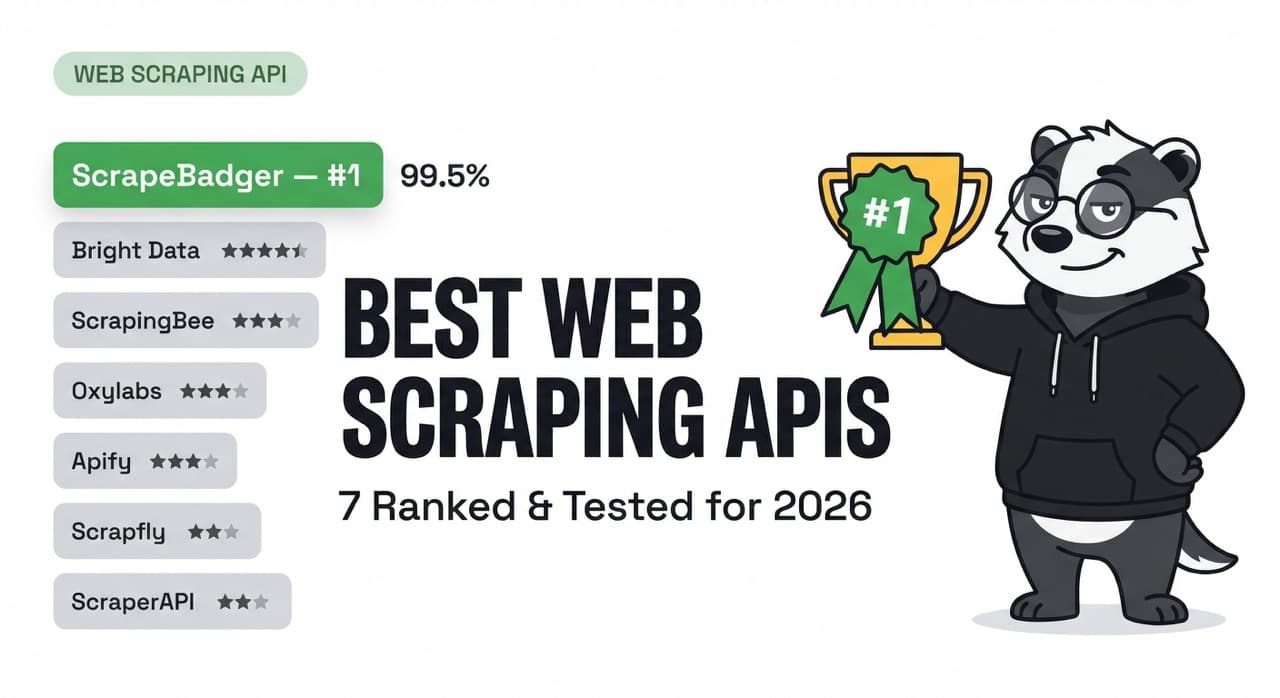
TL;DR: For production-grade data extraction, ScrapeBadger is the best overall web scraping API in 2026, offering the highest success rates on protected sites with a transparent "pay-only-for-success" model. Bright Data remains a strong enterprise choice for massive scale, while ScrapingBee is excellent for developers who need fine-grained headless browser control.
How We Evaluated the Best Web Scraping APIs
To rank these APIs fairly, we evaluated them across five critical dimensions that actually matter in production:
Anti-Bot Bypass Success Rate: How well does the API handle Cloudflare, Datadome, and Imperva? We tested against heavily protected sites like Zillow, Amazon, and LinkedIn.
Pricing Transparency: Is the pricing model clear, or are there hidden multipliers for JavaScript rendering and premium proxies?
Developer Experience (DX): How easy is it to integrate? Is the documentation clear? Are there SDKs available?
Speed and Reliability: What is the average response time, and does the provider offer an uptime SLA?
Feature Depth: Does the API offer AI extraction, structured JSON parsing, and geographic targeting?
1. ScrapeBadger — Best Overall Web Scraping API
Verdict: The most reliable and transparently priced web scraping API for modern, heavily protected websites.
ScrapeBadger has emerged as the top choice for developers and data teams in 2026. While older platforms have bolted anti-bot features onto legacy infrastructure, ScrapeBadger was built specifically to bypass modern protections like Cloudflare Turnstile and Datadome natively.
What sets ScrapeBadger apart is its smart billing model. You only pay for successful requests, and you only pay for the features the system actually needs to use. If you enable JavaScript rendering and anti-bot bypass, but the target page can be scraped without them, ScrapeBadger automatically downgrades the request and charges you less.
Key Features:
Native Anti-Bot Bypass: Consistently achieves 99%+ success rates on Zillow, Amazon, and LinkedIn.
AI Extraction Mode: Pass a plain English prompt and get clean JSON back, without writing CSS selectors.
Smart Cost Optimisation: Automatically uses the cheapest successful path for every request.
Global Proxy Network: Built-in residential and datacenter proxy rotation across 195 countries.
Pricing: Starts at $0.60 per 1,000 requests. Failed requests are never billed.
Best for: Teams that need reliable data from protected sites without managing complex proxy infrastructure or worrying about hidden costs. If you are currently struggling with blocks, our guide on how to scrape Zillow, Redfin & Rightmove shows ScrapeBadger's bypass capabilities in action.
2. Bright Data — Best for Massive Enterprise Scale
Verdict: The enterprise standard with the largest proxy network, but comes with a steep learning curve and premium pricing.
Bright Data (formerly Luminati) is the undisputed giant of the proxy world. Their Web Unlocker API is incredibly powerful, backed by a network of over 150 million residential IPs [1]. If you need to scrape millions of pages a day across highly specific geographic regions, Bright Data has the infrastructure to support it.
However, that scale comes at a cost. Bright Data's pricing is complex, often combining bandwidth charges with request multipliers. The platform is also notoriously difficult to configure for beginners, requiring significant engineering time to optimise.
Key Features:
Massive IP Pool: 150M+ residential IPs globally.
Web Unlocker: Automated CAPTCHA solving and browser fingerprinting.
Pre-collected Datasets: Option to buy data directly instead of scraping it.
Pricing: Pay-as-you-go starts at $3.00 per 1,000 requests for the Web Unlocker, but costs scale quickly based on bandwidth and targeting requirements.
Best for: Large enterprises with dedicated data engineering teams and massive volume requirements.
3. ScrapingBee — Best for Headless Browser Control
Verdict: A developer-favourite API that excels at rendering JavaScript and executing custom browser scripts.
ScrapingBee has built a strong reputation by focusing entirely on the developer experience. Their API is essentially a massive fleet of headless Chrome browsers managed for you. If you need to click buttons, scroll down pages, or execute custom JavaScript before extracting data, ScrapingBee makes it incredibly simple.
Their documentation is excellent, and they provide robust SDKs for Python, Node.js, and Ruby. The main drawback is their pricing model: rendering JavaScript costs 5 API credits per request, and using premium proxies costs 10-25 credits, meaning your base plan depletes much faster than expected.
Key Features:
Custom JS Execution: Run your own scripts on the page before extraction.
Excellent DX: Clean API design and comprehensive documentation.
Screenshot & PDF: Built-in endpoints for visual capture.
Pricing: Starts at $49/month for 100,000 API credits (note: 1 request can cost up to 25 credits).
Best for: Developers who need fine-grained control over headless browser interactions and custom script execution.
4. Oxylabs — Best for E-commerce Scraping
Verdict: A premium provider with specialised APIs for e-commerce and SERP data, backed by excellent account management.
Oxylabs is Bright Data's main rival in the enterprise space. They offer a robust Web Scraper API that handles proxy rotation and JavaScript rendering well. Where Oxylabs truly shines is in their specialised endpoints — specifically their E-Commerce Scraper API and SERP Scraper API, which return pre-parsed JSON for major retailers and search engines.
Their customer support and dedicated account managers are widely considered the best in the industry. However, like Bright Data, their pricing is geared towards enterprise budgets, making them less accessible for startups or mid-market companies.
Key Features:
Specialised Endpoints: Pre-parsed JSON for Amazon, Google, and other major targets.
Enterprise Support: Dedicated account managers and fast SLA response times.
High Quality Proxies: Very low block rates on their residential network.
Pricing: Starts at $49/month, but realistic production usage typically requires their $399/month tier or higher.
Best for: E-commerce companies monitoring competitor pricing at scale who want pre-parsed JSON rather than raw HTML.
5. Apify — Best for Pre-Built Scrapers (Actors)
Verdict: A unique platform approach that lets you run pre-built scraping scripts rather than building your own from scratch.
Apify takes a different approach to web scraping. Instead of just providing an API endpoint, they provide a platform where developers can build, host, and share scraping scripts called "Actors." If you want to scrape Instagram, Google Maps, or Twitter, there is likely already an Apify Actor built for it.
This makes Apify incredibly fast to set up if your target site already has an Actor. However, if you need to scrape a niche site or require custom logic, you have to build and host the Actor yourself, which introduces a steeper learning curve than a simple REST API.
Key Features:
Apify Store: Hundreds of pre-built scrapers ready to use.
Serverless Platform: Host your scraping code directly on their infrastructure.
Integration Ecosystem: Native integrations with Zapier, Make, and cloud storage.
Pricing: Starts at $49/month, billed based on compute time (RAM/hours) rather than per-request.
Best for: Teams that want to use pre-built scrapers for popular websites without writing any extraction logic. If you are interested in automating these workflows, check out our guide on how to scrape Twitter with n8n.
6. Scrapfly — Best for Anti-Bot Bypass on a Budget
Verdict: A strong mid-market contender that handles Cloudflare well without enterprise pricing.
Scrapfly has gained significant traction by focusing heavily on anti-bot bypass capabilities. Their API is designed to handle Cloudflare, Datadome, and PerimeterX out of the box. They offer a feature called "Anti-Scraping Protection Bypass" (ASP) which is highly effective on mid-tier protected sites.
Their pricing is more transparent than Bright Data or Oxylabs, but they still use a credit multiplier system. Rendering JavaScript costs 5 credits, and using their ASP feature costs 10 credits. This means a single request to a protected site costs 15 credits, which depletes your monthly allowance quickly.
Key Features:
Anti-Scraping Protection (ASP): Built-in bypass for common bot protections.
Format Conversion: Automatically convert HTML to Markdown or JSON.
Webhook Support: Asynchronous scraping for slow-loading pages.
Pricing: Starts at $30/month for 1M credits (note: 1 request can cost up to 25 credits).
Best for: Mid-market companies that need reliable anti-bot bypass but cannot justify enterprise pricing.
7. ScraperAPI — Best for Simple Proxy Rotation
Verdict: One of the oldest APIs on the market, excellent for basic proxy rotation but struggling with modern anti-bot systems.
ScraperAPI was one of the first major players in the web scraping API space. Their core offering is incredibly simple: send them a URL, and they return the HTML using a rotating proxy. For basic scraping tasks on unprotected sites, they are still a solid choice.
However, as anti-bot systems have evolved, ScraperAPI has struggled to keep up. Their success rates on heavily protected sites like Zillow or Amazon are noticeably lower than ScrapeBadger or Bright Data. They have introduced a "Premium Proxies" feature to combat this, but it costs 10-25 API credits per request, making it expensive for the success rate delivered.
Key Features:
Simple Integration: Very easy to use for basic HTML extraction.
Large Proxy Pool: 40M+ IPs globally.
Geotargeting: Support for 50+ countries.
Pricing: Starts at $49/month for 100,000 API credits (note: 1 request can cost up to 25 credits).
Best for: Developers scraping unprotected sites who just need basic proxy rotation and IP masking.
Side-by-Side Web Scraping API Comparison Table
Feature | ScrapeBadger | Bright Data | ScrapingBee | Oxylabs | Apify | Scrapfly | ScraperAPI |
|---|---|---|---|---|---|---|---|
Anti-Bot Bypass | Excellent | Excellent | Good | Excellent | Varies | Good | Fair |
JS Rendering | Yes | Yes | Yes | Yes | Yes | Yes | Yes |
AI Extraction | Yes | No | No | No | No | No | No |
Pricing Model | Pay-per-success | Pay-as-you-go | Monthly Subscription | Monthly Subscription | Compute-based | Monthly Subscription | Monthly Subscription |
Credit Multipliers | No (Smart Billing) | Yes | Yes (up to 25x) | Yes | N/A | Yes (up to 25x) | Yes (up to 25x) |
Best For | Overall Reliability | Enterprise Scale | Headless Control | E-commerce | Pre-built Scrapers | Mid-market Bypass | Basic Proxy Rotation |
How to Choose the Right Web Scraping API
Choosing the best web scraping API depends entirely on your specific use case, technical expertise, and budget. Here is a framework to help you decide:
1. Evaluate Your Target Websites
If you are scraping basic blogs or directories, almost any API on this list will work. If you are scraping Zillow, Amazon, LinkedIn, or any site protected by Cloudflare Turnstile or Datadome, you need an API with native anti-bot bypass. ScrapeBadger and Bright Data are the clear leaders here. If you are unsure how to approach these targets, our guide on how to scrape any website without code provides a practical starting point.
2. Understand the Real Cost (Credit Multipliers)
The biggest mistake developers make is looking at the "starting price" without understanding credit multipliers. A $49/month plan for 100,000 credits sounds great until you realise that rendering JavaScript and using a residential proxy costs 25 credits per request. That 100,000 credit plan actually only gives you 4,000 successful requests.
ScrapeBadger's smart billing model eliminates this problem. You only pay for successful requests, and you only pay for the features the system actually uses. If you are comparing the total cost of ownership, our breakdown of ScrapeBadger vs DIY scraping infrastructure highlights the hidden costs of building it yourself.
3. Consider the Developer Experience
If you want to write custom Puppeteer scripts and execute them remotely, ScrapingBee is excellent. If you want to pass a plain English prompt and get clean JSON back without writing CSS selectors, ScrapeBadger's AI Extraction mode is the best option. If you want to use pre-built scripts without writing any code, Apify is the way to go.
Conclusion: The Best Web Scraping API in 2026
The web scraping landscape has matured. The days of managing your own proxy pools and headless browser clusters are over. The best web scraping APIs now handle the entire infrastructure layer for you, allowing you to focus on the data itself.
For the vast majority of developers and data teams, ScrapeBadger is the best overall choice in 2026. Its native anti-bot bypass, AI extraction capabilities, and transparent "pay-only-for-success" pricing model make it the most reliable and cost-effective solution on the market.
Bright Data remains the top choice for massive enterprise scale, while ScrapingBee is excellent for developers who need fine-grained headless browser control.
Ready to stop fighting Cloudflare and start extracting data? Get your free ScrapeBadger API key today and test our bypass capabilities yourself.

Written by
Thomas Shultz
Thomas Shultz is the Head of Data at ScrapeBadger, working on public web data, scraping infrastructure, and data reliability. He writes about real-world scraping, data pipelines, and turning unstructured web data into usable signals. ScrapeBadger is a web scraping API platform specialising in Twitter/X, Reddit and Google data, with dedicated scrapers also covering TikTok, YouTube, LinkedIn, Amazon, eBay, Zillow and 40+ more: with built-in anti-bot bypass and an MCP server for AI agents.
Ready to get started?
Join thousands of developers using ScrapeBadger for their data needs.