Google Sued a Scraper Under Copyright Law and Lost. Here's What the SerpApi Ruling Actually Says.
 Domas Sakavickas
AI Summary: This article breaks down the July 2026 ruling that threw out Google's DMCA lawsuit against SerpApi, explaining what the court actually held, why Google reached for anti-circumvention copyright law against scraping public pages, and why the theory is now dead.
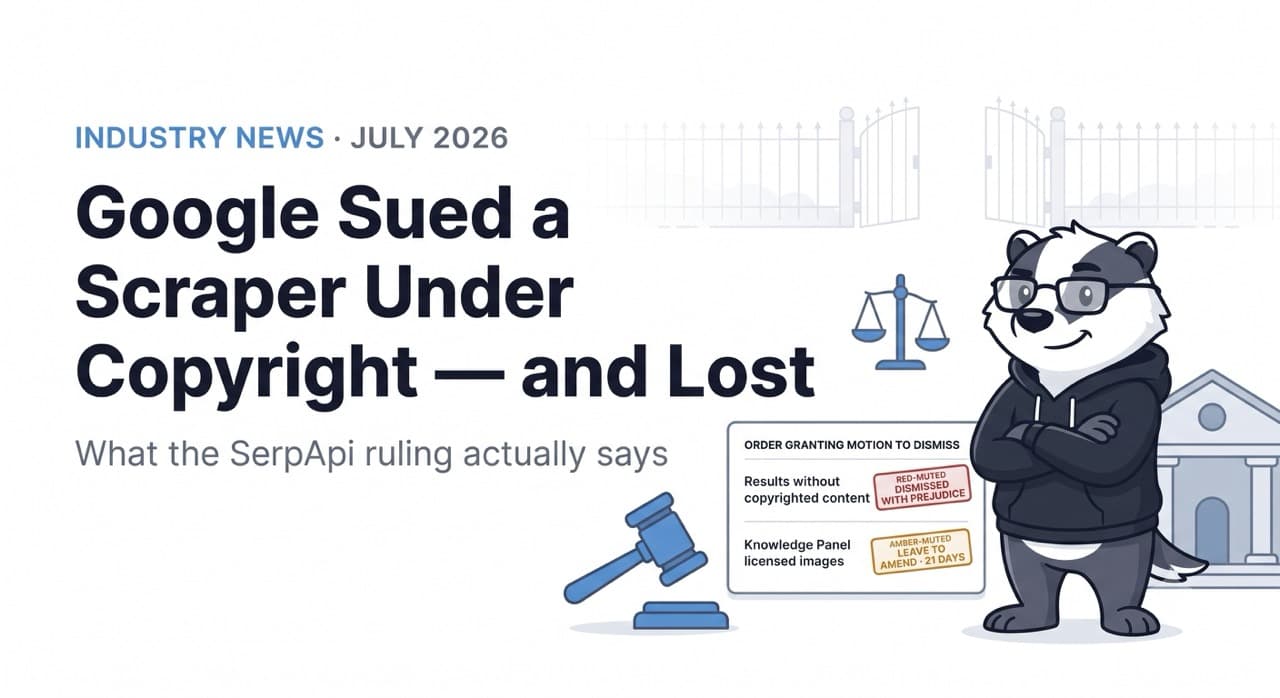
On July 20, 2026, a federal judge in California threw out Google's lawsuit against SerpApi — a roughly 40-person company that scrapes Google Search results and sells them through an API. Google had argued that bypassing its anti-bot system was a violation of the Digital Millennium Copyright Act, the same law written to stop people cracking DRM on DVDs. Chief Judge Yvonne Gonzalez Rogers disagreed, and part of her ruling kills that theory permanently.
The reaction online has been loud and, in places, wrong. So before the takes: what the court actually held, why Google reached for copyright law in the first place, and why a company that built a trillion-dollar business by crawling everyone else's content trying to use copyright to stop someone crawling its own is worth sitting with for a minute.
What the Court Actually Held
Google filed suit on December 19, 2025 in the Northern District of California, alleging SerpApi had run billions of automated queries that evaded "SearchGuard," Google's anti-scraping technology. The claim was not ordinary copyright infringement. It was DMCA Section 1201 — the anti-circumvention provision — which makes it illegal to bypass a technological measure that controls access to a copyrighted work. With statutory damages available per act of circumvention and billions of queries alleged, the exposure was existential for a company that size.
SerpApi moved to dismiss in February. The judge heard argument in May. On July 20 she granted the motion, and the details matter because the two halves of the ruling landed very differently.
Bucket one: search results containing no copyrighted content. Dismissed with prejudice — meaning permanently, as a matter of law. Section 1201 protects access controls that guard a copyrighted work. Where a search result contains no copyrighted work, there is nothing for SearchGuard to be controlling access to in the copyright sense, so the claim fails at the root. Google cannot replead this. That is the part of the ruling with real precedential weight.
Bucket two: results containing licensed images, such as those in Knowledge Panels. Dismissed too, but with leave to amend. Here the problem was authority. Section 1201(a)(3)(B) requires that a protective measure operate with the authority of the copyright owner. Google doesn't own those licensed images — third parties do. And Google pleaded no facts showing those owners authorized Google to deploy SearchGuard on their behalf. Google argued its display licenses implied that authority; the court wasn't persuaded, because Google never pleaded the terms of those agreements. Citing the Ninth Circuit's Blizzard decision, the judge noted a valid access control has to be put in place by the copyright owner or with that owner's authority.
Two more findings are worth flagging, because they cut to what SearchGuard actually is. The court observed that Google's own complaint described search results as a mixture of copyrighted and non-copyrighted material — a general-purpose gate over a mixed bag, not a lock on a specific protected work. And it found SearchGuard's function is to regulate automated access rather than to protect copyrighted works.
SerpApi's lawyers had made that argument vividly in their motion: the lock has to be on the book, not the building. A general anti-bot system guarding all of google.com doesn't become a copyright measure just because some licensed images happen to sit somewhere inside. Congress passed Section 1201 to stop what the legislative history calls <cite index="28-1">"the electronic equivalent of breaking into a locked room"</cite> to take a copy of a book. Fencing a public beach is not that, even if there's a towel on the sand.
Google has 21 days to amend the Knowledge Panel claim. The case isn't formally over. But the broad theory — that an anti-bot system is a DMCA access control over search results generally — is finished in this court.
Why Google Reached for Copyright Law
To understand why this matters beyond one lawsuit, you have to understand why Google used this statute at all.
Platforms have been losing the other arguments. hiQ Labs v. LinkedIn established in the Ninth Circuit that scraping publicly available data doesn't violate the Computer Fraud and Abuse Act — the "unauthorized access" theory that used to be the go-to weapon. Terms-of-service claims are contract claims: state-law, weaker remedies, messier to enforce at scale. Straight copyright infringement is awkward when the material is largely factual, public, and often owned by someone else entirely.
So platforms started reaching for DMCA Section 1201 instead. It's federal, it carries statutory damages, and it sidesteps the need to prove infringement of any particular work — you just need a "technological protection measure" and someone getting around it. Reddit ran the same play, moving from state TOS claims against Anthropic in 2024 to federal DMCA claims in its October 2025 suit against SerpApi and others.
This is what Google was really attempting: to establish that putting a bot detector in front of a public webpage converts that page into protected content. Had it worked, the implications would have gone far past search results. Any site with an anti-bot system — which is to say most of the commercial web — could claim DMCA protection over material it doesn't own, and access itself becomes the thing copyright law protects. That is a genuinely different internet from the one we have.
The court declined to build it.
Now the Uncomfortable Part
Here's where I'll stop being neutral, because the irony deserves saying out loud.
Google exists because scraping was allowed.
Every part of that trillion-dollar business rests on a single foundational act: Google's crawlers visit websites they don't own, copy content they didn't create, store it in an index, and monetize access to it. Nobody at those websites signed a licensing deal. Nobody was asked. Larry Page and Sergey Brin didn't negotiate with the web — they crawled it, and the open architecture of the internet is the only reason that was possible.
The company built its empire on the principle that public information can be accessed, indexed, and built upon by anyone who shows up. Then it went to federal court to argue that a bot detector in front of its own public pages should count as copyright protection, over content that in many cases belongs to the very websites it crawled in the first place.
And that's precisely where it broke. Google lost the second half of this ruling because it doesn't own the material it was trying to protect. It couldn't show that the actual copyright owners — the people whose images appear in Knowledge Panels — ever authorized Google to stand guard over their work. The court effectively told Google it was asserting rights over other people's property.
Read the two facts next to each other. Google built a business by taking public content without asking. When someone did the same thing to Google, it argued that was a federal crime. The asymmetry isn't subtle, and SerpApi's motion said as much in February: their scraping isn't circumvention for the same reason Google's own scraping isn't.
I don't say this because Google is uniquely villainous. Every company that benefits from an open commons eventually gets tempted to close the door behind itself — Cloudflare, Amazon, Reddit and others are all working the same seam right now, adding tolls and legal theories on top of public information they aggregated from somewhere else. It's the standard lifecycle: benefit from the commons, then privatize your slice of it. What makes this case worth marking is that a court looked at the most successful beneficiary of the open web making that move, and said no.
What This Actually Means (And What It Doesn't)
I want to be careful here, because plenty of the commentary is overshooting, and overshooting is how people end up making bad decisions.
What it means. The strongest anti-scraping legal theory of the last two years just took a serious hit. The with-prejudice half of the ruling — no copyrighted content, no Section 1201 claim, as a matter of law — is a clean holding that other courts can look to. It confirms the direction hiQ pointed: putting a barrier in front of public information doesn't transform that information into something you own. For the scraping industry, the AI companies training and grounding on public data, the researchers, the price-comparison tools, the SEO platforms and everyone else building on public web data, a very large legal cloud got smaller.
What it does not mean. It does not mean scraping is now legal in some blanket sense. This ruling addressed one statute — DMCA Section 1201 — on one set of facts. Terms of service still exist and still create contract exposure. Copyright still protects actual creative works; scraping a page and republishing its articles wholesale is a different case with a different outcome. GDPR and other privacy law still govern personal data regardless of whether it's public. The hiQ CFAA reasoning is Ninth Circuit law, not universal. And it is worth noting that the court accepted, at the pleading stage, Google's allegation that SerpApi's product was designed to and did get around SearchGuard. The dismissal wasn't a finding that nothing happened — it was a finding that what happened isn't what this law covers.
There's also a practical signal in the split ruling that anyone running collection at scale should absorb: the claims that died permanently were the ones about plain, non-copyrighted results. The claims Google gets another shot at are the ones involving licensed images. The line the court drew is between public factual information and actual copyrighted content sitting inside a page. That distinction is worth building your collection practices around — take the data, leave the licensed media, don't republish other people's creative work.
Where It Goes From Here
Google has three weeks to amend. It may try to plead the licensing facts the court found missing, narrow the claim to Knowledge Panel images, appeal later, or quietly let it go. Any of those is plausible. Meanwhile the Reddit cases running on the same DMCA theory now have an unhelpful data point sitting in the same district, and every legal team that was drafting a Section 1201 scraping complaint this month is rereading this order.
The bigger picture is that the open web keeps winning these fights, narrowly and unevenly, one ruling at a time. hiQ held the CFAA line. This holds the DMCA line. Neither is permanent and both are being probed constantly, because the commercial incentive to enclose public data is enormous and growing as AI makes that data more valuable.
Which is, in the end, why a 40-person company in Austin refusing to fold against Google matters more than the docket number suggests. The precedent that public information stays public isn't maintained by principle. It's maintained by whoever is willing to go to court over it.
Reading the Primary Sources
I'd encourage anyone with a stake in this to read the actual documents rather than the summaries, including mine:
SerpApi CEO Julien Khaleghy's statement and the full court order (PDF) — the order itself is the primary source
Why DMCA claims against scrapers face long odds — useful background on the strategic shift to Section 1201
Nothing here is legal advice. I run a scraping company; I'm obviously not a neutral party, and I'm not a lawyer. If you're making decisions about your own collection practices, talk to one.
Quick Answers
Did Google lose the whole case? Not formally. The claims about search results containing no copyrighted content were dismissed with prejudice and are gone for good. The claims about licensed images in Knowledge Panels were dismissed with leave to amend, and Google has 21 days to try again with the facts the court said were missing.
Does this make scraping legal? No — it makes one specific legal weapon much weaker. DMCA Section 1201 can't be used to treat a general anti-bot system as copyright protection over public search results. Terms of service, actual copyright in creative works, and privacy law all still apply.
Why did Google lose the licensed-images part? Because Section 1201 requires an access control to operate with the authority of the copyright owner, and Google doesn't own those images. It never pleaded facts showing the owners authorized it to guard their work, and the court refused to infer that authority from display licenses whose terms Google never described.
What's the practical takeaway for anyone collecting data? The court drew its line between public factual information and actual copyrighted content inside a page. Collect the data; don't lift licensed media; don't republish other people's creative work wholesale. That's roughly where the law is pointing.
Related Reading on the ScrapeBadger Blog
If you work with Google Search data, these go deeper on the practical side:
ScrapeBadger's Google SERP API — structured Google Search, AI Overviews, Maps, News, Shopping, Trends, Scholar, Flights and more
Google AI Mode vs AI Overviews vs Gemini: what each one is and how to get data from each
The ScrapeBadger MCP server — every endpoint exposed as native tools to Claude, Cursor and other AI agents
Free trial at scrapebadger.com — 1,000 credits, no credit card. Docs at docs.scrapebadger.com.

Written by
Domas Sakavickas
Dom Sakavickas is Co-founder of ScrapeBadger, building web scraping infrastructure for developers and data teams. He writes about the web data market, tool comparisons, and business use cases for scraping. ScrapeBadger is a web scraping API platform specialising in Twitter/X, Reddit and Google data, with dedicated scrapers also covering TikTok, YouTube, LinkedIn, Amazon, eBay, Zillow and 40+ more: with built-in anti-bot bypass and an MCP server for AI agents.
Ready to get started?
Join thousands of developers using ScrapeBadger for their data needs.