How Brands Use Amazon Data to Win the Buy Box
 Domas Sakavickas
AI Summary: This article explains how brands use Amazon data to win the Buy Box that drives roughly 82% of sales, arguing that ownership is a systematic performance-management problem across fulfillment, seller metrics, and price rather than simple price cutting.
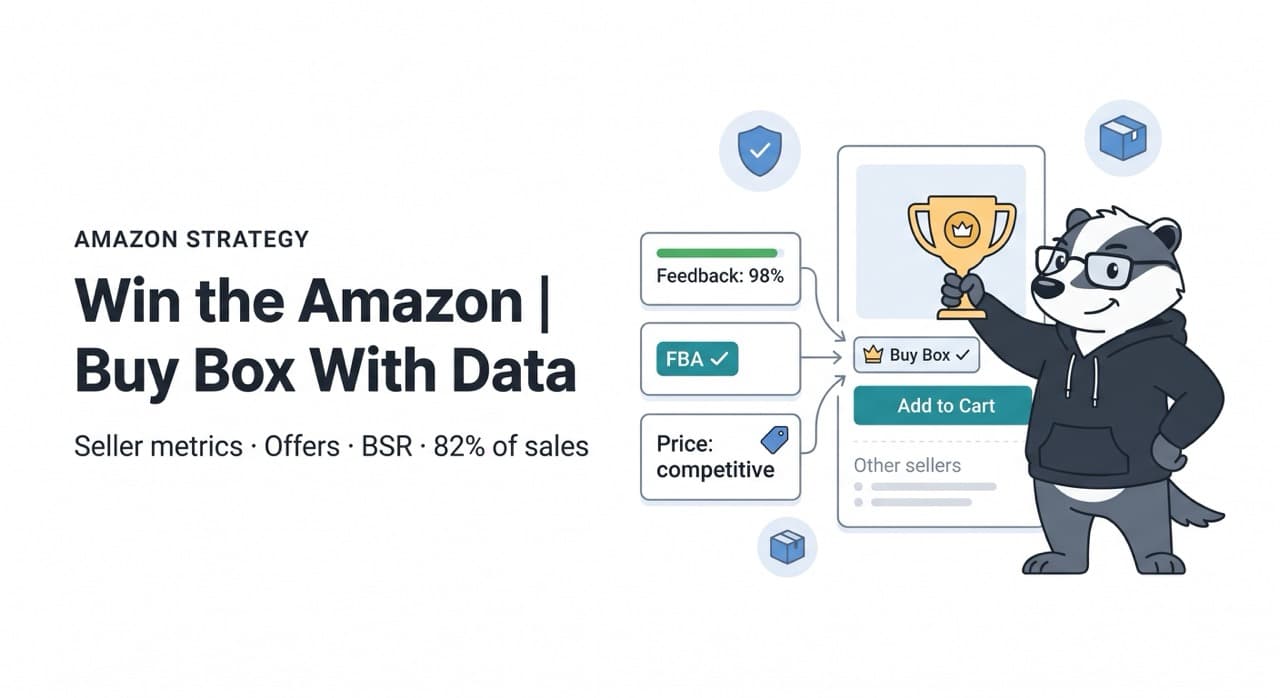
Roughly 82% of Amazon sales go through the Buy Box. On mobile, the number is higher. On most product pages, there is no visible path to purchasing from any other seller — the default Add to Cart button belongs to whoever owns the Buy Box, and everyone else is a scroll and a click away that most customers never take.
That number — 82% — explains why Amazon sellers and brands obsess over Buy Box ownership in a way that seems disproportionate until you run the math. If your product generates $500,000 in annual Amazon revenue and you own the Buy Box 60% of the time, you are leaving approximately $170,000 per year on the table compared to 100% ownership. The economics of Buy Box strategy are not marginal. They are material.
What most teams get wrong is treating Buy Box optimisation as a pricing problem. Price is one factor. It is not the only factor, and for brands with strong seller metrics, it is often not even the dominant factor. Understanding the Buy Box algorithm — and which data inputs it weights — changes the strategy from price cutting to systematic performance management.
How Amazon's Buy Box Algorithm Works
Amazon does not publish the Buy Box algorithm. What is understood comes from seller data, third-party analysis, and pattern observation across thousands of accounts. The factors that consistently emerge:
Fulfillment method. FBA (Fulfilled by Amazon) carries a significant trust premium over FBM (Fulfilled by Merchant). Amazon's algorithm weights delivery reliability heavily, and FBA inherits Amazon's own delivery guarantee. A seller offering the same product at the same price wins the Buy Box more consistently with FBA than FBM in the majority of categories.
Seller feedback score. Amazon measures seller feedback over 30-day, 90-day, and lifetime windows. Scores above 95% positive are considered competitive. Scores below 90% actively disadvantage Buy Box eligibility. This is not the product's star rating — it is the seller's service rating from buyer feedback.
Price competitiveness. Amazon evaluates your price relative to the "landed price" — product price plus shipping cost. Price needs to be competitive but does not need to be the lowest. A seller with a 98% feedback score and FBA fulfillment can price moderately above competitors and still win the Buy Box because algorithm weighting across other factors compensates.
Inventory availability. Being in stock is a prerequisite. Frequent stockout events reduce Buy Box eligibility over time, even after restocking. Amazon's algorithm penalises unreliable availability because stockouts create poor customer experience.
Order defect rate, cancellation rate, and late shipment rate. For FBM sellers, these operational metrics feed directly into Buy Box scoring. A seller cancelling 3% of orders is approaching the threshold where Buy Box eligibility becomes compromised.
Competitive offer count. When fewer sellers are competing for the Buy Box on a product, the algorithm has less choice and winning becomes easier. For private label brands, owning the only or primary offer on an ASIN simplifies Buy Box ownership substantially.
The Data Inputs That Drive Strategy
Understanding the algorithm factors tells you what to measure. Measuring them systematically — across your own ASINs and competitor ASINs — turns Buy Box management from reactive firefighting into proactive strategy.
Your Own Seller Metrics
ScrapeBadger's seller profile endpoint returns your seller feedback summary including positive, neutral, and negative percentages across 30-day, 90-day, and lifetime windows. Running this weekly creates the trend visibility that Amazon Seller Central provides but does not alert on — you see whether your feedback score is trending toward a threshold that will affect Buy Box eligibility before it gets there.
As covered in the ScrapeBadger Amazon seller data guide, the seller feedback endpoint also returns individual buyer feedback entries. Negative feedback with recurring themes — shipping delays, wrong item, condition issues — identifies operational problems before they compound into score degradation significant enough to cost Buy Box ownership.
Competitor Offer Monitoring
ScrapeBadger's product offers endpoint returns every seller currently listing on an ASIN — their price, fulfillment method, seller rating, and Buy Box status. Running this daily on your key ASINs gives you the competitive offer landscape the algorithm is evaluating when it assigns the Buy Box.
The intelligence this produces:
Who is winning the Buy Box and why. If a competitor with a lower price is winning the Buy Box while your higher price is not, the algorithm is weighting another factor in their favor — likely FBA versus your FBM, or a stronger seller feedback score. The offer data shows you which seller is winning and at what price point, but the deeper intelligence is in the other fields — fulfillment method and seller metrics.
When to price-match versus when to improve metrics. If the Buy Box winner has better fulfillment metrics and a competitive price, cutting your price alone will not win the Buy Box. The correct intervention is addressing the fulfillment gap. If the Buy Box winner has identical metrics but a slightly lower price, price is likely the tiebreaker. The offer data distinguishes these scenarios.
New entrant alerts. A new seller appearing on one of your key ASINs, particularly a seller with high metrics and FBA fulfillment, is a competitive threat to Buy Box ownership that requires immediate strategic assessment. The Amazon price tracker tutorial on the ScrapeBadger blog covers the change detection pipeline that surfaces these new entrants within hours of them appearing.
BSR as a Buy Box Proxy Signal
Best Sellers Rank does not directly determine Buy Box eligibility, but BSR movement correlates with Buy Box ownership changes. A product whose BSR was improving but has suddenly plateaued or started declining, with no change in listing quality or marketing spend, often indicates that Buy Box ownership has shifted to a competitor.
ScrapeBadger's product detail endpoint returns the current BSR and the BSR history for a product. Tracking BSR alongside Buy Box ownership data — stored in the same database, compared on the same timeline — creates the signal correlation that makes diagnostic work faster when something changes.
The Buy Box Strategy Framework by Seller Type
Brand Owners Selling Direct
For brand owners who are the sole or primary seller on their ASINs, Buy Box strategy simplifies considerably — there is no multi-seller competition, and the primary objective is maintaining the metrics that Amazon requires for eligibility. FBA fulfillment, strong feedback management, and consistent inventory availability cover most of the algorithm requirements.
The data work here is monitoring seller metrics regularly, collecting all buyer feedback entries to catch emerging issues before they affect scores, and tracking inventory levels relative to sales velocity to prevent stockout events.
Brands Managing Authorized Resellers
The more complex scenario: a brand has authorized multiple resellers on their ASINs, and Buy Box ownership rotates among them based on price and metrics. The brand wants to win the Buy Box — or ensure their highest-margin channel partner wins it — without triggering a race to the bottom on price.
Offer data monitoring across all authorized ASINs shows exactly which resellers are winning the Buy Box at any given time, at what price, and with what margin for the brand. This intelligence feeds channel management decisions — resellers consistently winning the Buy Box at prices that compress brand margins get different treatment than resellers who maintain pricing discipline and earn the Buy Box at healthy price points.
Third-Party Sellers on Competitive ASINs
For resellers competing on ASINs they do not own, Buy Box strategy is primarily a metrics and pricing game. The offer endpoint shows the current competitive landscape. The key data question is: what is the minimum price at which a seller with your metrics profile wins the Buy Box, given the current competitive offer set?
This question cannot be answered precisely from data alone — the algorithm has undisclosed weightings. But offer data monitoring over time builds an empirical model: at what price have you historically won and lost the Buy Box, given different competitive configurations? That empirical model, built from stored offer observations, gives more actionable guidance than any algorithmic theory.
Putting It Into Practice
The brands winning the Buy Box consistently in 2026 are not guessing at the algorithm. They are running systematic data collection across three levels — their own seller metrics, the competitive offer landscape on their ASINs, and BSR trends as a validation signal — and making operational decisions based on what the data shows rather than what internal intuition suggests.
ScrapeBadger's Amazon Scraper covers all three levels through the seller, offers, and product detail endpoints. Zero credits charged for failed requests. All 20 Amazon marketplaces supported with country-matched residential proxies. Full documentation at docs.scrapebadger.com/amazon/overview. Free trial at scrapebadger.com/amazon-scraper.

Written by
Domas Sakavickas
Dom Sakavickas is Co-founder of ScrapeBadger, building web scraping infrastructure for developers and data teams. He writes about the web data market, tool comparisons, and business use cases for scraping. ScrapeBadger is a web scraping API platform specialising in Twitter/X, Reddit and Google data, with dedicated scrapers also covering TikTok, YouTube, LinkedIn, Amazon, eBay, Zillow and 40+ more: with built-in anti-bot bypass and an MCP server for AI agents.
Ready to get started?
Join thousands of developers using ScrapeBadger for their data needs.