How Brands Use Twitter Intelligence to Stay Ahead of Customer Complaints
 Domas Sakavickas
AI Summary: With crisis narratives now hardening within roughly two hours and persisting in AI search results, this guide explains how brands use real-time Twitter intelligence to catch complaints early and contain them before they cross-post and set the permanent public record.
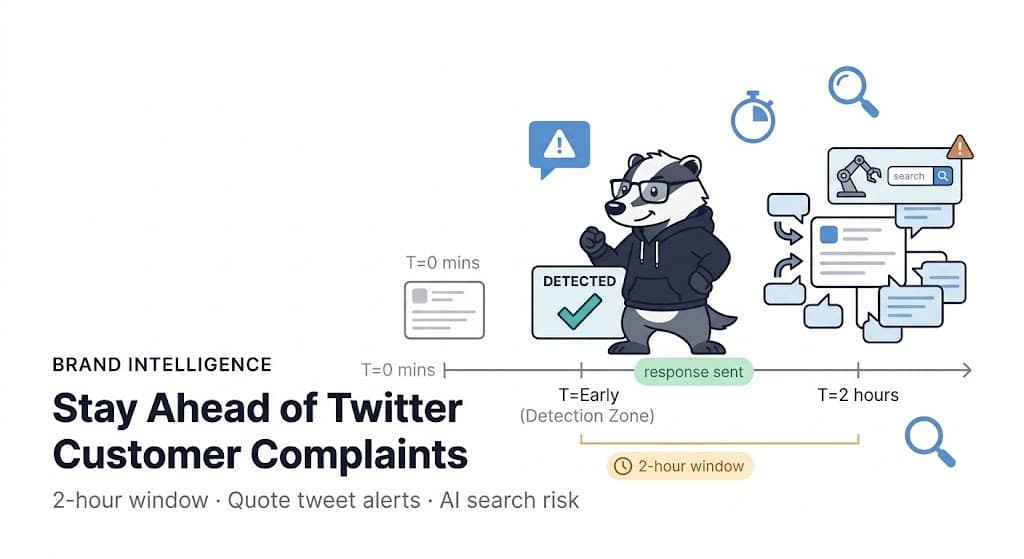
The 2-hour rule defines modern Twitter crisis management: in 2026, the window between a crisis starting and the public narrative being set is roughly two hours. In 2020, a 24-hour response was considered prompt. The timeline has compressed by more than 90%.
The compression happened because of three structural changes to how Twitter complaint dynamics work in 2026.
First, cross-platform amplification is faster and more automatic. A complaint that gains traction on Twitter gets screenshotted and shared to LinkedIn within the hour, cross-posted to relevant Reddit communities by the evening, picked up by newsletters and aggregators by the next morning. What starts as a Twitter complaint does not stay on Twitter.
Second, AI search has made complaint permanence significantly worse. A viral negative thread on Twitter doesn't just reach Twitter users. It gets cited in ChatGPT responses, Perplexity answers, and Google AI Overviews for months afterward. A brand that fails to contain a complaint narrative on Twitter in 2026 is not just managing a social media moment — they are managing a search result that will appear when potential customers research them for the next six to twelve months.
Third, the audiences have changed. A complaint from a mid-size account (10,000–100,000 followers) used to matter only if that account had genuine influence in your category. In 2026, any account with a coherent, credible-sounding complaint can reach decision-makers in your customer base through algorithmic amplification before you have even seen the original post.
Brands that stay ahead of this environment are not responding faster to crises they discover late. They are building detection infrastructure that surfaces relevant complaints before they compound — and they are using ScrapeBadger's Twitter Scraper as the data layer that makes that detection systematic rather than manual.
The Twitter Complaint Dynamics That Make It Different From Reddit
Understanding Twitter's specific complaint mechanics is necessary for building the right monitoring response.
The Untagged Complaint Problem
Most complaints on Twitter do not tag the brand's official handle. A customer who tweets "the [Brand] app keeps crashing and support has been completely useless" is publicly complaining to their followers. The brand never gets a notification. The tweet is not in the brand's mentions feed. It accrues retweets and replies from people who follow the complainer, none of which reach the brand automatically.
This is the structural problem that makes Twitter complaint monitoring different from traditional social media management. The tools built around monitoring your mentions — the native Twitter notification system, basic social media management tools that track mentions of your handle — systematically miss the most authentic complaints because authentic complaints do not tag the brand.
A Twitter search for your brand name, product name, and common misspellings — without the @ — surfaces the complaints that your mentions feed will never show you. This search-based detection is where the monitoring gap is, and it requires proactive querying rather than reactive notification processing.
The Quote Tweet Amplification Mechanism
Twitter's quote tweet function allows any user to add their own commentary to another person's tweet, publishing both together to their own audience. A complaint with 50 original retweets can become a viral brand story if someone with 200,000 followers quote-tweets it with their own perspective. The original complaint becomes one component of a new post that reaches a much larger audience.
The amplification is asymmetric: negative commentary generates higher engagement than positive commentary on most platforms, and Twitter's recommendation algorithm amplifies high-engagement content. A quote-tweeted complaint that is gaining engagement gets recommended to accounts who follow neither the original tweeter nor the quote-tweeter, creating organic distribution that compounds beyond any network you could manually monitor.
Tracking quote tweets on high-engagement complaints is a distinct monitoring requirement from tracking mentions or direct complaints. A brand monitoring system that does not check for quote tweet amplification on their key complaint conversations is missing a significant portion of the narrative about them.
The Reply Chain as Public Service Record
When a brand responds to a complaint on Twitter, the entire conversation — the original complaint, the brand's response, the customer's follow-up, and any third-party commentary — is visible to anyone who reads the original tweet. There is no private resolution of a public Twitter complaint. The resolution, or lack of it, becomes part of the public record attached to the original post.
This creates both a risk and an opportunity. A brand that responds to a complaint with acknowledgement, specific action, and genuine resolution turns the original complaint thread into a demonstration of responsive customer service — visible to everyone who reads the original post, permanently. A brand that responds defensively, dismissively, or not at all leaves a different permanent record.
The monitoring system must include reply chain tracking on complaints that warrant a response, both to manage the ongoing conversation and to ensure the public record reflects the resolution rather than only the complaint.
The 2-Hour Narrative Window
The reason detection speed matters so much on Twitter is not that complaints grow continuously from zero to crisis — it is that the narrative around a complaint gets established quickly and is difficult to change once set.
A complaint that receives genuine acknowledgement and a resolution path within two hours develops a different comment thread trajectory than the same complaint left unaddressed for six hours. The first scenario: the original post shows the complaint followed by a brand response, followed by the customer confirming the response was helpful, followed by a few comments noting the brand handled it well. The second scenario: the original post accumulates comments agreeing with the complaint, people sharing similar experiences, escalating frustration at the lack of response, and eventually someone noting that the brand does not care.
Both conversations are now permanent. The difference is that the first is a demonstration of good service; the second is documented evidence of failure.
What Twitter Monitoring Actually Requires
The monitoring infrastructure that addresses these dynamics has three components.
Component 1: Brand Mention Search (Untagged)
A continuous or near-continuous search across Twitter for your brand name, product names, key personnel names, and common misspellings — without the @ symbol. This surfaces the untagged complaints that do not appear in your mentions feed.
Running this search every two hours provides detection within the response window for most complaint trajectories. Running it every thirty minutes provides detection before the amplification cycle can begin on high-engagement complaints.
The search queries that work in practice are broader than most teams expect. Your brand name alone is necessary but not sufficient. Common abbreviations, competitor comparisons ("switched from [Brand]"), category terms plus your brand ("web scraping [Brand] broken"), and product-specific terms all surface relevant complaints that a brand-name-only search misses.
Component 2: Reply Chain and Quote Tweet Monitoring
For any complaint that has been detected and meets an engagement threshold — typically five or more retweets or fifty or more likes — actively monitor for reply chain developments and quote tweet activity.
A complaint gaining engagement is actively being discussed. New reply perspectives, quote tweets from accounts with larger audiences, and any response activity from the brand's own account all need to be tracked. This is not a one-time detection — it is ongoing monitoring of a specific conversation until it resolves or fades.
ScrapeBadger's Twitter Scraper covers tweet replies and quote tweet collection. The Twitter research agent built with ScrapeBadger's MCP tools can monitor a specific high-engagement complaint conversation — tracking reply development, sentiment shift, and amplification activity — as a scheduled workflow that reports changes rather than requiring manual checking.
Component 3: Influencer and Journalist Amplification Alert
A complaint from a mid-size account carries different risk than the same complaint from a verified journalist, an industry analyst, or an account with 500,000 followers. The follower count and account type of the original complainer should adjust the urgency tier of the response.
This requires combining tweet detection with account profile data — pulling the follower count and verified status of the account that posted the complaint to determine the appropriate response priority. A complaint from an account with 500 followers warrants monitoring. A complaint from an account with 50,000 followers warrants immediate response. A complaint from a verified journalist warrants executive awareness within the hour.
The Twitter user profile data that ScrapeBadger returns for any account includes follower count, verified status, and bio text — enough context to implement automatic urgency tiering without manual review of every detected complaint.
The Complaint Severity Classification Framework
Not every negative tweet is a complaint worth acting on. A classification framework prevents alert fatigue while ensuring nothing genuinely important is missed.
Severity 1 — Immediate response required (within 2 hours): Any negative mention from an account with 10,000+ followers. Any negative mention that has received 50+ retweets or 200+ likes within the first two hours. Any mention from a verified journalist or industry publication. Any complaint about safety, legal liability, or data privacy. Any complaint that matches a known product issue currently under investigation internally.
Severity 2 — Same-day response warranted: Complaints from accounts with 1,000–10,000 followers. Negative mentions with 10–49 retweets. Complaint threads with 5+ replies including confirming experiences from other users. Any complaint where the brand is tagged by three or more separate accounts in a 24-hour window on the same topic — this cluster pattern indicates a systemic issue, not a single customer experience.
Severity 3 — Monitor and route: Single complaints from accounts with under 1,000 followers showing no amplification. Complaints that appear resolved without brand intervention (customer answered by another user, or customer edited the post to indicate resolution). Negative sentiment without a specific actionable complaint.
Not a complaint — informational: Category discussion that mentions your brand neutrally. Competitor comparisons where your brand is the preferred option. Customer-to-customer support exchanges. These are monitored for intelligence but do not require a service response.
The Monitoring Gap That AI Search Has Created
One dimension of Twitter complaint monitoring has changed materially in 2026 and is not yet well-understood by most brand teams: the AI search citation problem.
A viral negative Twitter thread in 2026 does not fade when it leaves the trending topics. It gets indexed, cited, and quoted in AI-generated search results. When a potential customer asks an AI assistant "is [Brand] reliable?" or "what are [Brand]'s complaints?", the AI's response draws on publicly available web content — including tweets, Twitter threads, and screenshot collections that circulated during a complaint storm.
A complaint narrative that a brand failed to contain on Twitter can continue to affect consideration for months, appearing in AI-generated responses to research queries from potential customers who never saw the original Twitter discussion. This makes the 2-hour response window even more consequential: a complaint narrative that is not corrected in the original thread is more likely to be captured as a permanent signal in AI search indexes.
The implication for monitoring strategy: every high-engagement complaint thread where the brand has responded well should be treated as an asset, not just a resolved incident. The public thread showing the complaint, the brand's acknowledgement, the resolution, and the customer's positive follow-up is the counter-narrative that AI search systems will also index. Ensuring that positive resolution threads exist and are substantive protects against the negative citation risk.
The Response Playbook for Twitter Complaints
Detection without a response framework produces a team that knows complaints exist but does not know what to do with them. The response approach varies significantly by complaint type.
Product failure complaints — where the customer is describing a genuine malfunction, defect, or service failure — require direct acknowledgement and a clear next step. The response that converts a detractor into a neutral or advocate: acknowledge the specific problem they described (not a generic "we're sorry for the inconvenience"), explain what will happen next (support ticket, replacement, investigation), and give a timeline. "We're sorry your [product] is experiencing this. We're DM-ing you now to arrange a replacement — this shouldn't happen and we want to make it right" does more for the public thread than a support portal redirect.
Policy or pricing complaints — where the customer is frustrated with a company decision rather than a product failure — require a different approach. Acknowledging the frustration without retreating from the policy is the calibration to hit. "We understand this change is frustrating. The reason behind it is [X], and here's what we're offering customers who are affected" is honest and maintains the policy while showing the customer was heard. Defensive responses explaining why the policy is justified produce worse outcomes than empathetic acknowledgements.
Comparison complaints — where the customer is publicly considering switching to a competitor — are the highest-stakes complaint type. The customer has already done the work of deciding to evaluate alternatives. A public response that provides a specific reason to reconsider — a feature they may not know about, an upcoming improvement relevant to their stated frustration, or a concrete offer — has a chance of changing the outcome. A generic "we'd love to help" response does not.
The response channel decision: Severity 1 complaints warrant a public reply in the thread — this makes the brand's engagement visible to the audience who saw the complaint. Following up with a DM to resolve the details is standard. Severity 2 complaints can often be handled via DM, with a brief public acknowledgement in the thread directing the customer to DM. Severity 3 complaints that are genuinely idiosyncratic can sometimes be handled via DM only, but erring toward a brief public acknowledgement is lower risk.
The permanent record consideration applies to every response: the public thread showing your response will be visible indefinitely. Write responses as if the audience is every future potential customer who will read the thread while evaluating your brand — because that is exactly who will read it.
Building the System With ScrapeBadger
The Twitter complaint monitoring system described above uses ScrapeBadger for three distinct data needs.
Complaint detection uses the Twitter search endpoint — cross-Reddit keyword search over your brand terms, running on a two-hour cycle, routing detected posts to a severity classification layer.
Amplification monitoring uses the tweet replies and quote tweets endpoints — triggered on any complaint meeting a severity threshold, running on a 30-minute cycle while the complaint is active.
Account intelligence uses the Twitter user profile endpoint — fetching follower count, verified status, and bio for any account that posts a Severity 1 or Severity 2 complaint.
Combined with the Reddit brand monitor already covered in this series, the full social intelligence stack covers both the real-time Twitter environment and the slower-moving but longer-lasting Reddit amplification channel. Both are necessary — as covered in the Reddit customer complaints guide, Reddit and Twitter serve different complaint amplification roles and require different detection timing and response strategies.
The ScrapeBadger MCP integration enables AI agents to run complaint analysis as a continuous background process — detecting, classifying, enriching with account data, and routing to the appropriate response team without requiring a human to perform the initial detection work. Full documentation at docs.scrapebadger.com. Free trial at scrapebadger.com — 1,000 credits, no credit card.

Written by
Domas Sakavickas
Dom Sakavickas is Co-founder of ScrapeBadger, building web scraping infrastructure for developers and data teams. He writes about the web data market, tool comparisons, and business use cases for scraping. ScrapeBadger is a web scraping API platform specialising in Twitter/X, Reddit and Google data, with dedicated scrapers also covering TikTok, YouTube, LinkedIn, Amazon, eBay, Zillow and 40+ more: with built-in anti-bot bypass and an MCP server for AI agents.
Ready to get started?
Join thousands of developers using ScrapeBadger for their data needs.