How to Use Amazon Data for Competitive Intelligence Beyond Just Pricing
 Domas Sakavickas
AI Summary: Using ScrapeBadger's Amazon API, this guide shows how to move past commoditized price monitoring by mining BSR rank shifts, review-documented operational weaknesses, subcategory entries, and international market presence, so teams build real competitive advantage instead of racing repricing bots to the bottom.
Every serious Amazon seller has price monitoring. Most have some version of Buy Box tracking. The result is a category where everyone knows what everyone else is charging within a few hours, and the competitive response is automatic repricing that drives margins down until someone blinks or exits.
Pricing intelligence is table stakes. It is necessary and it is not sufficient.
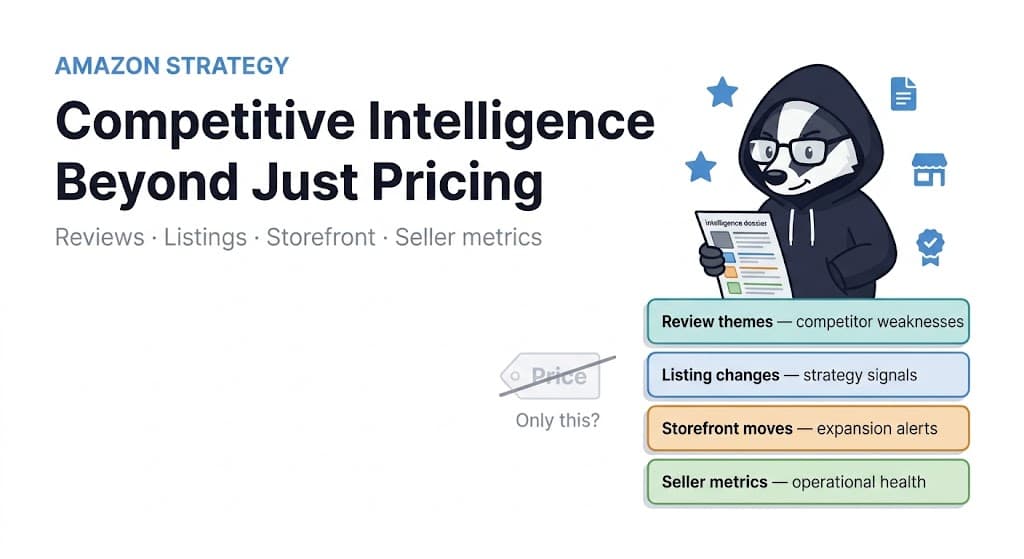
The teams that build genuine competitive advantage on Amazon are using the platform's data to answer questions that a price monitoring dashboard cannot. Why is a competitor gaining BSR rank even when they are not the cheapest option? What are the specific operational weaknesses documented in their customer reviews? When did they enter a new subcategory, and what does their current inventory signal about their upcoming moves? Which markets are they winning outside the US, and where are they not yet competing?
The data to answer all of these questions is on Amazon, publicly accessible, and available through ScrapeBadger's Amazon Scraper. This guide covers the intelligence dimensions that most teams are not looking at.
BSR as a Revenue Proxy Without Direct Sales Access
Amazon does not publish competitor sales volumes. For external competitive intelligence, Best Sellers Rank is the closest publicly available proxy.
The raw BSR number tells you a product's relative position in its category today. The business intelligence value is in what BSR movement over time reveals about sales trajectory.
A product improving from BSR 4,000 to BSR 1,500 over 30 days is experiencing significant sales acceleration. A product stable at BSR 800 for three months has consistent, sustained demand. A product declining from BSR 1,200 to BSR 3,800 over 60 days is losing velocity — possibly from stockouts, quality issues, increased competition, or changing demand. None of these trajectory signals are visible in a price monitoring dashboard.
The conversion formula between BSR and estimated monthly sales varies by category and is imprecise — the relationship is non-linear and category-specific. The directional intelligence is nonetheless valuable. A competitor whose BSR rank has improved consistently for 90 days while their price has remained stable is gaining share through a non-price factor. The intelligent response is to identify that factor — is it their review count growing past a critical threshold, a listing optimisation they made, a bundling change, or a fulfillment upgrade that improved delivery estimates? The BSR trend surfaces the question; the other data streams answer it.
BSR also reveals product lifecycle stage at a granularity that no other public Amazon data provides. A product sitting at a stable BSR position for two years is mature. A product that was BSR #150 eighteen months ago and is now BSR #2,800 is declining. A product that launched six months ago and reached BSR #500 is gaining. Knowing the lifecycle stage of your key competitor products determines whether you are entering a growing, mature, or declining competitive dynamic.
ScrapeBadger's product detail endpoint returns the current BSR and primary category for any ASIN. Daily collection builds the time series that reveals trajectory — the single daily observation is almost useless; the 90-day trend is what generates intelligence.
New Releases as Competitive Entry Signal
Most Amazon sellers monitor what competitors are selling. Almost none systematically monitor what competitors are about to sell.
The new releases list — updated hourly by Amazon — shows recently launched products sorted by sales velocity within their launch period. When a direct competitor launches a new product, it appears in the new releases list for its category. The product's performance in its first 30–60 days on the new releases list predicts its mature BSR position with reasonable accuracy — products that launch into the top 20 of new releases typically stabilise in the top 500 of their category.
ScrapeBadger's new releases endpoint returns current new releases for any product category. Monitoring this weekly for your category surfaces competitor product launches within days of listing, provides early data on whether the launch is gaining traction, and identifies new entrants in your category before they have enough reviews to appear prominently in main category listings.
The intelligence application: a competitor launching a new product that is gaining immediate traction tells you three things simultaneously. They believe this product category has demand worth entering (market validation). They have production and supply chain capacity for new launches (operational intelligence). The specific product they chose tells you where they believe the unmet need is (strategic intelligence). All three insights are available before you would ever see the product in a standard competitor monitoring setup.
Why Pricing Intelligence Alone Is Insufficient
A concrete example illustrates the limitation.
Two sellers compete on identical Owala-style water bottles in the sports and outdoors category. Seller A runs a price monitoring system and reprices automatically to match or beat Seller B's price. The automatic repricing is technically functioning perfectly — every time Seller B moves, Seller A responds within hours.
Seller A's market share still declines over six months. Their BSR rank worsens. Their organic ranking drops. Their ad spend increases to compensate, compressing margins further.
The pricing intelligence system never surfaced the actual cause: Seller B had been collecting negative reviews about Seller A's bottle leaking after three months. Seller B used their review intelligence to reformulate their product and actively highlight leak-proof testing in their A+ content and listing copy. They also quietly expanded into three adjacent subcategories — insulated travel mugs, gym water bottles, and kids' water bottles — which increased their cross-catalogue visibility and boosted their overall seller metrics.
None of this was visible in a price monitoring dashboard. All of it was in Amazon's data.
The Intelligence Dimensions Worth Monitoring
Review Intelligence: Competitor Product Weaknesses as Your Product Roadmap
The most commercially valuable Amazon data for competitive intelligence that most teams ignore is competitor review data — specifically the negative reviews on competing products in your category.
A competitor with a 4.2-star average across 3,000 reviews contains, within that average, hundreds of documented product failures described in the customer's own words. The recurring themes in their one-star and two-star reviews are a publicly available product roadmap for any competitor who reads them.
The pattern to look for: negative review clustering. When 15% of negative reviews for a competing product mention the same specific failure — "the lid doesn't seal properly", "strap breaks after two weeks", "the finish scratches immediately" — that is a documented, community-validated weakness that the current market leader has not addressed. A competing product that explicitly addresses that weakness in its listing copy and A+ content has a positioning advantage that does not require being cheaper.
ScrapeBadger's Amazon reviews endpoint returns paginated reviews with rating, text, date, and verified purchase status for any public ASIN. Running this on the top five products in your category, applying simple keyword clustering to the negative reviews, and identifying the top three recurring complaint themes takes less than an hour with a basic pipeline. The intelligence — your competitors' documented operational weaknesses, in their customers' own words — is worth significantly more than the effort to collect it.
The review velocity dimension adds a second intelligence layer. A competitor whose review count is growing at 50 per month in a category where the average is 10 per month is experiencing significantly higher sales velocity than their BSR alone reveals. BSR is smoothed and can lag actual velocity. Review velocity is a leading indicator of sales momentum that price monitoring systems never surface.
Listing and A+ Content Intelligence
What a competitor says in their product listing is a window into their positioning strategy. Their bullet points, their title structure, their A+ content module selection, their lifestyle photography choices — all of these represent strategic decisions about how they believe their target customer makes purchasing decisions.
Monitoring competitor listings systematically — not manually checking once a year, but tracking changes over time — surfaces strategic moves before they produce measurable BSR impacts. When a competitor adds "tested to 50,000 seal cycles, guaranteed leak-free" to their bullet points, they are responding to the review complaints described above. They made a product improvement, validated it, and changed their messaging. You can see the strategic move in their listing data before you see it in their BSR trajectory.
Listing content changes also reveal marketing experimentation. A competitor who changes their main image, title structure, or primary keyword targeting is A/B testing their way to better organic conversion. Their changes are visible in the listing data before you see any impact in their rank.
ScrapeBadger's product detail endpoint returns the full listing data including title, bullet points, description, A+ content indicators, and main category. Running this on competitor ASINs weekly and storing the observations builds the change log that reveals when and how their strategy evolves.
Storefront Intelligence: Catalogue Expansion as Early Warning
A competitor's Amazon storefront is a complete catalogue map. It shows every product they are currently selling, across every category and subcategory they have entered. Monitoring storefront changes over time reveals strategic moves before they generate competitive pressure at the ASIN level.
A competitor whose storefront adds 30 new SKUs in a subcategory adjacent to your core category is entering your competitive space. This move is visible in their storefront data weeks before any of those new products have enough reviews or BSR rank to appear in your category monitoring. The ScrapeBadger Amazon seller storefront endpoint returns the full product listing for any seller across any marketplace — as covered in the ScrapeBadger Amazon seller intelligence guide on the blog, storefront monitoring is one of the three seller endpoints with the most direct competitive intelligence value.
The storefront expansion signal is particularly valuable for category expansion decisions. If you are considering entering a new subcategory and your main competitor has been steadily expanding their own storefront in that direction over the past six months, you have both confirmation that the subcategory is attractive (a sophisticated competitor validated it) and an earlier entry window if you move now rather than waiting.
Conversely, a competitor whose storefront shrinks — products being delisted or categories being abandoned — is a signal of their own operational constraints. They may be having supply chain issues, quality control problems, or profitability challenges in those categories. Filling the space they vacate is a real market opportunity, and storefront monitoring is the only way to detect the signal early.
Seller Performance Metrics as Operational Intelligence
Buyer feedback on a seller's performance is a different dataset from product reviews — and often more revealing about their operational health than anything visible in their listing.
A seller whose positive feedback percentage drops from 97% to 91% over 90 days, with recurring themes around "late delivery" and "item not as described", is experiencing operational degradation. This degradation will affect their Buy Box eligibility, their organic ranking, and their customer retention — but none of it is visible in price monitoring or listing analysis. It only appears in seller feedback data.
The intelligence value: a competitor experiencing operational degradation is vulnerable. Their price advantage, which they have been defending with automatic repricing, may be about to be overwhelmed by their service disadvantage. Their customers are already documenting the problem publicly. This is the moment to compete on fulfillment quality rather than price — and it is only actionable if you know about the degradation while it is happening rather than six months later when it has affected their metrics.
ScrapeBadger's seller feedback endpoint returns individual buyer feedback entries with rating, comment text, and date. Monitoring this weekly on your key competitors creates an early warning system for their operational health that no other monitoring approach provides.
Cross-Marketplace Geographic Intelligence
Amazon operates 20 distinct marketplaces across the world. A competitor's strategy, market position, and pricing in the UK may be completely different from their US position. They may dominate certain European markets while having minimal presence in others. They may be pricing aggressively in Germany while running premium positioning in France.
This geographic intelligence has two applications. The first is identifying markets where your competitor has not yet built strong presence — expansion opportunities where their brand recognition and review count advantages are lower than in their home market. The second is using their pricing and positioning in other markets as a signal of where their overall strategy is heading.
ScrapeBadger's Amazon Scraper covers all 20 marketplaces with country-matched residential proxies that ensure you are seeing the prices and listings that actual local customers see, not the prices Amazon shows to international visitors. Running the same competitor ASIN through five marketplace endpoints simultaneously produces the geographic intelligence picture that a single-market monitoring setup cannot provide.
Deals and Promotional Activity as Competitor Strategy Signals
When a competitor runs a lightning deal, they are making a deliberate strategic choice that tells you several things simultaneously: they have excess inventory to move, they want to accelerate review accumulation on a newer product, or they are trying to defend BSR rank during a slow period. All three of these motivations are strategically meaningful.
ScrapeBadger's deals endpoint returns all current lightning deals and promotional products across any category. Monitoring this daily across your product categories builds a picture of competitor promotional patterns that price monitoring alone cannot provide.
The specific signals worth tracking:
Deal frequency by seller: A competitor running lightning deals every two to three weeks is using deals as a systematic acquisition and velocity tool, not as a one-off inventory clearance. Their pricing strategy is built around promotional cycles. Your pricing and inventory strategy should account for these predictable promotional windows.
New products appearing in deals: A product in its first 90 days appearing in a lightning deal is almost certainly trying to accelerate initial review accumulation. When competitors use deals aggressively for new product launches, your own launch cadence needs to account for the fact that they are effectively subsidising their review acquisition.
Deal timing correlation with external events: Competitors who consistently run deals around Prime Day, major sports events, or category-specific seasonal peaks are optimising for high-traffic windows. Understanding these timing patterns lets you plan counter-scheduling — either competing for the same high-traffic window with your own promotional activity, or intentionally running promotions in the troughs when competition for deal visibility is lower.
Promotional pattern intelligence combined with pricing intelligence, review intelligence, and listing intelligence creates the full competitive picture. Price monitoring answers "what is their price right now?" Deal monitoring answers "when and how are they using price as a strategy tool?"
Building a Comprehensive Competitive Intelligence Stack
The full competitive intelligence stack on Amazon is not one dashboard. It is several data streams feeding different decision-making workflows.
Product development feed: Competitor negative reviews, clustered by theme, delivered weekly to the product team. Input: what should the next version or next product address?
Positioning intelligence feed: Competitor listing changes tracked over time, flagged when keywords, bullet points, or main images change. Input: how is their messaging evolving and what does that tell us about their strategy?
Expansion early warning: Competitor storefront changes monitored monthly. Flags when new categories are entered or abandoned. Input: where is the competitive pressure moving?
Operational health monitor: Competitor seller feedback tracked weekly for score trend and comment theme changes. Input: when is a competitor vulnerable?
Geographic opportunity map: Competitor presence across marketplaces assessed quarterly. Input: where are they not competing that we should be?
Price monitoring sits alongside all of this as the operational tactical layer. It answers "what should our price be right now?" The intelligence stack described above answers "what is our competitive position, where is it going, and what should we do about it?"
Teams that build both — operational price response plus strategic competitive intelligence — make better decisions than teams that build only one.
The ScrapeBadger Amazon Scraper documentation at docs.scrapebadger.com/amazon/overview covers all 14 endpoints used in the intelligence stack above. Free trial at scrapebadger.com/amazon-scraper — 1,000 credits, no credit card.

Written by
Domas Sakavickas
Dom Sakavickas is Co-founder of ScrapeBadger, building web scraping infrastructure for developers and data teams. He writes about the web data market, tool comparisons, and business use cases for scraping. ScrapeBadger is a web scraping API platform specialising in Twitter/X, Reddit and Google data, with dedicated scrapers also covering TikTok, YouTube, LinkedIn, Amazon, eBay, Zillow and 40+ more: with built-in anti-bot bypass and an MCP server for AI agents.
Ready to get started?
Join thousands of developers using ScrapeBadger for their data needs.