How to Use Reddit Data for Product Research Before You Build
 Domas Sakavickas
AI Summary: Using ScrapeBadger's Reddit API, this guide shows how to systematically read what target users say to each other in topic-specific communities before building, so product teams surface objections, adjacent problems, and price expectations while decisions are still cheap to change.
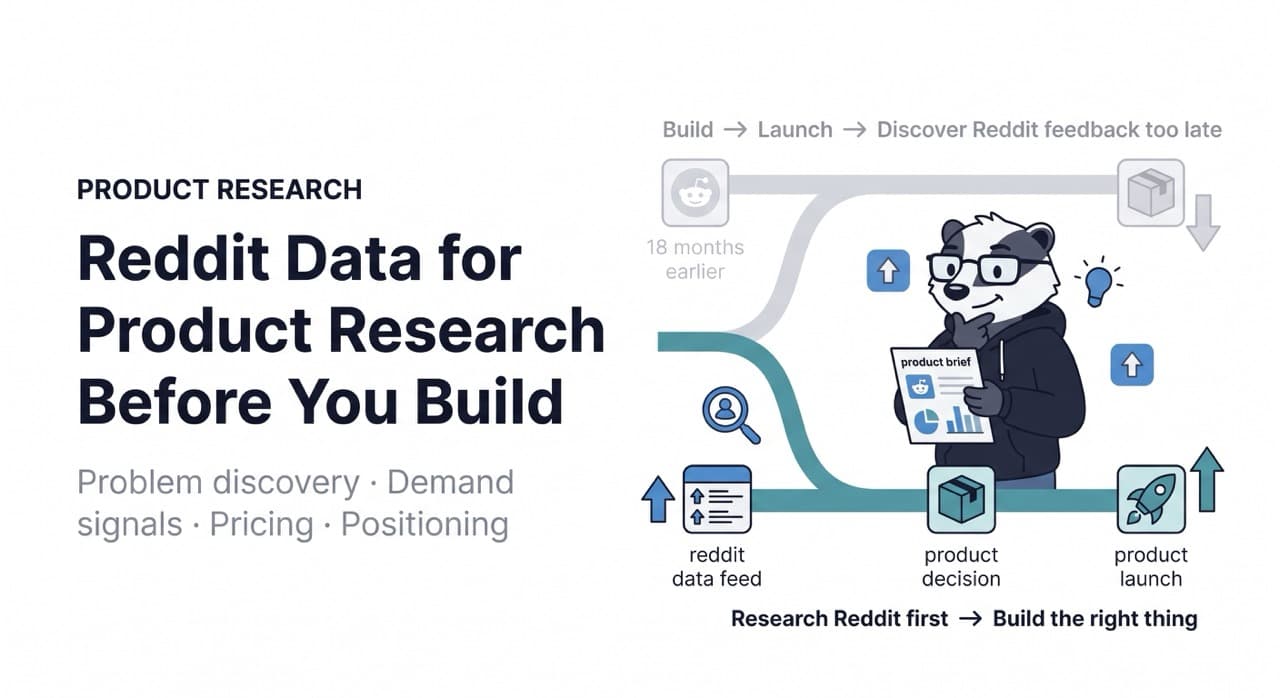
Most founders and product managers discover Reddit as a research tool too late. They build the product first. They launch. They watch the numbers disappoint. Then someone says "have you looked at what people are saying about this on Reddit?" and they discover, in a thread from eighteen months ago, that their exact product concept was discussed thoroughly — including the reasons why it would not work the way they had imagined, the adjacent problem that was actually more pressing, and the pricing point their target users were willing to pay.
The information was public. It was there before they started. It would have changed what they built.
This is not an argument that Reddit is infallible market research. It is an argument that a product team that has not systematically read what its target users say to each other, anonymously, in topic-specific communities, is making decisions with incomplete information that is freely available.
Why Reddit Is Different From Every Other Research Source
Surveys tell you what people say when they know they are being studied. Interviews tell you what articulate early adopters think. Sales calls tell you what people say when a vendor is listening. Customer support tells you what people experienced after they already bought.
Reddit tells you what people say when none of those dynamics apply. The anonymity is the data source. The candour that emerges when someone is not protecting a professional relationship, not performing for a researcher, and not filtering for politeness is qualitatively different from every other research input you have access to.
The voting system adds something no survey or interview provides: community validation. A post describing a specific problem, upvoted 800 times with 200 confirming comments, is not one person's frustration — it is a documented pattern endorsed by hundreds of people in the same situation. That signal density is irreproducible by any other research method at any comparable cost.
The community structure means the conversations are already pre-qualified for relevance. The people in r/personalfinance discussing budgeting tools are your target users if you build personal finance software. The people in r/devops discussing infrastructure pain points are your target users if you build developer tooling. You do not need to recruit them or screen them. They are already there.
The Five Research Use Cases
Use Case 1: Problem Discovery Before Solution Definition
The single most valuable Reddit research activity is reading subreddit communities in your target space without a specific hypothesis — looking for what problems come up repeatedly, how people describe them, and what language they use.
A team building a time management tool will find different things in r/productivity depending on whether they search for "time tracking" (their product concept) versus reading the community without a filter. The tool concept search confirms whether people discuss time tracking. The filter-free reading reveals whether what they actually talk about is task prioritisation, context switching, the difficulty of ending work at a fixed time, the challenge of managing collaborative projects with distributed teams, or something else entirely.
The gap between "the problem we assumed exists" and "the problem the community actually discusses" is where most product-market fit failures originate. Reddit closes that gap before development begins.
ScrapeBadger's Reddit Scraper covers keyword search across all of Reddit, subreddit feed collection, and post-with-comment extraction. The research workflow: identify the 5–10 subreddits where your target users congregate, collect the top posts from the last six months by upvote score, read the highest-engagement discussions, and note what problems get the most validation. This is qualitative research on a quantitative substrate — the upvote count tells you which problems the community considers most significant.
Use Case 2: Demand Validation Without a Landing Page
Before building a landing page to collect email signups and "validate" demand, there is a research signal available that requires no product and no outreach: are people on Reddit already asking for what you are considering building?
Searching Reddit for the problem your product solves — not the product category, but the problem description — reveals whether genuine unsolicited demand exists. Posts asking "is there a tool that does X", "does anyone have a way to automate Y", "how are other teams handling Z" are organic expressions of unmet demand. The absence of these posts in a community where your target users congregate is itself a signal worth examining.
Counting these posts and measuring their engagement is a rough proxy for market size that requires no survey infrastructure and no ad spend. Ten posts asking about a problem, each with 50+ upvotes and 20+ comments, is meaningfully different from zero posts. One post with two upvotes is also meaningfully different from ten with fifty.
Use Case 3: Incumbent Weakness Analysis
Before positioning your product, read what people say about the existing solutions they are using or have abandoned. The negative reviews on G2 and Capterra are curated — users know they are writing a review and moderate their language. Reddit complaints are not curated.
The specific pattern to look for: posts in your target subreddit that name a competitor, describe a frustration, and generate confirmation comments from other users with the same experience. These threads are a product roadmap. The complaint themes that appear repeatedly across multiple threads — not just one angry post — represent genuine, validated weaknesses in incumbents that a well-positioned alternative can exploit.
This analysis is available for any category where competitors exist and users are active on Reddit. It requires collecting posts mentioning competitor names in relevant subreddits and reading the sentiment and comment structure. ScrapeBadger's Reddit Scraper handles the collection; the analysis is reading the output.
Use Case 4: Pricing Intuition Calibration
The pricing conversations on Reddit are some of the most valuable pre-launch research available. Users discuss what they pay for tools, what they consider reasonable, when they churn from a tool because pricing changed, and what price points would cause them to switch.
These conversations appear in several formats: posts asking whether a tool is "worth it" at a specific price point, posts complaining about a pricing change that raised costs, posts comparing tools partly on price, and comment threads in product-related subreddits where pricing comes up naturally.
A team considering a $99/month pricing tier that reads a Reddit thread where users say they cancelled a competitor at $75/month because it was not generating enough ROI to justify the cost has pricing-relevant market intelligence that no internal pricing model can generate. The conversation happened without the team's involvement, which is precisely what makes it credible.
Use Case 5: Early Distribution Intelligence
Reddit communities are not just research sources — they are distribution channels. Understanding which subreddits are receptive to new tools in your category, what kind of launches get a positive community response, and how community members describe recommendations to each other shapes your launch strategy.
The subreddits where tools in your category get genuinely positive reception — not the promotional self-posts that get ignored, but the organic recommendations that accumulate upvotes and comments — are your initial distribution targets. Reading how community members describe those tools to each other tells you the language that resonates with the audience before you write a single word of marketing copy.
The Research Framework in Practice
A systematic pre-build Reddit research process covers four activities:
Community mapping — identifying the five to ten subreddits where your target users spend time. This is more nuanced than it appears. The users of a developer tool might be in r/programming, r/Python, r/devops, r/sysadmin, r/webdev, and several language-specific or niche subreddits. Comprehensive coverage requires knowing the full community landscape, not just the obvious subreddit.
Problem frequency analysis — collecting the top 100–200 posts by upvote score from each identified community over a six-to-twelve month period and categorising them by problem type. The distribution of upvotes across problem categories quantifies relative community prioritisation.
Competitor sentiment collection — searching for competitor brand mentions in each community and reading the resulting threads. The sentiment breakdown and specific complaint themes provide the incumbent weakness intelligence.
Demand signal detection — searching for posts that express unmet need in the form of questions ("is there a tool that does X"), comparisons ("what's a good alternative to Y that also does Z"), or frustration with the absence of a solution. The volume and engagement on these posts is the demand signal.
The combination of these four activities, conducted before a team commits to building a specific solution, produces a research foundation that most teams do not have even after six months of customer interviews — because the Reddit data is broader, less filtered, and representative of the silent majority of users who will never agree to an interview but will absolutely upvote a Reddit post describing their problem.
What Systematic Collection Adds
Reading Reddit manually works for initial research. It does not scale to ongoing competitive monitoring or longitudinal demand signal tracking.
ScrapeBadger's Reddit Scraper returns structured JSON for subreddit posts, comment threads, and keyword search results — the same data available in the browser, programmatically accessible for storage and analysis. Collecting posts from ten subreddits weekly, storing them with engagement metrics and timestamps, builds the time series that reveals whether a problem category is growing in community discussion over time.
As covered in the ScrapeBadger Reddit brand monitoring guide, the same infrastructure that powers ongoing brand monitoring works for pre-build research — the collection patterns are identical, only the analysis purpose differs.
Combining Reddit demand signals with Google Trends data — search interest over time for the same problem keywords — creates a two-platform validation of whether a problem is growing or stable. Reddit surface level plus Trends breadth is a stronger validation signal than either alone.
The MCP integration exposes Reddit data to AI agents that can do the first pass of analysis — reading collected posts, identifying recurring themes, extracting pricing signals, and summarising competitive weakness patterns — before a human researcher reviews the findings.
Free trial at scrapebadger.com/reddit-scraper — 1,000 credits, no credit card. Full documentation at docs.scrapebadger.com.

Written by
Domas Sakavickas
Dom Sakavickas is Co-founder of ScrapeBadger, building web scraping infrastructure for developers and data teams. He writes about the web data market, tool comparisons, and business use cases for scraping. ScrapeBadger is a web scraping API platform specialising in Twitter/X, Reddit and Google data, with dedicated scrapers also covering TikTok, YouTube, LinkedIn, Amazon, eBay, Zillow and 40+ more: with built-in anti-bot bypass and an MCP server for AI agents.
Ready to get started?
Join thousands of developers using ScrapeBadger for their data needs.