Reddit Data for Lead Generation: Finding Buyers Before They Find You
 Domas Sakavickas
AI Summary: Using ScrapeBadger's Reddit API, this guide shows how to surface five high-intent post formats, especially 'any recommendations for...' threads, where buyers openly describe their problem and budget, so sellers reach qualified prospects standing in the doorway of a purchase.
Somewhere on Reddit right now, someone is describing the exact problem your product solves — in their own words, with their budget, their frustration with the tool they're currently using, and an open request for someone to point them somewhere better. Here is a real one, posted to r/smallbusiness a few weeks ago: a business owner wants a branded email service that can send post-service automations and a monthly newsletter, "just the basics at an affordable cost." That is not a lead you have to warm up. That is a person standing in the doorway of a purchase, asking to be sold to.
Reddit is full of these. People go there specifically to ask strangers what to buy, because they trust a candid thread from real users more than any ad or sales page. "Any recommendations for..." is one of the most common post formats on the entire platform. For anyone selling a product, that is the highest-intent, lowest-cost buying signal that exists anywhere online — higher intent than a search keyword, because the person has written out their whole situation, and cheaper than any ad, because finding them costs nothing but attention.
And yet Reddit is where most companies go to get humiliated. Because the same platform that hands you these buyers will detect, downvote, and permanently remember anyone who shows up treating it like a lead list. That tension — the richest buying signal in existence, guarded by the community most hostile to selling — is the whole subject of this guide. Finding the buyers is the easy part, and most articles stop there. Not getting yourself banned when you show up is the part that actually determines whether this works.
Why Reddit Intent Beats Everything Else
Start with why this is worth the trouble, because the intent quality genuinely is different in kind, not just degree.
A search keyword tells you someone is interested in a topic. A Reddit post tells you someone's entire situation. Look again at the posts real buyers write. One person didn't just want "booking software" — they wrote three paragraphs explaining they run a junk-pickup business with two trucks, aren't tech-savvy, have a small budget, want ZIP-code-based scheduling, and have already tried Microsoft Bookings and found it doesn't integrate the way they need. That single post contains the use case, the company size, the budget band, the technical constraint, the competitor they've already rejected, and the specific gap that rejected it. A sales team would pay hundreds of dollars for a qualified lead with that much context. It's sitting in public, for free, posted by someone actively asking for a better option.
Three things make Reddit intent uniquely valuable. It's self-qualifying — people describe their own constraints, so you know before you ever respond whether they're a fit. It's timed to the decision — someone posting "looking for recommendations" today is buying this week, not this quarter. And it's competitor-aware — a huge share of these posts name the tool the person is unhappy with, which tells you exactly which switching pitch will land. As practitioners repeatedly confirm in threads like the recurring r/smallbusiness "what actually worked for you to get leads" discussions, the responses that win these threads are never pitches — they're genuinely useful answers from people who happen to have a relevant product. Hold that thought; it's the whole game.
The Signal Taxonomy: What to Actually Search For
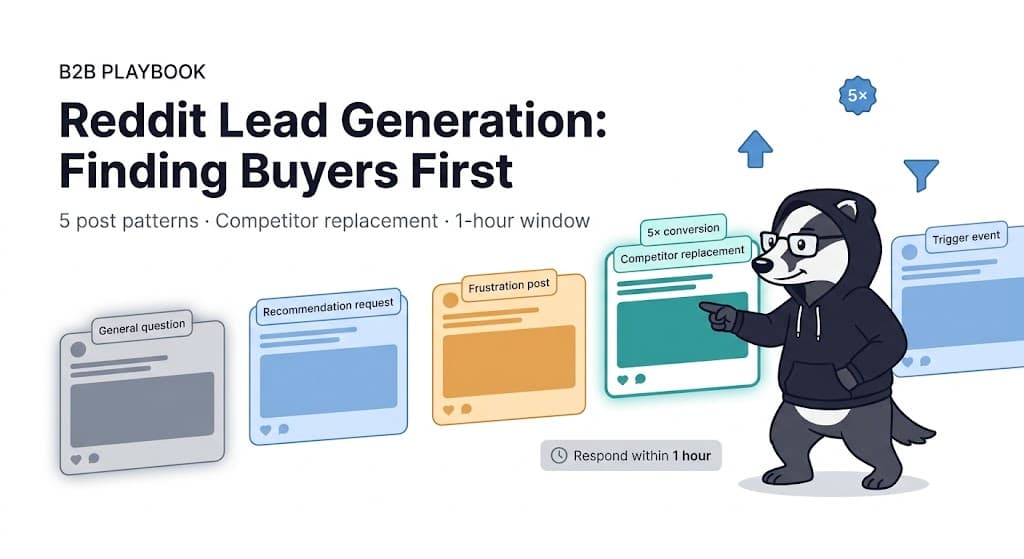
Buying intent on Reddit falls into recognizable language patterns. Each one is a search query you can run continuously, and each maps to a different kind of opportunity. This is where a data approach beats manual browsing — you can watch every relevant subreddit for these patterns at once instead of hoping to stumble across them.
Direct recommendation requests. The purest signal. "Any recommendations for," "looking for a tool to," "what do you use for," "suggest an app that," "best [category] for." These people are explicitly asking to be pointed at a product. In the real data, this pattern surfaced buyers for business email, booking software, expense tracking, and a second phone line — all in one subreddit, in one month.
Pain and complaint language. One level earlier in the journey. "Frustrated with," "[competitor] keeps," "is there a better way to," "tired of doing X manually." These people haven't asked for a recommendation yet, but they've named a problem you solve. The junk-pickup owner whose scheduler "is getting burned out doing things manually" was a booking-software buyer who hadn't yet framed it as a purchase. Catching pain language gets you there before the recommendation request even goes up.
Competitor-switching signals. The highest-value pattern for a challenger product. "Alternative to [competitor]," "moving away from [competitor]," "[competitor] is too expensive," "does [competitor] do X." Someone actively dissatisfied with a named competitor is the warmest possible prospect for that competitor's alternative. If you sell against a specific incumbent, a standing search for that incumbent's name plus switching language is the single most productive query you can run.
Solution-shopping questions. "How do I," "what's the best way to," "is it possible to." Broader and higher-volume, more mixed in quality, but a real top-of-funnel source — these are people with the underlying problem who haven't yet discovered that a category of tool exists to solve it.
The practical setup is to maintain a list of these phrase patterns crossed with the subreddits where your buyers actually gather, and run them on a schedule. ScrapeBadger's Reddit Scraper exposes exactly the endpoints this needs — search across all of Reddit or scoped to specific subreddits, pull a subreddit's newest posts, and read full comment threads — as structured JSON.
python
# reddit_intent_monitor.py
import asyncio
import os
from datetime import datetime
from scrapebadger import ScrapeBadger

# Buying-intent phrase patterns, grouped by signal type
INTENT_QUERIES = {
    "recommendation": [
        "recommendations for", "looking for a tool", "what do you use for",
        "suggest an app", "best tool for",
    ],
    "pain": [
        "frustrated with", "tired of", "is there a better way",
        "doing this manually",
    ],
    "competitor_switch": [
        # Fill with YOUR competitors' names + switching language
        "alternative to competitorX", "competitorX too expensive",
        "moving away from competitorX",
    ],
}

# Subreddits where your buyers actually gather — tune to your category
TARGET_SUBREDDITS = ["smallbusiness", "Entrepreneur", "SaaS", "marketing"]


async def scan_intent(client) -> list[dict]:
    leads = []
    seen = set()

    async with ScrapeBadger(api_key=os.environ["SCRAPEBADGER_API_KEY"]) as client:
        for signal_type, phrases in INTENT_QUERIES.items():
            for phrase in phrases:
                for sub in TARGET_SUBREDDITS:
                    try:
                        res = await client.reddit.search_posts(
                            q=phrase, subreddit=sub, sort="new", t="week", limit=25,
                        )
                        posts = res.posts if hasattr(res, "posts") else []
                        for p in posts:
                            pd = p.model_dump() if hasattr(p, "model_dump") else dict(p)
                            if pd["id"] in seen:
                                continue
                            seen.add(pd["id"])
                            leads.append({
                                "signal_type": signal_type,
                                "matched_phrase": phrase,
                                "subreddit": pd["subreddit"],
                                "title": pd["title"],
                                "body": pd.get("selftext", ""),
                                "url": pd["url"],
                                "author": pd["author"],
                                "comments": pd.get("num_comments", 0),
                                "created": pd.get("created_at"),
                            })
                        await asyncio.sleep(0.3)
                    except Exception as e:
                        print(f"  {phrase} in r/{sub}: {e}")
    return leads
Scoring: Not Every Post Is a Lead
Raw matches are noisy. A search for "recommendations for" in r/smallbusiness returns genuine software buyers, but also posts asking for a business coach, a supplier in Vietnam, or advice on a failing company — real in the data above, and none of them your customer. The scoring step is what turns a keyword match into a qualified lead, and it's mostly about relevance and freshness.
Score each candidate on a few dimensions. Relevance — does the post actually describe a need your product meets, versus merely containing your keyword? This is where a language model earns its place: feed it the post and your product description and ask, plainly, is this person a plausible buyer, yes or no, and why. Freshness — a "looking for recommendations" post from today is live; one from eight months ago is a closed decision, and worse, replying to it looks like exactly the graveyard-digging that marks you as a spammer. Engagement stage — a post with two comments still has room for a helpful answer to be seen; a post with ninety comments has already been answered, and yours will be buried. And specificity — the more constraints the person listed (budget, current tool, use case), the more qualified they are and the more precisely you can help.
The output you want is not "here are 500 posts containing your keywords." It's a short, ranked list of genuinely relevant, still-open threads where a helpful answer would actually be seen — the ten this week worth a human's attention.
The Part Everyone Gets Wrong: How to Actually Show Up
Here is where most Reddit lead-gen advice ends and most Reddit lead-gen attempts die. You have found a qualified, in-market buyer asking for exactly what you sell. Now, if you do the obvious thing — drop a link to your product — you will likely be downvoted, reported, possibly banned, and you'll have taught that subreddit's most active members to associate your brand with spam. Reddit communities are extraordinarily good at detecting self-interest, and their memory is long.
The counterintuitive truth is that the finding is the easy 20% and the showing-up is the hard 80%, which is the exact inverse of how most people budget their effort. So spend it correctly.
Answer the question, don't pitch the product. The comments that win recommendation threads are the ones that genuinely help — including recommending options that aren't yours, being honest about trade-offs, and mentioning your product as one option among several, disclosed as yours. "I build one of these (Xtool), so take this with salt, but for a two-truck operation on a budget I'd honestly look at [neutral option] first, and here's the one thing to check regardless of what you pick..." earns trust. A bare link does not. The person asking, and the hundreds who'll read the thread later via Google, can tell the difference instantly.
Have an account that isn't brand new. A three-day-old account with zero history dropping product mentions is the single clearest spam signal on the platform. This is why the durable version of Reddit lead gen requires building genuine standing first — participating usefully in your target communities for weeks before you ever mention what you sell, so that when you do, you're a known contributor rather than a stranger with a link. There is no shortcut here, and the shortcut attempts are exactly what get caught.
Disclose, always. When you mention your own product, say it's yours. Every time. Undisclosed promotion that gets discovered — and it gets discovered — converts a mild self-promo into a trust violation the community punishes far harder. Disclosure costs you nothing and is the thing that keeps you welcome.
Know when not to respond at all. Some threads aren't worth it — already answered thoroughly, or in a subreddit with a hard no-promotion rule, or where your product genuinely isn't the best fit. Walking away from those is what preserves your ability to show up in the ones that count. Not every qualified post is a post you should answer.
A note on DMs, since the data shows they work: several posters explicitly thanked people who "replied and DM'd." A direct message that continues a genuinely helpful public comment can be welcome. A cold DM to someone who never engaged with you is not — it's the same spam signal in a more annoying channel. The distinction is whether you earned the conversation in the open first.
What This Adds Up To
Done wrong, Reddit lead generation is a fast way to burn brand reputation in the exact communities that matter most to you. Done right, it's a standing source of the highest-intent, most context-rich, most competitor-aware leads available anywhere, at a cost of near zero — buyers describing their needs in public, days before they buy, often naming the competitor you'd be replacing.
The data layer makes it scalable: a monitor watching your intent phrases across every relevant subreddit, scoring for genuine relevance and freshness, and surfacing the short list of open threads worth a real answer this week. But the data only finds the door. Whether it opens depends entirely on showing up as a helpful member of the community rather than a link with a login. Build the standing first, answer more than you pitch, disclose always, and let the monitor point you at the conversations where being genuinely useful also happens to be good business.
Free trial at scrapebadger.com/reddit-scraper — 1,000 credits, no card. Full endpoint docs at docs.scrapebadger.com.
Common Questions
Isn't finding leads on Reddit just spamming? Finding them isn't — monitoring public posts for people describing a need is ordinary market research, the same thing sales teams do on every channel. The spamming is in how you respond. If you show up with genuine help, disclose your affiliation, and treat product mentions as one honest option among several, you're contributing. If you drop links from a fresh account, you're spamming. The method is neutral; the conduct is what the community judges.
How is this different from Reddit Ads? Reddit Ads put your message in front of an audience you target by interest. Intent monitoring finds individuals who have already stated the exact need you meet, in their own words, right now. Ads are broadcast; this is catching a hand already raised. They're complementary — but the intent quality of someone actively posting "looking for recommendations" is higher than any ad audience, because there's no inference involved. They told you.
Which subreddits should I monitor? The ones where your specific buyers gather, which is narrower than the big generic ones. A niche subreddit for your exact category will out-convert r/smallbusiness even though it's a fraction of the size, because the intent is more concentrated and the competition for helpful answers is lower. Start by finding where people already discuss the problem you solve, using a subreddit search on your category terms.
How do I avoid getting banned? Read each subreddit's rules before participating — many have explicit self-promotion policies. Build account history and karma by being useful before you ever mention your product. Disclose your affiliation every time. Recommend options other than your own when they're genuinely better. And skip threads where you can't add real value. The teams that get banned are the ones who skip all of that and go straight to link-dropping.
Is it legal to scrape Reddit for this? Monitoring public Reddit posts is broadly comparable to any public-web research, but Reddit's terms and API policies govern automated access, so use a compliant approach, collect only public data, respect rate limits, and don't store or repurpose users' personal data beyond the immediate research use. As always, consult legal counsel for your specific situation.

Written by
Domas Sakavickas
Dom Sakavickas is Co-founder of ScrapeBadger, building web scraping infrastructure for developers and data teams. He writes about the web data market, tool comparisons, and business use cases for scraping. ScrapeBadger is a web scraping API platform specialising in Twitter/X, Reddit and Google data, with dedicated scrapers also covering TikTok, YouTube, LinkedIn, Amazon, eBay, Zillow and 40+ more: with built-in anti-bot bypass and an MCP server for AI agents.
Ready to get started?
Join thousands of developers using ScrapeBadger for their data needs.