Twitter Data for Lead Generation: Finding Buyers Before They Find You
 Domas Sakavickas
AI Summary: Using ScrapeBadger's Twitter API, this guide shows how to systematically capture public buying signals, procurement intent, tool frustration, team-growth and budget moments, so sales teams reach qualified prospects with a timely helpful reply before competitors ever see the tweet.
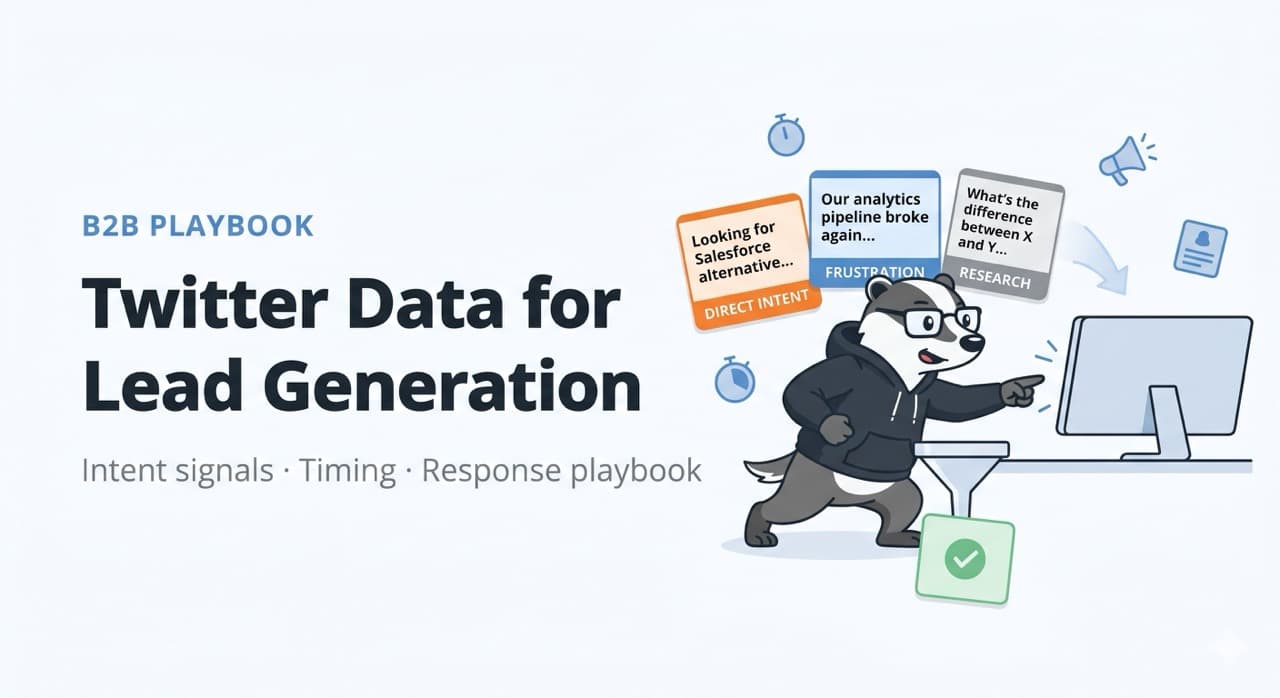
Someone in your target market just tweeted: "we've outgrown Notion for project management, team of 45, need something more structured. open to suggestions."
That is a buying signal. It names the incumbent they are leaving, indicates company size, describes the problem, and explicitly invites recommendations. The person who sees this tweet and responds with a relevant, helpful reply within a few hours has a warm conversation with a qualified prospect. Everyone who misses it has no conversation at all.
Twitter is full of these signals. Procurement intent, tool frustration, team growth moments, budget announcements, hiring surges that imply growth — all of it posted publicly by professionals who did not intend to broadcast it to every vendor in their category, but effectively did.
The gap between companies capturing these signals systematically and companies that are not is not a capability gap. It is a data infrastructure gap. The signals are public. The question is whether you have a system that surfaces them before the window closes.
The Intent Signal Taxonomy
Not all public tweets are equally valuable as buying signals. The most actionable signals fall into distinct categories, each requiring different monitoring approaches and different response playbooks.
Direct Purchase Intent
The most explicit signal category. Someone publicly stating that they are evaluating, switching, or purchasing in a product category. Examples:
"Looking for a Salesforce alternative for a startup, don't need all the enterprise features"
"Does anyone have experience with data scraping APIs? evaluating options for a project"
"Our current email platform is killing us, shopping around, budget ~$500/mo"
These posts are search-intent converted into social posts — the person has moved past awareness into active evaluation. Response time matters enormously. A post asking for tool recommendations gets most of its engagement in the first two to four hours. After that, the thread is buried and the person has already heard from multiple respondents.
Frustration and Failure Signals
Equally valuable but requiring more interpretive work. Someone expressing frustration with a category or a specific incumbent is not asking for solutions — but they are broadcasting a pain point that may be your product's core value proposition.
"Another afternoon lost to manually updating spreadsheets. there has to be a better way"
"Our analytics pipeline broke again. third time this month. starting to lose confidence in [tool]"
"[Competitor name] just changed their pricing and now we're 3x what we budgeted"
These signals require a response approach that leads with empathy rather than pitch. The person is venting, not shopping. But they are in the emotional state that precedes shopping — frustration with the status quo is the catalyst for evaluation.
Trigger Events
Life events that imply changed purchasing requirements. A startup announcing a Series A is about to grow their team and their infrastructure needs. A company posting a hiring surge in engineering implies they are scaling and will need tools that scale with them. An executive announcing a new role at a company implies a potential re-evaluation of that company's existing tool stack.
"Excited to announce we've closed our Series B"
"We're hiring 20 engineers this quarter — scaling fast"
"Starting my new role as CTO at [company] next week"
Trigger events are less direct than purchase intent but often higher-converting because you are reaching someone at the exact moment their situation changed. Timing is everything.
Category and Comparison Queries
Implicit research intent. Questions about how products in your category work, requests for recommendations, comparisons between tools — all signal active market research.
"What's the difference between [category A] and [category B] for this use case"
"Anyone have recommendations for web scraping APIs that handle Cloudflare?"
"Building a price monitoring tool, what data sources do people use?"
These signals identify people in the awareness and consideration phase of the buying cycle — earlier than direct purchase intent, but with a longer window to engage.
Building the Signal Detection System
Search Query Construction
Effective Twitter lead generation starts with search queries designed to surface intent signals rather than brand mentions. The difference is significant.
Brand monitoring queries find people already talking about you. Intent signal queries find people who might not know you exist but are in the market for what you offer.
For a web scraping API provider, intent signal queries include: "scraping API", "web scraping python problem", "cloudflare blocking", "need data extraction", "API alternative", "proxy rotation issues", along with category terms like "competitive intelligence tool", "price monitoring", "data pipeline".
The negative keyword list matters as much as the positive. "web scraping" returns enormous volume, much of it tutorials, news articles, and developer questions with no commercial intent. Refining with terms that indicate evaluation or frustration narrows to the signal you want.
Engagement Window and Response Timing
Most intent signals on Twitter have a short half-life. Direct purchase intent posts get significant engagement in the first two to four hours. After six hours, the original poster has moved on and the thread has lower visibility.
This means monitoring frequency matters. A system that collects signals once per day and queues them for morning review is too slow for the highest-value direct intent signals. The monitoring cycle needs to run at minimum every two to four hours for the intent categories with short windows.
ScrapeBadger's Twitter Scraper supports real-time search with time-filter parameters that let you query for posts from the last hour, last six hours, or last 24 hours. Running the signal detection queries on a two-hour cycle and routing high-priority signals immediately to the appropriate sales or community representative creates the response speed that makes this approach work.
Scoring and Routing
Not all detected signals warrant immediate response. A scoring framework that prioritises based on signal type, account authority, and estimated audience size makes the workflow manageable.
High priority signals for immediate routing:
Direct purchase intent from accounts with 500+ followers
Competitor frustration from accounts in your target industry
Trigger events (funding, hiring) from accounts matching your ICP
Medium priority for daily review:
Category comparison queries
Generic frustration signals without specific incumbent mentioned
Lower-follower accounts with direct intent
Low priority for weekly digest:
Indirect signals, single keywords without context
High-volume accounts that appear to be bots or media
Signals in adjacent but non-core categories
The ICP matching and scoring infrastructure from the Twitter user profiles guide applies directly here — the account behind a signal carries context that affects how you respond and how urgently.
The Response Playbook
Responding to Direct Purchase Intent
Speed and specificity beat elaboration. The response that converts is one that acknowledges the specific situation they described and offers a clear next step — not a product pitch.
Wrong: "Hey! We at [Company] would love to help with your project management needs. We offer [list of features]. DM us for a demo!"
Right: "Team of 45 outgrowing Notion is a super common inflection point. [Product] has a free trial specifically for teams coming from Notion — the migration tool handles most of it automatically. Worth trying before making a final call."
The difference: the second response proves you read the tweet, addresses the specific context they gave (team size, incumbent), and offers a concrete next step without requiring a meeting commitment.
Responding to Frustration Signals
Lead with understanding, not solution. The person is venting. Meeting them where they are converts better than jumping to pitch.
Wrong: "Sorry to hear that! Have you considered [Product]? We handle this exact problem."
Right: "Manual spreadsheet updates are genuinely painful at scale. What's the bottleneck — is it the data collection or the distribution to stakeholders? Either way there are usually some quick wins before committing to a new tool."
The second response demonstrates expertise, invites dialogue, and creates a natural path to discussing your product — without leading with it.
Responding to Trigger Events
The congratulatory response that plants a seed. Forcing a pitch at someone who just announced funding is off-tone and generates negative associations. A warm congratulation that signals category awareness works better.
"Congrats on the Series B. Series B scaling usually means the data infrastructure decisions that worked at seed start getting painful — happy to talk through what we've seen work if that's useful whenever you're ready."
This response acknowledges the milestone, signals relevant expertise, and offers value without demanding attention at a moment when they are focused elsewhere.
Combining Twitter Signals With Other Intelligence
The highest-conversion lead generation workflows combine Twitter intent signals with additional context from complementary sources. Someone tweeting about needing a data extraction tool, whose company profile shows recent Series A funding, whose LinkedIn indicates a growing engineering team, and whose website technology stack (visible via web scraping) does not include a data pipeline tool — that is a multi-signal qualified prospect, not just a tweet.
ScrapeBadger's multi-source infrastructure connects Twitter signal detection with Google Search data (what does their company site say), Google News monitoring (has there been recent coverage), and Google Trends signals (is demand in their category growing). The MCP integration makes this multi-source enrichment available to AI agents that can research a prospect in real time before routing to a sales representative.
As covered in the ScrapeBadger blog on competitive intelligence, the teams building systematic lead generation from public social data are not doing anything their competitors cannot do — they are just doing it consistently, at scale, with infrastructure that surfaces the signals rather than relying on manual monitoring.
Free trial at scrapebadger.com — 1,000 credits, no credit card required.

Written by
Domas Sakavickas
Dom Sakavickas is Co-founder of ScrapeBadger, building web scraping infrastructure for developers and data teams. He writes about the web data market, tool comparisons, and business use cases for scraping. ScrapeBadger is a web scraping API platform specialising in Twitter/X, Reddit and Google data, with dedicated scrapers also covering TikTok, YouTube, LinkedIn, Amazon, eBay, Zillow and 40+ more: with built-in anti-bot bypass and an MCP server for AI agents.
Ready to get started?
Join thousands of developers using ScrapeBadger for their data needs.