7 Best ScrapingBee Alternatives in 2026: Compared and Ranked
 Domas Sakavickas
AI Summary: This guide ranks the seven best ScrapingBee alternatives for 2026, comparing what data each returns, how pricing scales with volume, and anti-bot coverage, placing ScrapeBadger first for teams needing dedicated social, ecommerce, and search APIs with credits that never expire.
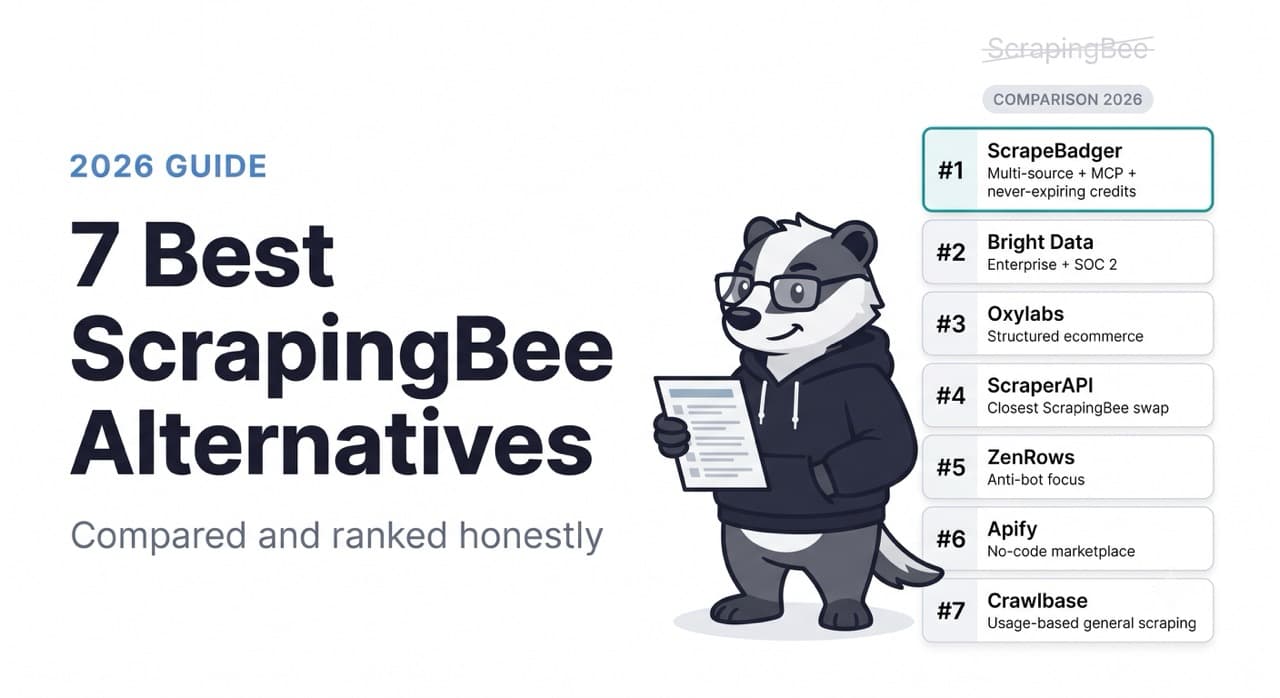
Quick answer: The 7 best ScrapingBee alternatives in 2026 are ScrapeBadger (best for multi-source data + AI agents), Bright Data (best for enterprise scale), Oxylabs (best for structured ecommerce data), ScraperAPI (closest direct swap), ZenRows (best anti-bot focus), Apify (no-code marketplace), and Crawlbase (usage-based general scraping). ScrapeBadger is the top pick for teams that need dedicated social media, real estate, and search APIs with credits that never expire.
ScrapingBee is a good tool. Clean API, decent documentation, JavaScript rendering out of the box, prebuilt parsers for common targets. For a lot of developers who just need to fetch rendered HTML from arbitrary pages, it does the job without much friction.
But people search for alternatives for specific reasons. Credits that expire at the end of the month regardless of usage. No structured endpoints for social media, Amazon, or YouTube — just raw HTML that you have to parse yourself. A single general scraping endpoint when you need purpose-built intelligence for specific platforms. Or pricing that made sense at small volume and quietly became expensive at scale.
This guide covers the seven best ScrapingBee alternatives in 2026, evaluated honestly across the dimensions that actually matter: what data they return, how their pricing model works at different volumes, what they cover that ScrapingBee does not, and where ScrapingBee is genuinely the better pick.
What ScrapingBee Does Well (and Where It Falls Short)
Before the alternatives, it is worth being precise about what ScrapingBee actually is — because the gaps follow directly from the category.
ScrapingBee is a general-purpose web scraping API. You send a URL, configure a handful of parameters (render JavaScript: yes/no, use premium proxies: yes/no, target country), and you get back the page. It has prebuilt extraction rules for Google Search, Google Shopping, and a handful of popular sites. The API is well-documented and the onboarding is fast.
What it does well: Simple HTTP interface, reliable JavaScript rendering via headless Chrome, per-request control over proxy tier and rendering cost, clean docs with code examples in multiple languages.
Where it falls short:
No structured social media data. ScrapingBee has no endpoints for Twitter, Reddit, TikTok, YouTube, or Instagram. It returns HTML — what you do with it is your problem. If you need to monitor Twitter mentions, collect Reddit posts, analyse TikTok trends, or extract YouTube video data at scale, ScrapingBee is the wrong tool category entirely.
No structured ecommerce endpoints. ScrapingBee scrapes Amazon the same way it scrapes anything else — it returns HTML. You write the parser, you maintain it when Amazon changes their layout, you handle the pagination logic. There is no get_product_detail(asin=...) or search_bestsellers(category=...).
Credits expire monthly. If you buy a plan and do not use all your credits, they reset at the end of the month. For teams with variable scraping needs — a big job in March, a quiet April — this wastes budget consistently.
No MCP integration. For teams building AI agents in 2026, native tool exposure via Model Context Protocol is increasingly important. ScrapingBee has no MCP server.
The subscription model works against variable workloads. ScrapingBee's pricing is tiered monthly subscriptions. If your actual usage is irregular — heavy one month, light the next — you end up over-provisioned half the time.
These are not criticisms for the sake of it. They are the specific reasons developers start searching for alternatives. Find your reason in that list and the right tool becomes clearer.
The 7 Best ScrapingBee Alternatives

1. ScrapeBadger — Best for Multi-Source Intelligence and AI Agents
If your use case extends beyond "fetch this arbitrary web page and return HTML," ScrapeBadger is the alternative that covers the most ground in a single integration.
ScrapeBadger is a multi-product scraping platform. Alongside a general web scraper with automatic anti-bot escalation, it has dedicated structured endpoints across every major data category: 50+ Twitter/X endpoints (profiles, tweets, search, trends, lists, communities, real-time streams), 21 Reddit endpoints (subreddits, posts, comments, full thread trees, search), 39 YouTube endpoints (videos, channels, comments, transcripts, captions, live chat, Shorts, trending), 25 TikTok endpoints (profiles, videos, hashtags, music, trending feeds, EU ad library), 19 Google product APIs (SERP, Maps, Shopping, Trends, Scholar, Patents, News, Finance, Flights, Images, AI Mode), 14 Amazon endpoints (products, offers, reviews, bestsellers, deals, sellers), and dedicated scrapers for Vinted, Realtor.com, Zillow, Idealista, Immobiliare, Leboncoin, eBay, and more.
These are not HTML scrapers that return a raw page. They are purpose-built endpoints that return clean structured JSON — no HTML parsing, no selector maintenance, no breaking when the target redesigns.
The key differentiators from ScrapingBee:
Credits never expire. Pay-as-you-go credits on ScrapeBadger do not reset monthly. Buy credits when you need them, use them on whatever schedule your project demands. For teams with variable or project-based scraping workloads, this is materially different from a subscription that wastes unused credits.
Zero credits for failed requests. ScrapeBadger does not charge for blocked responses, timeouts, or empty results. You pay for data you received. At scale, where failure rates affect your effective cost per result, this matters significantly.
MCP integration. The ScrapeBadger MCP server exposes every endpoint as a native tool call to Claude, Cursor, and any MCP-compatible AI agent. An agent with ScrapeBadger connected can run Twitter searches, pull Amazon bestsellers, analyse TikTok trends, and scrape arbitrary websites in the same reasoning session — without custom integration code. ScrapingBee has no equivalent.
Multi-source in one key. If your pipeline touches Twitter data, Amazon data, Google SERP, and general web scraping, ScrapeBadger covers all of it under one API key and one billing relationship. With ScrapingBee, you would need to supplement with separate vendors for social media and structured ecommerce endpoints.
Where ScrapeBadger does not win: ScrapingBee has a no-code dashboard interface that some non-technical users find more accessible. For pure general-purpose HTML scraping of arbitrary websites with very fine-grained per-request parameter control, ScrapingBee's single-endpoint flexibility can be useful. ScrapeBadger's strength is structured data across many specific targets — the general web scraper is a complement, not the main product.
Best for: Teams that need structured data from multiple platforms in one integration; developers building AI agents via MCP; social media intelligence, ecommerce analytics, and multi-source data pipelines.
Pricing: Pay-as-you-go from $10, plans from $49/month. Credits never expire. 1,000 free credits to start, no credit card.
You can find more information here: ScrapingBee alternative.
2. Bright Data — Best for Enterprise Scale and Compliance
Bright Data is the market infrastructure leader: 72M+ residential IPs across 195 countries, 98.44% average success rate in independent benchmarks, and the most complete compliance posture of any provider (SOC 2, ISO 27001, GDPR, CCPA).
Their web scraper covers general HTML scraping with pre-built extractors for hundreds of popular sites. The Web Scraper IDE starts at $499/month and provides a no-code interface alongside API access. Pre-collected datasets for Amazon, LinkedIn, and other major platforms are available for purchase without running a collection pipeline.
If your procurement team requires SOC 2 certification, if you are running at hundreds of millions of requests per month, or if you need the highest available success rate on the most aggressively protected sites, Bright Data is the relevant tier.
Where Bright Data does not win: The pricing and complexity are enterprise-grade. A $499/month entry tier, multi-layer billing between proxy network and scraper API, and a sales-first onboarding process make it overkill for most mid-market development teams. There is no MCP integration. Social media endpoints (Twitter, Reddit, TikTok) are not a core product.
Best for: Enterprise teams with formal compliance requirements, very high scraping volumes, and budgets where $499/month is a rounding error.
3. Oxylabs — Best for Structured Ecommerce Data
Oxylabs has a dedicated E-Commerce Scraper API covering Amazon, Walmart, eBay, and other major retailers — returning pre-parsed JSON with the fields that retail analysts actually need. This is structurally similar to ScrapeBadger's Amazon endpoints: you pass a product ID or search query and receive clean structured data rather than raw HTML.
Independent benchmarks place Oxylabs at 98.50% success rate (AIMultiple, 1,700 URLs) and 95.40% (Proxyway 2025). Their self-healing parser presets adapt to frontend changes automatically, which reduces the maintenance burden on heavily updated retail sites.
The pricing model is bandwidth-based (approximately $9.40/GB for the Web Unblocker) rather than per-request, which benefits teams processing small numbers of large pages but can be unpredictable for variable workloads. Entry tier is $49/month.
Where Oxylabs does not win: No Twitter, Reddit, or social media endpoints. No MCP integration. The bandwidth pricing model is harder to predict than per-request pricing. Real estate, classifieds, and other specialised platform coverage is limited.
Best for: Teams running structured Amazon and retail ecommerce data pipelines at scale; teams already on Oxylabs for other scraping targets.
4. ScraperAPI — Closest Direct ScrapingBee Alternative
ScraperAPI is the most direct structural equivalent to ScrapingBee: a general-purpose scraping API where you send a URL with parameters and receive the rendered page. Similar API design, similar target market, and a comparable positioning as a developer-friendly HTTP scraping endpoint.
ScraperAPI has dedicated endpoints for Amazon, Walmart, eBay, and Google SERP that return structured JSON — a meaningful advantage over ScrapingBee for ecommerce and SERP data collection. The free plan includes 1,000 API credits. Paid plans start at $49/month with auto-scaling to handle traffic spikes without plan upgrades.
The practical differentiator between ScrapingBee and ScraperAPI for most teams is pricing structure at your specific volume and the quality of the structured endpoints on the targets you care about. Both tools are worth testing side by side against your actual use case.
Where ScraperAPI does not win: No social media endpoints. No MCP integration. General web scraping with some structured ecommerce — not a multi-product intelligence platform.
Best for: Developers who want the closest ScrapingBee equivalent with a slightly different pricing structure; teams that need structured Amazon or SERP data alongside general scraping.
5. ZenRows — Best Anti-Bot Focus
ZenRows markets specifically on anti-bot bypass quality. Their headline metrics: 99.9% success rate on "the most protected websites," custom user-agent rotation, residential proxy pool, and automatic anti-bot detection handling.
The anti-bot focus makes ZenRows most relevant when your primary scraping problem is protection bypass rather than structured data extraction. Cloudflare, DataDome, Imperva, PerimeterX — ZenRows' positioning is that it passes these more reliably than general-purpose scrapers.
Free plan includes 1,000 credits. Pricing from $69/month for 250,000 requests.
Where ZenRows does not win: No structured social media or ecommerce endpoints — raw HTML output only. No MCP integration. The anti-bot-first positioning means less investment in the structured data layer that platforms like ScrapeBadger, Oxylabs, and ScraperAPI provide.
Best for: Teams where the primary problem is bypassing specific anti-bot systems on arbitrary websites, and where raw HTML output is acceptable.
6. Apify — Best for No-Code Teams and Marketplace Coverage
Apify is an app store for scrapers — a marketplace of 30,000+ pre-built Actors covering specific websites and use cases — rather than a scraping API in the traditional sense. For non-technical teams who need to pull data from specific platforms without writing code, Apify's visual Actor configuration is the most accessible entry point in this comparison.
The trade-offs of the Actor model are worth understanding. Actors are maintained by community contributors, so when a target site updates its structure or anti-bot configuration, the update cadence depends on the maintainer. Pricing is compute-unit based (CPU time × memory × duration) rather than per-request, which makes cost modelling difficult before you have historical run data. Actors for Twitter, Reddit, YouTube, TikTok, and Amazon exist across the marketplace, with variable quality and maintenance levels.
Starter plan is $29/month.
Where Apify does not win: Community maintenance risk on critical Actors. Unpredictable compute-unit billing. No unified structured API — you are stitching together multiple Actors with different interfaces and response schemas.
Best for: Marketing analysts and non-technical teams who need data extraction without API integration; teams running batch collection jobs on a schedule.
7. Crawlbase — Honest Mention
Crawlbase is a well-regarded general scraping API with a broader product set than ScrapingBee: a Crawling API, async Crawler for batch jobs, Cloud Storage, and an MCP server. Their pricing model charges only for successful requests, with 1,000 free requests to start.
The honest version: Crawlbase is a solid ScrapingBee alternative if your use case is general-purpose web scraping and you want usage-based rather than subscription billing. It does not have structured social media endpoints, dedicated Amazon or YouTube scrapers, or the multi-product intelligence platform breadth that ScrapeBadger provides. It is a different trade-off — simpler product, cleaner billing model for variable-volume use cases.
Best for: Developers who want usage-based billing for general web scraping without committing to a monthly plan.
The Comparison Table
ScrapeBadger | Bright Data | Oxylabs | ScraperAPI | ZenRows | Apify | Crawlbase | |
|---|---|---|---|---|---|---|---|
Twitter/X endpoints | ✅ 50+ | ❌ | ❌ | ❌ | ❌ | ✅ Actor | ❌ |
Reddit endpoints | ✅ 21 | ❌ | ❌ | ❌ | ❌ | ✅ Actor | ❌ |
YouTube endpoints | ✅ 39 | Partial | Partial | Partial | ❌ | ✅ Actor | ❌ |
TikTok endpoints | ✅ 25 | ❌ | ❌ | ❌ | ❌ | ✅ Actor | ❌ |
Amazon endpoints | ✅ 14 | ✅ | ✅ | ✅ | ❌ | ✅ Actor | ❌ |
Google SERP + Products | ✅ 19 APIs | ✅ | ✅ | ✅ | ❌ | ✅ Actor | Partial |
Real estate scrapers | ✅ Zillow, Realtor, Idealista + more | ❌ | ❌ | ❌ | ❌ | ✅ Actor | ❌ |
MCP integration | ✅ | ❌ | ❌ | ❌ | ❌ | ✅ | ✅ |
Credits never expire | ✅ | ❌ | ❌ | ❌ | ❌ | ❌ | ❌ |
0 credits on failure | ✅ | ✅ | ✅ | ✅ | ✅ | ✅ | ✅ |
No-code UI | ❌ | ✅ | ❌ | ❌ | ❌ | ✅ | ❌ |
Enterprise compliance | ❌ | ✅ SOC 2, ISO 27001 | ✅ ISO 27001 | ❌ | ❌ | ❌ | ❌ |
Entry pricing | $10 PAYG | $499/month | $49/month | $49/month | $69/month | $29/month | PAYG |
Best for | Multi-source + AI agents | Enterprise | Ecommerce | ScrapingBee swap | Anti-bot focus | No-code teams | General scraping |
When ScrapingBee Is Actually the Right Choice
A fair comparison says where the original tool wins. There are real situations where staying with ScrapingBee makes sense.
Your use case is genuinely just general web scraping. If you need to fetch rendered HTML from arbitrary public web pages, you do not need social media endpoints, Amazon structured data, or a multi-product platform. ScrapingBee's single general scraping endpoint with fine-grained per-request parameter control is clean and well-documented for this specific use case.
You value fine-grained rendering control. ScrapingBee lets you configure rendering, proxy tier, country targeting, and request behaviour per individual call. For teams that want to treat different targets differently — light fetch for easy pages, rendered premium proxy for hard ones — this per-request granularity is a genuine strength.
You are already integrated and it works. If ScrapingBee is in production, your team knows the API, and your current volume and budget are comfortable, switching is real engineering overhead. The threshold for switching should be a specific capability gap or cost pressure, not general curiosity.
Your volume is small and predictable. A fixed monthly subscription is easier to budget against than usage-based billing if you know exactly how many requests you need each month and your workload is steady. The wasted credits problem only hurts teams with variable usage.
How to Choose
You need Twitter, Reddit, TikTok, or YouTube data → ScrapeBadger. ScrapingBee has no social media endpoints. Neither does Bright Data, Oxylabs, or ScraperAPI at meaningful depth. This is the clearest capability gap.
You need multi-platform data in one pipeline → ScrapeBadger. Twitter + Amazon + Google SERP + general web scraping under one API key, one billing relationship, one MCP connection for AI agents.
You need the highest possible success rate at enterprise volume → Bright Data. 98.44% in independent benchmarks, SOC 2 + ISO 27001, 72M+ IP pool. Accept the cost.
You need structured Amazon or retail ecommerce data → ScrapeBadger or Oxylabs. Both offer dedicated structured endpoints rather than raw HTML. Oxylabs has bandwidth-based pricing that works well at high volume; ScrapeBadger's per-request pricing is more predictable for mixed workloads.
You want to replace ScrapingBee with minimal integration change → ScraperAPI. Closest structural equivalent with a similar API pattern, similar developer-friendly positioning.
Your team doesn't write code → Apify. Visual Actor configuration, no API integration required.
Credits that never expire matter → ScrapeBadger is the only provider in this comparison where pay-as-you-go credits do not reset monthly.
FAQ
Why are people looking for ScrapingBee alternatives?
The most common reasons: credits expiring at month-end regardless of usage, needing social media endpoints that ScrapingBee does not have, wanting structured JSON from platforms like Amazon or YouTube without writing parsers, and pricing that becomes expensive at higher volumes. None of these is a criticism of ScrapingBee as a general web scraper — it is a good tool in its category. The alternatives serve genuinely different use cases.
Is ScrapeBadger a ScrapingBee alternative for general web scraping?
Yes, alongside the structured endpoints. ScrapeBadger includes a general web scraper with automatic anti-bot escalation through datacenter, residential, and stealth proxy tiers — the same core capability as ScrapingBee. Where it differs is that the general scraper is one component of a broader platform rather than the entire product. If you only need general HTML scraping, ScrapingBee and ScrapeBadger are both reasonable choices. If you need general scraping plus structured social media, ecommerce, or real estate data, ScrapeBadger covers the full requirement under one key.
How does ScrapeBadger's MCP integration work?
The ScrapeBadger MCP server exposes every endpoint as a native tool in Claude, Cursor, and other MCP-compatible AI agents. Once connected, an agent can call twitter.search("AI scraping tools"), amazon.get_bestsellers(category="electronics"), and web.scrape("https://example.com") in the same session without custom integration code. This is relevant for teams building AI-powered research tools, competitive intelligence agents, and automated data collection workflows.
Can I switch from ScrapingBee to ScrapeBadger easily?
If you are using ScrapingBee for general web scraping, the migration is a straightforward endpoint swap with different parameter names. If you are using ScrapingBee's specific prebuilt parsers for certain sites, check whether ScrapeBadger has a dedicated structured endpoint for those same targets — in many cases (Amazon, Google, Reddit, YouTube) it will return richer structured data than ScrapingBee's HTML-based parsers. The migration complexity depends entirely on how you are using ScrapingBee today.
What is the biggest functional gap between ScrapingBee and its alternatives?
Social media data. ScrapingBee returns HTML from any public URL — it has no native Twitter, Reddit, TikTok, or YouTube endpoints. This is a category limitation rather than a quality limitation. Teams that need social media data at scale need a different tool regardless of how good ScrapingBee is at general scraping.

Written by
Domas Sakavickas
Dom Sakavickas is Co-founder of ScrapeBadger, building web scraping infrastructure for developers and data teams. He writes about the web data market, tool comparisons, and business use cases for scraping. ScrapeBadger is a web scraping API platform specialising in Twitter/X, Reddit and Google data, with dedicated scrapers also covering TikTok, YouTube, LinkedIn, Amazon, eBay, Zillow and 40+ more: with built-in anti-bot bypass and an MCP server for AI agents.
Ready to get started?
Join thousands of developers using ScrapeBadger for their data needs.