Best LinkedIn Scraper APIs in 2026: Compared and Ranked
 Domas Sakavickas
AI Summary: After Proxycurl's shutdown left teams stranded, this guide ranks the seven LinkedIn scraper APIs that actually work in 2026, explaining why LinkedIn's aggressive multi-signal defenses make it uniquely hard to scrape and detailing each tool's real trade-offs.
In early 2025, LinkedIn sued Proxycurl. By mid-year the service was gone.
For a lot of developers, that was not an abstract legal story — it was a production outage. Proxycurl had been the default LinkedIn data API for years: reliable, well-documented, API-first, widely trusted. Teams had built products on top of it. When it shut down, those teams got cut off overnight and had to scramble for a replacement.
If you are reading this, there is a decent chance that is roughly why you are here. Either your previous LinkedIn data source disappeared, got too expensive, or started failing — or you are building something new and discovered that LinkedIn is one of the hardest major platforms to extract data from reliably.
Both problems come down to the same reality. LinkedIn holds the most accurate, current professional dataset that exists anywhere — job titles, company headcounts, hiring activity, career histories, skills, org structures — and it defends that data more aggressively than almost any platform on the internet. There is no official API that gives commercial access to public profile, company, and search data at scale. So the market runs on scraping APIs.
This guide covers the seven that actually work in 2026, ranked honestly, with the real trade-offs of each.
Why LinkedIn Is Uniquely Hard to Scrape
Most anti-bot systems operate on a small number of signals — IP reputation, TLS fingerprint, a CAPTCHA challenge. LinkedIn runs a fundamentally different model.
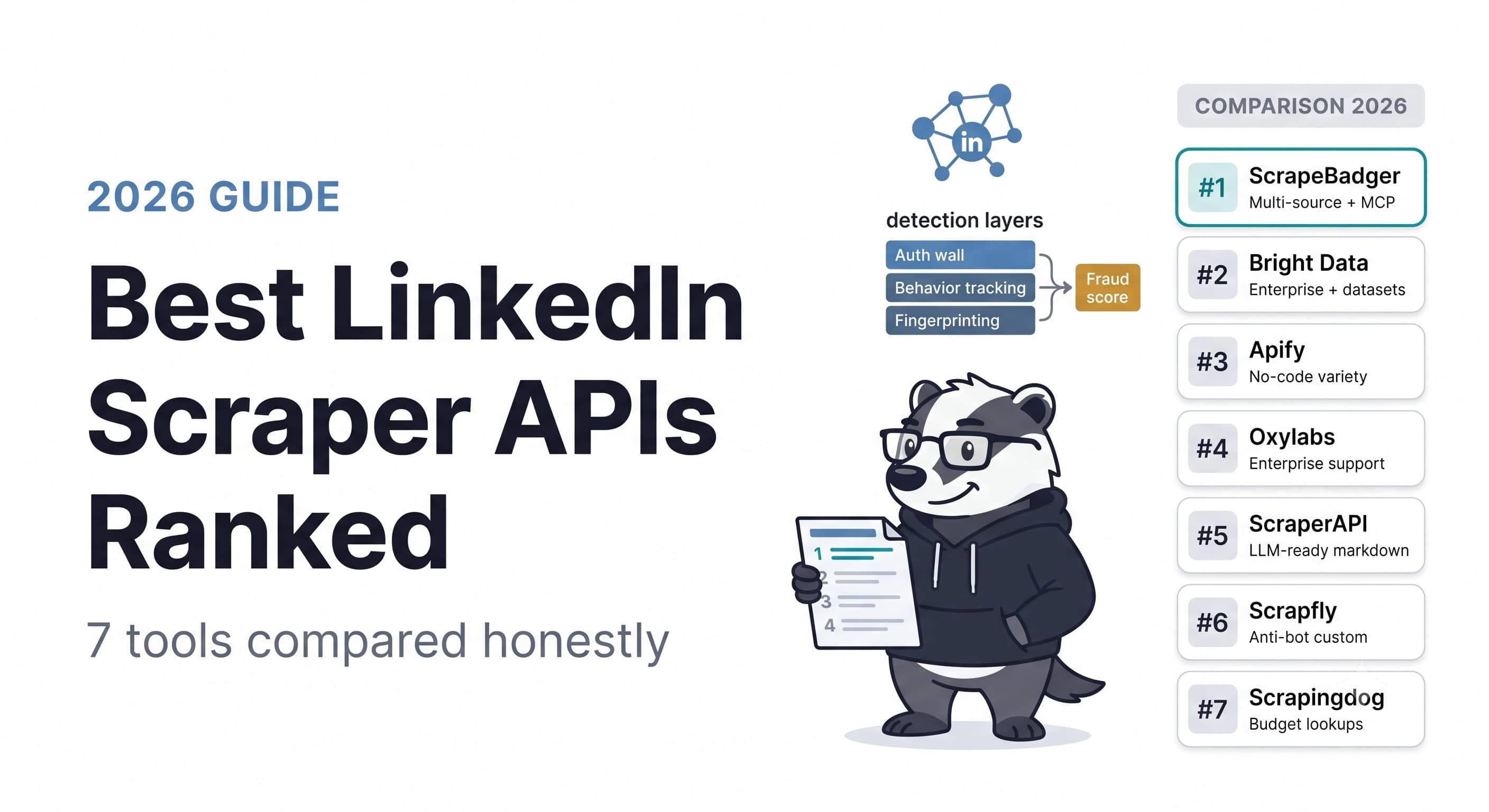
LinkedIn's detection is a three-layer fraud score. The first layer is the authentication wall: public data is genuinely public and reachable without login, but the moment your request pattern looks automated, LinkedIn throws up a login wall that your normal browser never sees. The second layer is behavior tracking: request cadence, navigation graph, timing entropy, and interaction patterns are scored continuously. The third layer is fingerprinting: canvas, WebGL, fonts, and dozens of browser environment signals are checked against known-human baselines.
These three feed a single fraud score. Cross the threshold and you are blocked — often silently, with a login redirect or an empty response rather than an error code. This is why LinkedIn scraping breaks in ways that other targets do not: your script completes, your CSV has headers, and you assume everything worked. It did not. You collected challenge pages.
The practical consequence is that LinkedIn scraping is not a "send a request, parse the HTML" problem. It requires managed anti-bot infrastructure that maintains clean sessions, rotates residential IPs, mimics human behavioral patterns, and updates constantly as LinkedIn changes its defenses. This is exactly why most teams buy this capability rather than build it — the maintenance burden of a DIY LinkedIn scraper is a full-time engineering job, and the day it breaks is the day your product breaks.
The data types worth collecting, all of which are publicly visible without login:
Profiles — name, headline, location, current position, full work history, education, skills, certifications, and public activity.
Companies — name, industry, headcount, headquarters, specialties, follower count, employee lists, and recent posts.
Jobs — title, company, location, description, seniority level, employment type, applicant count, and posted date.
Posts — post text, author, engagement metrics, date, and comments.
Search — people search, company search, and job search results.
A Note on Legality
Every provider in this comparison operates in the same legal context, so it is worth stating once up front.
The hiQ Labs v. LinkedIn case (Ninth Circuit, 2019, reaffirmed 2022) established that scraping publicly available data does not violate the Computer Fraud and Abuse Act. Scraping public LinkedIn data is not a crime. However, LinkedIn's Terms of Service explicitly prohibit automated access, which is a contractual matter, and LinkedIn actively enforces it through technical blocks and, as Proxycurl discovered, litigation.
The practical guidance every responsible provider gives: collect only publicly visible data, do not collect private or protected information, treat personal data of EU residents as subject to GDPR (which means having a lawful basis and honoring data rights), and use the data for analysis rather than wholesale republication. Consult legal counsel for your specific use case. This is not optional diligence — the Proxycurl shutdown is the clearest possible evidence that the legal dimension of LinkedIn scraping is real.
The Seven Providers
1. ScrapeBadger — Best for Multi-Source Pipelines and AI Agents
ScrapeBadger's LinkedIn Scraper covers the full public data model — profiles, companies, jobs, posts, and search — returning clean structured JSON rather than raw HTML. It runs on the same auto-escalation anti-bot engine that powers the rest of the platform: the system identifies which protection a target is using and escalates through datacenter, residential, and stealth browser tiers automatically until the request succeeds. For LinkedIn's three-layer fraud scoring, that automatic escalation is exactly the right architecture.
The reason ScrapeBadger ranks first for most teams is not LinkedIn in isolation — it is what surrounds it. LinkedIn data is rarely the only data a growth, sales, or research team needs. The same API key that pulls LinkedIn profiles and company data also covers 50+ Twitter/X endpoints, 21 Reddit endpoints, 19 Google product APIs (including Google Jobs, which aggregates LinkedIn listings alongside Indeed and company career pages in a single call), 14 Amazon endpoints, and dedicated scrapers for YouTube, TikTok, and more. For a lead-generation pipeline that combines LinkedIn company data with Twitter monitoring and Google News signals, that is one integration instead of four.
The differentiators that matter against the rest of this list:
MCP integration. The ScrapeBadger MCP server exposes LinkedIn scraping — and every other endpoint — as native tools to Claude, Cursor, and any MCP-compatible AI agent. An agent can research a company's LinkedIn presence, pull employee data, cross-reference against news mentions, and write a report in a single reasoning loop. No other LinkedIn scraper in this comparison has MCP support.
Credits never expire. Pay-as-you-go credits do not reset monthly. For teams with the bursty usage that lead-gen and recruiting workflows typically produce — a big prospecting push one month, quiet the next — this avoids the wasted spend of a subscription model.
Zero credits for failed requests. On a target as block-prone as LinkedIn, where silent failures are common, only paying for successful structured data materially affects your real cost per record.
Where ScrapeBadger does not win: It does not sell pre-collected LinkedIn datasets — if you want to buy a bulk dataset of 50 million profiles without running a collection pipeline, Bright Data is the better route. It has no no-code UI; this is an API-first product for teams that write code.
Best for: Teams building lead generation, recruiting, or market intelligence pipelines that combine LinkedIn with other data sources; developers building AI agents; anyone who wants LinkedIn data under the same key as Twitter, Reddit, Google, and Amazon.
Pricing: Pay-as-you-go from $10, plans from $49/month. Credits never expire. 1,000 free credits, no card.
2. Bright Data — Best for Enterprise Scale and Datasets
Bright Data is the enterprise standard for LinkedIn data, and it shows in both infrastructure depth and price. It offers separate, independently optimized scraper APIs for Profiles, Companies, Posts, and Jobs, each returning structured JSON, NDJSON, or CSV via webhook or direct response.
The model is dataset-trigger rather than synchronous request: you POST a batch of LinkedIn URLs, receive a snapshot ID, and poll until the job completes. This is built for high-volume batch collection, not real-time single lookups. Bright Data also sells pre-collected LinkedIn datasets — if your need is "give me 10 million profiles matching these criteria" rather than "scrape this specific list," the dataset product skips the collection step entirely.
Pay-as-you-go LinkedIn scraping starts around $1.50 per 1,000 records with no monthly commitment and no charge for failed requests. Bright Data holds the most complete compliance posture in the market — GDPR, CCPA, SOC 2, ISO 27001 — which matters if your procurement requires it.
Where Bright Data does not win: The trigger-and-poll model is more cumbersome than a synchronous API for small, real-time lookups. Pricing and billing complexity are enterprise-grade. No MCP integration. No coverage of non-LinkedIn social or ecommerce sources under the same simple interface.
Best for: Enterprise teams needing LinkedIn data at very high volume, pre-collected datasets, or formal compliance certification.
3. Apify — Best for No-Code Teams and Actor Variety
Apify is a marketplace of pre-built scrapers ("Actors") rather than a single API, and its LinkedIn coverage is the broadest by variety in this comparison. Separate Actors exist for job scraping, profile scraping, company scraping, post search, comment scraping, and post reactions — many built by community developers, several claiming 98%+ success rates, several requiring no login or cookies.
For non-technical teams, this is the most accessible entry point: configure an Actor in a visual interface, run it, and export CSV, JSON, or XLS. Actors connect to Apify's MCP server, and integrations with Make and Zapier support no-code automation flows.
The trade-offs are the standard Apify ones. Actors are community-maintained, so quality and update cadence vary by Actor and maintainer — when LinkedIn changes its defenses, the fix depends on whoever built the Actor. Pricing is compute-unit based, which makes cost hard to predict before you have run a specific Actor at your volume. Running a full pipeline often means stitching several different Actors together, each with its own interface and output schema.
Where Apify does not win: Community-maintenance risk on a target that changes as often as LinkedIn. Unpredictable compute-based billing. No unified API across data types.
Best for: Non-technical teams and analysts who need LinkedIn data through a visual interface; teams that want a specific niche Actor (post reactions, comment scraping) that dedicated APIs do not offer.
4. Oxylabs — Best for Structured Enterprise Infrastructure
Oxylabs covers LinkedIn through its Web Scraper API, backed by one of the strongest proxy networks in the market (195 countries) and self-healing parsers that adapt when LinkedIn changes its structure. Independent benchmarks place Oxylabs among the top providers for success rate on protected targets, and their customer support and account management are consistently rated the best in the enterprise tier.
The pricing model is bandwidth-based rather than per-record, which favors high-volume steady workloads but is harder to predict for variable usage. Entry tier is accessible at $49/month, but production LinkedIn workloads typically land in higher tiers.
Where Oxylabs does not win: No dedicated LinkedIn dataset products at Bright Data's scale. No MCP integration. Bandwidth pricing is less predictable than per-record for LinkedIn specifically, where page sizes vary. Best suited to teams already on Oxylabs for other targets.
Best for: Enterprise teams that value support quality and self-healing parsers, or that already run other scraping on Oxylabs and want LinkedIn on the same account.
5. ScraperAPI — Best for LLM-Ready Output
ScraperAPI is a managed proxy and scraping infrastructure layer rather than a LinkedIn-specific product. You do not get pre-structured LinkedIn fields out of the box — you get a reliable way to reach LinkedIn without being blocked, and you control parsing and storage yourself.
Its standout feature for 2026 workflows is output_format=markdown, which returns LinkedIn pages as clean structured Markdown ready to feed directly into an LLM pipeline without writing parsers. For teams building AI tools that summarize profiles or analyze companies, this removes a whole cleaning step. ScraperAPI also targets LinkedIn's hidden public job-search endpoints, geo-targeting across 150+ countries, an async API with webhook delivery, and DataPipeline endpoints for scheduled collection.
Free trial includes 5,000 credits. Hobby is $49/month for 100,000 credits, Startup $149/month for 1 million, Business $299/month for 3 million.
Where ScraperAPI does not win: No pre-structured LinkedIn JSON — you build the parsing (except via the markdown-to-LLM route). No MCP integration. Less LinkedIn-specific structuring than Bright Data or ScrapeBadger.
Best for: Developer teams that want raw reliable access plus markdown output for LLM pipelines, and are comfortable owning the parsing layer.
6. Scrapfly — Best Anti-Bot Focus for Custom Builds
Scrapfly positions its LinkedIn scraper around anti-bot engineering: it handles the auth wall, behavior tracking, and fingerprinting layers, renders JavaScript, rotates proxies, and — importantly — updates the scraper when LinkedIn updates its defenses, so you focus on data rather than evasion. It returns structured JSON for profiles, companies, jobs, and search results, and publishes its LinkedIn scraper code openly, which is useful for teams that want to understand exactly what is happening under the hood.
Free tier includes 1,000 credits, no card required. Scrapfly sits in the mid-market: stronger anti-bot handling than basic proxy APIs, more accessible than the Bright Data / Oxylabs enterprise tier.
Where Scrapfly does not win: No dedicated dataset products. No MCP integration. Narrower non-LinkedIn coverage than a full multi-product platform. Best when LinkedIn is a primary, custom-built use case rather than one source among many.
Best for: Developer teams that want strong anti-bot handling with transparency into the scraper logic, building a custom LinkedIn pipeline.
7. Scrapingdog — Honest Budget Mention
Scrapingdog offers a dedicated LinkedIn scraping endpoint at a lower price point than the enterprise providers, returning structured profile and company data. It is a reasonable budget option for straightforward profile and company lookups at moderate volume.
The honest framing: it does not match the anti-bot depth of Bright Data or Oxylabs at high volume, has no MCP integration, and covers a narrower slice of the LinkedIn data model than the top providers. But for a small team that needs occasional structured LinkedIn lookups without an enterprise budget, it does the job.
Best for: Budget-conscious teams needing basic profile and company data at moderate volume.
The Comparison Table
ScrapeBadger | Bright Data | Apify | Oxylabs | ScraperAPI | Scrapfly | Scrapingdog | |
|---|---|---|---|---|---|---|---|
Profiles | ✅ | ✅ | ✅ | ✅ | ✅ (raw/markdown) | ✅ | ✅ |
Companies | ✅ | ✅ | ✅ | ✅ | ✅ | ✅ | ✅ |
Jobs | ✅ | ✅ | ✅ | ✅ | ✅ | ✅ | Partial |
Posts | ✅ | ✅ | ✅ | Partial | Raw | Partial | ❌ |
Structured JSON | ✅ | ✅ | ✅ | ✅ | Markdown/raw | ✅ | ✅ |
Pre-collected datasets | ❌ | ✅ | ❌ | ❌ | ❌ | ❌ | ❌ |
MCP integration | ✅ | ❌ | ✅ (Actors) | ❌ | ❌ | ❌ | ❌ |
No-code UI | ❌ | ✅ | ✅ | ❌ | ❌ | ❌ | ❌ |
Multi-source (Twitter, Google, etc.) | ✅ | ✅ | ✅ 30K+ actors | ✅ | ✅ | ✅ | ❌ |
Credits never expire | ✅ | ❌ | ❌ | ❌ | ❌ | ❌ | ❌ |
0 charge on failure | ✅ | ✅ | ✅ | ✅ | ✅ | ✅ | Varies |
Enterprise compliance | ❌ | ✅ SOC 2, ISO 27001 | ❌ | ✅ ISO 27001 | ❌ | ❌ | ❌ |
Entry pricing | $10 PAYG | ~$1.50/1K records | $29/month | $49/month | $49/month | Free tier | Budget |
Best for | Multi-source + AI agents | Enterprise + datasets | No-code + variety | Enterprise support | LLM pipelines | Anti-bot custom builds | Budget lookups |
The Scenarios That Determine Your Choice
"I'm building a B2B lead generation or sales intelligence pipeline"
ScrapeBadger. LinkedIn company and profile data is most valuable combined with other signals — Twitter activity, Google News mentions, hiring trends. The multi-source coverage under one key, plus MCP for AI-driven enrichment, fits lead-gen architecture directly. Credits never expiring suits the bursty nature of prospecting work.
"I need millions of LinkedIn profiles as a dataset, not a scraping pipeline"
Bright Data. Their pre-collected dataset products skip collection entirely, and their trigger-and-poll API is built for exactly this batch scale. Accept the enterprise pricing and billing complexity.
"My team doesn't write code"
Apify. Visual Actor configuration, CSV export, no-code Make and Zapier automation. Accept community-maintenance risk and compute-unit billing as the cost of accessibility.
"I'm feeding LinkedIn data into an LLM"
ScraperAPI's markdown output, or ScrapeBadger via MCP. ScraperAPI's output_format=markdown gives clean LLM-ready text with no parsing; ScrapeBadger's MCP integration lets an agent pull and reason over LinkedIn data natively.
"My procurement requires SOC 2"
Bright Data. The only provider here with both SOC 2 and ISO 27001.
"LinkedIn is my one hard target and I want to understand the scraper"
Scrapfly. Strong anti-bot handling with published, transparent scraper logic.
"I need occasional profile lookups on a small budget"
Scrapingdog for the lowest cost, or ScrapeBadger's 1,000 free credits to start with room to scale into multi-source.
FAQ
Why did Proxycurl shut down, and what does it mean for choosing a provider?
LinkedIn filed suit against Proxycurl in early 2025, and the service wound down by mid-year, cutting off the teams that depended on it. The lesson for provider selection is to weigh durability and diversification. A provider that offers LinkedIn as one of many data sources — rather than a single-point LinkedIn dependency — reduces the blast radius if any one target becomes unavailable. Multi-source platforms like ScrapeBadger and Bright Data spread that risk across many data sources under one integration.
Is scraping LinkedIn legal?
Scraping publicly visible LinkedIn data does not violate the US Computer Fraud and Abuse Act, per the hiQ Labs v. LinkedIn ruling (Ninth Circuit, reaffirmed 2022). However, LinkedIn's Terms of Service prohibit automated access as a contractual matter, and LinkedIn enforces this technically and, at times, through litigation. Collect only public data, avoid private or protected information, treat EU residents' data as subject to GDPR, and consult legal counsel for your use case.
Can I get LinkedIn data without an account or cookies?
Yes — the public data (profiles, companies, jobs, search) is reachable without login, and the providers in this comparison collect it without requiring your LinkedIn account credentials. Account-based scraping (using your own logged-in session) carries a high risk of account restriction or ban and is a fundamentally different, riskier approach that the managed APIs here specifically avoid.
What is the most reliable LinkedIn data type to scrape?
Job listings are consistently the most reliable, because LinkedIn's public job search runs through relatively stable public endpoints. Profiles and company pages ship structured data in embedded JSON blocks, which makes them reliable to parse but more aggressively protected against automated access. If you want the widest job coverage with the least friction, the ScrapeBadger Google Jobs endpoint aggregates LinkedIn listings alongside Indeed and company career pages through Google's index — which sidesteps LinkedIn's direct anti-bot layer entirely for job data.
How do I avoid getting blocked scraping LinkedIn?
Use a managed scraping API rather than a DIY scraper. LinkedIn's three-layer fraud scoring — auth wall, behavior tracking, fingerprinting — will block naive requests within a handful of attempts. Managed providers maintain clean residential sessions, mimic human behavior, and update continuously as LinkedIn changes its defenses. Building and maintaining that yourself is a full-time engineering job, which is the core reason this market exists.

Written by
Domas Sakavickas
Dom Sakavickas is Co-founder of ScrapeBadger, building web scraping infrastructure for developers and data teams. He writes about the web data market, tool comparisons, and business use cases for scraping. ScrapeBadger is a web scraping API platform specialising in Twitter/X, Reddit and Google data, with dedicated scrapers also covering TikTok, YouTube, LinkedIn, Amazon, eBay, Zillow and 40+ more: with built-in anti-bot bypass and an MCP server for AI agents.
Ready to get started?
Join thousands of developers using ScrapeBadger for their data needs.