Google AI Mode vs AI Overviews vs Gemini: What Each One Is and How to Get Data From Each
 Domas Sakavickas
AI Summary: This article follows one real query through AI Overviews, AI Mode, and Gemini to clarify what each Google surface is after their January 2026 shifts, where they overlap and diverge, and how to actually capture data from each.
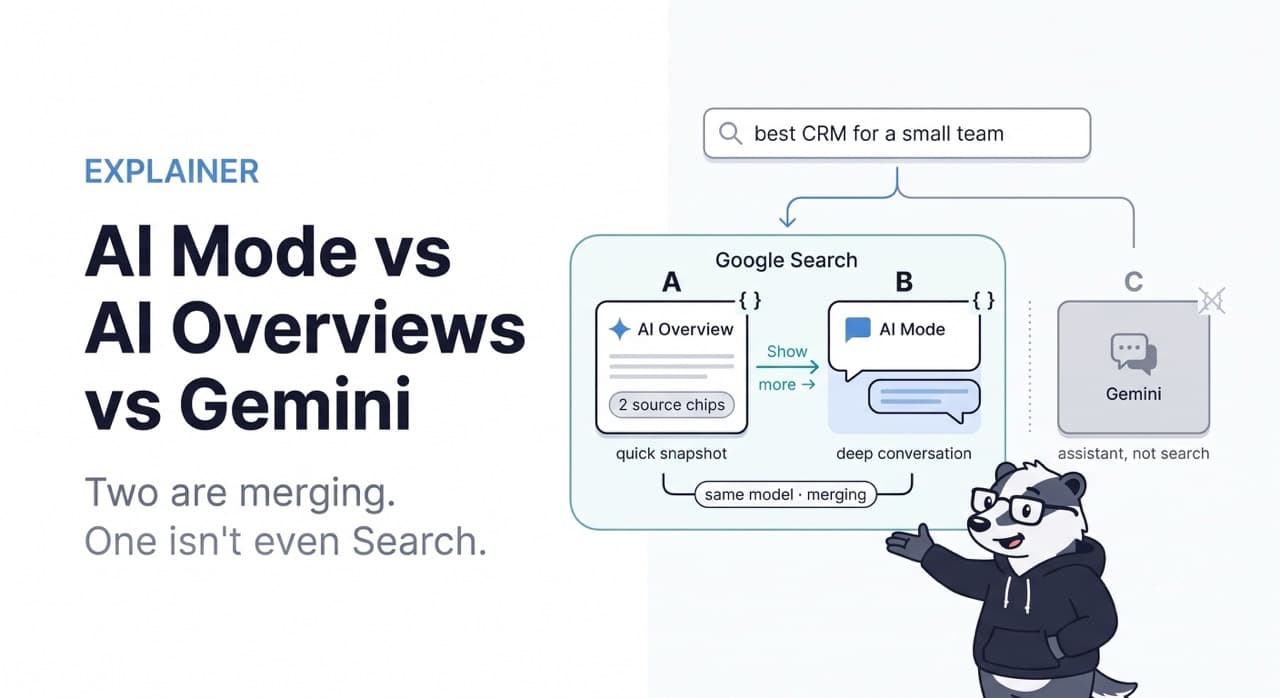
Ask a friend who works in search marketing to explain the difference between AI Overviews, AI Mode, and Gemini, and watch them hesitate. Not because they don't know — because the honest answer changed in January 2026, and a lot of the explainers still floating around describe a world that no longer exists. Most articles on this topic draw three tidy boxes and call it done. The reality is messier and more interesting: two of these three are actively merging into one thing, the third is off doing something different, and Google has spent the last year deliberately blurring the line everyone's trying to draw.
So instead of three definitions, let's do one thing: take a single real question and follow it through all three surfaces. Watch how each one handles it, where they overlap, where they diverge — and, because that's the practical reason most people are asking, how you'd actually capture data from each. The question we'll follow: "what's the best CRM for a small real estate team?" A normal commercial query, the kind a real buyer types, the kind a business would kill to show up in.
Surface One: The AI Overview — The Answer You Didn't Ask For
You type the CRM question into normal Google Search and hit enter. Before the ten blue links, a boxed AI-generated summary appears at the top: a few paragraphs naming several CRMs, describing what each is good for, with a cluster of source links off to the side. You didn't opt into anything. You did a normal search; Google decided this query deserved a summary and generated one.
That's an AI Overview. It lives on the standard search results page, it's triggered by Google rather than requested by you, and the blue links still exist underneath it. It's the most passive of the three surfaces from the user's side — it comes to you.
Here's what most explainers get wrong about it in 2026. As of January 27, 2026, Gemini 3 became the default model powering AI Overviews globally — the same model family that runs AI Mode. Before that, Overviews ran on a lighter model and only routed the hardest queries to Gemini 3 through a router. Now every Overview, worldwide, runs on the heavier reasoning model. That single change quietly rewired how Overviews pick and cite sources, which matters enormously if your visibility depends on being one of those cited links.
How you capture it: AI Overviews are the one surface with a clean programmatic path, because they render on the normal search results page. The catch is that Google loads the Overview through a deferred, asynchronous request — it doesn't arrive in the initial page HTML, which is why naive scrapers miss it entirely and report "no Overview" when one is clearly there. ScrapeBadger's Google Search endpoint handles this with an ai_overview flag: set it, and the scraper chases Google's deferred Overview token and merges the resolved summary — text plus the cited source URLs — back into the structured response. You get the Overview the user sees, including which domains it credited, as JSON.
python
from scrapebadger import ScrapeBadger

client = ScrapeBadger(api_key="your_key")

result = client.google.search(
    q="best CRM for a small real estate team",
    ai_overview=True,   # chase the deferred AI Overview token and merge it in
    gl="us", hl="en",
)

overview = result.get("ai_overview")
if overview:
    print(overview["text"])              # the summary the user sees
    for src in overview["sources"]:      # the domains it cited
        print(src["title"], src["url"])
That cited-sources list is the whole game for anyone tracking AI visibility — it's the answer to "did we make it into the Overview for this query, and who else did."
Surface Two: AI Mode — The Answer That Wants a Conversation
Now take the same CRM question, but instead of typing it into normal search, you tap into AI Mode — Google's dedicated conversational search tab. The response is different in character: longer, more structured, more thorough, and — crucially — it invites a follow-up. You can reply "which of those is cheapest for a two-person team?" and it answers in context, remembering the original question. It behaves like a conversation with a search engine, not a lookup.
Under the hood, AI Mode uses a technique Google calls query fan-out: it breaks your question into subtopics, searches each one simultaneously, then synthesizes the results into a single response. For "best CRM for a small real estate team," it might separately search for real-estate-specific CRMs, small-team pricing, ease of setup, and integrations — then weave those threads together. That fan-out is why AI Mode answers tend to be more comprehensive than an Overview, and why they cite a wider, sometimes different set of sources. By Google I/O 2026, AI Mode had moved to Gemini 3.5 Flash as its default and, per Google, AI Mode queries were more than doubling every quarter.
Here's the part that breaks the "three separate boxes" model. As of that January 2026 update, AI Overviews and AI Mode are no longer cleanly separate. Finish reading an Overview and tap "Show more," or ask a follow-up, and Google carries you — and your context — straight from the Overview into an AI Mode conversation. Google's own framing is that it's one fluid experience: a quick snapshot when you want it, a deeper conversation when you don't. So these two aren't really "versus" each other at all. They're the shallow end and the deep end of the same pool, and Google built a ramp between them on purpose.
How you capture it: AI Mode is harder to access programmatically than Overviews precisely because it's conversational and doesn't render as a simple results page — there's no deferred token to chase on a standard SERP. The practical approach is to treat it as its own surface: query the AI Mode experience directly and capture the synthesized answer plus its citations. This is exactly the AI Mode scraping problem — the response is streamed and structured differently from a normal SERP, so it needs handling built for that surface rather than a generic scraper. The payoff is the same shape of data as the Overview: the answer text and the sources it drew from, which together tell you whether you're present in the deeper, higher-intent surface where buyers go to actually decide.
Surface Three: Gemini — The One That Isn't Search
Now do something different with our CRM question: open the Gemini app and ask it there. You'll get a helpful answer — possibly a very good one — but notice what's different. Gemini is a standalone AI assistant, a separate product from Google Search entirely. It's a chatbot you go to, not a summary that comes to you, and not a search tab. It's built around the model's reasoning first, and it reaches out to the web only when it decides it needs to, rather than treating fresh web results as the whole point.
This is the distinction that matters most for anyone thinking about visibility, and it's worth stating plainly: Gemini is a workspace, not a search engine. People go to Gemini for long-running tasks — drafting, analyzing, coding, thinking through a problem across many turns — not for the quick "which CRM" lookup they'd do in Search. And as practitioners who track this closely have noted, Gemini doesn't return links to your site in any volume comparable to Search. It's a chatbot. So the common question "how do we optimize for Gemini?" mostly has the answer: you don't, not the way you optimize for the two Search surfaces, because Gemini isn't a discovery channel that sends referral traffic in meaningful amounts.
How you capture it: because Gemini is a conversational assistant rather than a search surface with cited results pages, it isn't a "scrape the SERP" target the way Overviews and AI Mode are. There's no results page with a ranked, cited source list to capture. If your goal is tracking brand visibility in Google's AI, your effort belongs on the two Search surfaces — AI Overviews and AI Mode — where the answers cite sources, send traffic, and directly affect discovery. Gemini is worth understanding so you can tell it apart from the surfaces that actually move your numbers, which is the whole reason this confusion is worth clearing up.
The Picture Once You Step Back
Follow that one CRM query through all three and the real relationship becomes clear, and it's not three equal siblings.
Two of them — AI Overviews and AI Mode — are the same system at different depths. Same underlying Gemini model family, same job of answering a search query with cited sources, now stitched together so a user flows from the quick Overview into the deep AI Mode conversation without a seam. Google spent 2025 and early 2026 deliberately merging them, and treating them as rivals misreads where this is going. For anyone who cares about being found, these two are the arena. They cite sources, they send traffic, and being present in them is the new version of ranking.
The third — Gemini — is a different kind of thing wearing a similar coat. A reasoning assistant for tasks, not a search surface for discovery. Genuinely useful, genuinely important to Google's strategy, and genuinely not where your search visibility is won or lost.
That's the distinction the tidy-three-boxes explainers miss, and it's the one worth remembering: the "versus" that people frame as three-way is really two Search surfaces converging into one, plus a workspace assistant off to the side. Get that straight and everything downstream — where to track visibility, what to optimize, what to ignore — falls into place. The reason to be able to capture data from each is exactly this: to know which surface a buyer met you on, and to focus your attention on the two that actually decide whether they meet you at all.
A closing caveat, because this space moves fast: every specific here — which model powers what, how the handoff behaves, what's default — is a snapshot of a system Google is actively reshaping. The three-way convergence described above is the direction of travel, and it's worth re-checking the current state rather than assuming today's configuration is permanent. The structural point holds even as the details shift: two Search surfaces merging, one assistant apart.
Free trial at scrapebadger.com/google-scraper-api — 1,000 credits, no card. Full docs at docs.scrapebadger.com.
Common Questions
Are AI Overviews and AI Mode the same thing now? Not identical, but no longer cleanly separate. They run on the same Gemini model family, and as of January 2026 you can move directly from an AI Overview into an AI Mode conversation carrying your context with you. Think of the Overview as the quick snapshot on the results page and AI Mode as the deep, conversational continuation of the same query — the shallow and deep ends of one pool, not two rival products.
If I can only track one surface for visibility, which? AI Overviews, for most businesses. They appear on the standard results page for a huge range of queries and reach the broadest audience, and they're the most straightforward to capture programmatically. AI Mode is the higher-intent, deeper surface worth adding once you're tracking Overviews, since it's where users go to actually decide. Both cite sources; both affect discovery.
Should I optimize for Gemini? Mostly no, not the way you optimize for Search. Gemini is a standalone assistant for tasks, not a discovery channel — it doesn't send referral traffic to your site in volumes comparable to Search, and it doesn't surface a ranked list of cited sources the way the two Search surfaces do. Your AI-visibility effort belongs on AI Overviews and AI Mode.
Why do naive scrapers miss AI Overviews? Because Google loads the Overview through a deferred, asynchronous request rather than including it in the initial page HTML. A scraper that only reads the first HTML response sees no Overview even when one is present for the user. Capturing it requires chasing Google's deferred Overview token — which is what the ai_overview flag on the ScrapeBadger Google Search endpoint does before merging the resolved summary and its sources into the response.
Does the model behind AI Overviews actually matter to me? Yes, if you track AI visibility. When Gemini 3 became the default for AI Overviews in January 2026, it changed how Overviews reason about queries and, in turn, which pages they cite and how answers are structured. A model change on the surface you're tracked in can move which sources get credited — so it's worth watching model announcements as visibility events, not just product news.

Written by
Domas Sakavickas
Dom Sakavickas is Co-founder of ScrapeBadger, building web scraping infrastructure for developers and data teams. He writes about the web data market, tool comparisons, and business use cases for scraping. ScrapeBadger is a web scraping API platform specialising in Twitter/X, Reddit and Google data, with dedicated scrapers also covering TikTok, YouTube, LinkedIn, Amazon, eBay, Zillow and 40+ more: with built-in anti-bot bypass and an MCP server for AI agents.
Ready to get started?
Join thousands of developers using ScrapeBadger for their data needs.