Google Finance API: What Happened to It and What to Use in 2026
 Domas Sakavickas
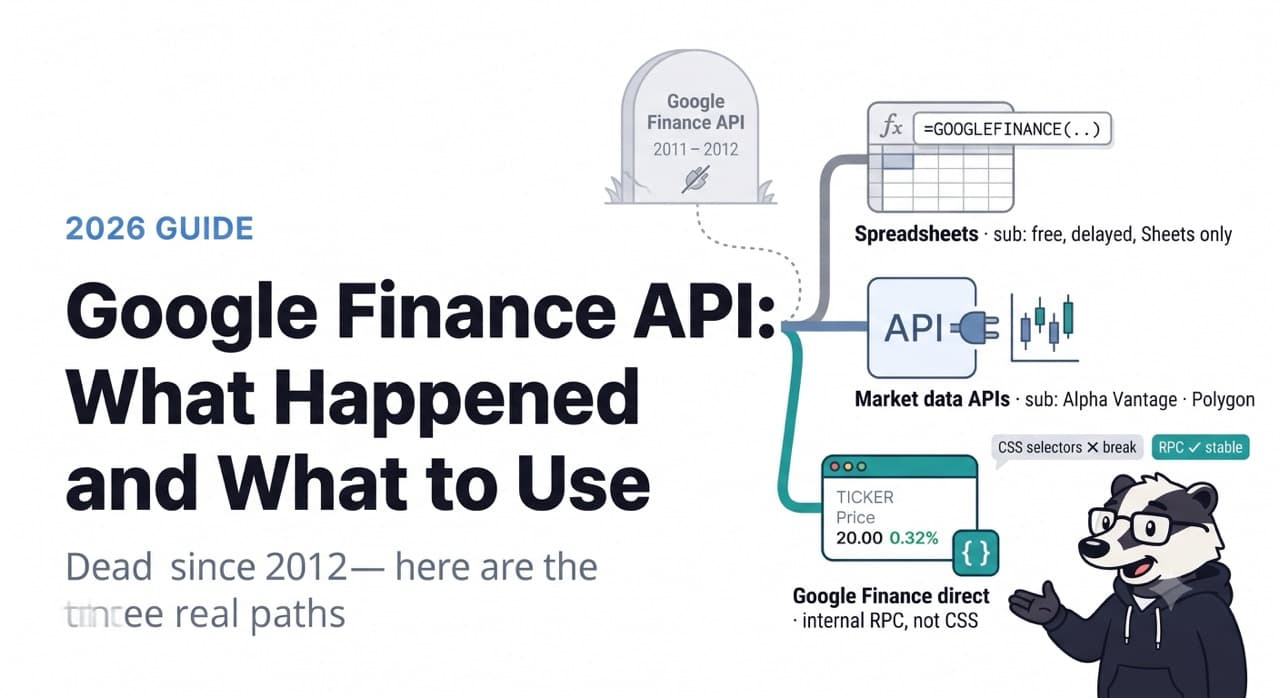
AI Summary: Google deprecated its Finance API on May 26, 2011 and shut it down permanently on October 20, 2012. No official replacement exists. Three paths remain: the GOOGLEFINANCE function in Google Sheets (free, delayed, Sheets-only), market data APIs like Alpha Vantage or Polygon.io for general stock data, and reading Google Finance directly via its internal RPC when you need Google's own figures. Note: IEX Cloud, still widely recommended, shut down on August 31, 2024.
On May 6, 2010, the US stock market fell nearly a thousand points in minutes and clawed most of it back before the hour was out. The flash crash broke a lot of things that day. Market data feeds buckled. Financial APIs timed out or returned garbage. The Google Finance API was one of the few that stayed up and kept serving accurate data through the whole thing, and people who were building trading tools at the time still bring it up.
Google deprecated it a year later, on May 26, 2011, and shut it off permanently on October 20, 2012.
If you have landed here after finding dead documentation, a finance.google.com/finance/info endpoint that returns nothing, or a Stack Overflow answer from 2014 confidently explaining an API that no longer exists — that is why. There is no official Google Finance API, there has not been one for over a decade, and Google has never rebuilt it.
What follows is what actually replaced it, which of the commonly recommended alternatives are still alive (one very popular recommendation has been dead since 2024), and how to decide between the three real paths available in 2026.
Why Google Killed It
The Google Finance API was part of the GData suite, Google's older family of REST APIs, and it did something unusual for the time: alongside quotes and historical prices, it exposed portfolio management. You could create portfolios, query positions, track performance, and wire your Google Finance portfolio into third-party apps. Yahoo's API, its main rival, only served market data. That portfolio layer is a big part of why people remember it fondly and why nothing since has felt like a true replacement.
Google gave two reasons when it went. The first was that a meaningful developer ecosystem never formed around the API. The second was the more telling one: Google decided it could serve more people by folding the data into its own products than by asking developers to write code against an API. That is the same logic that closed several GData APIs in the same wave, and it explains why the replacement was not another API but a spreadsheet function.
First, Which Question Are You Actually Asking?
This is where most guides go wrong, and getting it right saves you a lot of wasted effort. People searching for "Google Finance API" are almost always asking one of two very different questions, and they have different correct answers.
Question one: "I need stock market data." You need prices, historical bars, fundamentals, maybe crypto or forex. Google Finance is incidental — it was just the tool you happened to know. If this is you, the honest answer is that you should not be scraping Google at all. Purpose-built market data APIs exist, they are properly licensed, they give you clean historical series and fundamentals that Google Finance never exposed well, and they are designed for exactly this. Skip to the market data section below.
Question two: "I need Google Finance data specifically." You need the numbers as Google Finance displays them, because your product mirrors what a user sees on that page, or because you need Google's particular coverage of international tickers and cross-exchange listings, or because you are reconciling against Google's figures. Google Finance is the source of truth for your use case, not a convenient proxy for the market. This is a genuinely different requirement, and it has a genuinely different answer.
Most people are asking question one and think they are asking question two. Sort that out before you write any code.
A Short Detour Through the Graveyard
Before the recommendations, something worth knowing about this particular corner of the software world: financial data APIs die at an unusual rate. This is not a Google story. It is a pattern, and it should shape how you choose.
Yahoo's finance API — the other giant of that era — was killed in 2017. Quandl, beloved by quants, was absorbed into Nasdaq Data Link and reshaped. And most importantly for anyone reading recommendations written in the last two years: IEX Cloud shut down on August 31, 2024.
That one matters because IEX Cloud was the developer favourite. Clean API, transparent pricing, genuinely affordable — it was the answer everyone gave when someone asked for a Google Finance replacement. IEX Group announced the wind-down on May 31, 2024 and gave customers three months. The reason was pure economics: IEX Cloud represented less than 2% of IEX Group's revenue and had operated at a loss since inception, so the parent refocused on its core exchange business. No successor product. Thousands of dashboards, bots and side projects went dark.
Here is the practical warning. Search "Google Finance API alternatives" today and you will find articles on the first page of Google still recommending IEX Cloud — nearly two years after every one of its endpoints stopped responding. If you follow one of those lists, you will spend an afternoon integrating against a service that no longer exists.
The lesson is not that APIs are bad. It is that in market data specifically, the free and cheap tiers are structurally fragile: serving quality financial data cheaply is brutally hard economics, exchanges charge for their feeds, and the vendor absorbing that cost is usually subsidising you until it decides to stop. Choose accordingly, and check that anything you are about to integrate still exists.
Path One: The GOOGLEFINANCE Function
The only officially supported way to get Google's financial data today is the GOOGLEFINANCE function inside Google Sheets. It is not an API — it is a spreadsheet formula that pulls Google Finance data into a cell:
=GOOGLEFINANCE("NASDAQ:AAPL", "price")
=GOOGLEFINANCE("NASDAQ:AAPL", "close", DATE(2026,1,1), DATE(2026,6,30), "DAILY")
It takes a ticker, an attribute (price, volume, high, low, marketcap, pe and others), and optionally a date range and interval for historical series. For a personal portfolio tracker or a quick analysis, it is genuinely good, free, and requires no key.
Its limits are equally real, and you should know them before building anything on it:
It only works in Google Sheets. Not Excel, not your application, not a script running anywhere else. You can bridge it into Python via the Sheets API with something like
gspread, but that is a spreadsheet acting as a middleman, not a data pipeline.The data is delayed, typically by around 15–20 minutes for many exchanges. It is not a real-time feed.
There is no service guarantee. It is a consumer spreadsheet feature. It is not a supported data product with an SLA, and Google can change or limit it without consulting anyone.
Coverage and fundamentals are shallow compared to a real market data provider — fine for price and a handful of ratios, thin for serious analysis.
Use it for spreadsheets. Do not architect a product on top of it.
Path Two: Real Market Data APIs
If you are asking question one — you need market data and Google was incidental — this is your answer, and it is a better answer than anything involving Google Finance.
Alpha Vantage is the most common landing spot, and it absorbed a lot of the IEX Cloud refugees. It covers equities, forex, crypto, and a solid set of technical indicators and fundamentals, with a free API key and a free tier that is workable for prototyping and small projects. The free tier is rate-limited enough that any production workload will need a paid plan, but the API is clean, well-documented, and has been around long enough to trust.
Polygon.io is where you go when you need real-time and depth. It serves tick-level data, full historical archives, aggregates, and WebSocket streaming, and it is licensed for the kind of use where accuracy and latency actually matter — trading systems, serious backtesting, production fintech. It is a paid product for anything meaningful, and priced accordingly. If you are building something where being wrong or late costs money, this tier is where you belong.
Others in the same category worth knowing: Finnhub, Twelve Data, Tiingo, Financial Modeling Prep, and Nasdaq Data Link. Each trades off free-tier generosity, asset coverage, and historical depth differently, and any of them is a more appropriate foundation for a market data application than scraping a consumer website.
Be clear-eyed about the trade-off, though: none of these will give you Google Finance's numbers. They give you the market's numbers, from their own licensed sources. Usually that is what you actually want, and it is better. Occasionally it is not — which brings us to the third path.
Path Three: When You Genuinely Need Google Finance Itself
There is a real set of use cases where no market data API will do, because the requirement is Google Finance specifically:
Your product displays or reconciles against what a user sees on the Google Finance page
You need Google's coverage of international tickers and its cross-exchange listing data, which is unusually broad
You are monitoring Google's own presentation of a company — the figures, the currency, the exchange it defaults to
You need after-hours and market-state information exactly as Google reports it
For those, the only route is reading Google Finance directly, since the API is not coming back. And here there is a technical distinction worth understanding, because it determines whether what you build survives contact with production.
The fragile way is what most tutorials teach: fetch the page HTML and parse it with CSS selectors. It works on a Tuesday. Google Finance's front-end class names rotate frequently — even guides that recommend this approach concede that the selectors need constant upkeep — so what you actually build is a maintenance obligation that breaks without warning and often fails silently, quietly returning stale or empty values into whatever depends on it.
The stable way is to read the same internal RPC endpoint that Google Finance's own front end calls to populate the page. ScrapeBadger's Google Finance API does this: it queries Google Finance's internal mKsvE RPC rather than scraping rendered HTML, which means there are no CSS selectors to break when Google reskins the page. A single call returns price, change and change percent, previous close, after-hours data, market hours and state, timezone, currency, country, and alternate exchange listings for the same security — typically in about a second.
It handles the identifier formats you would expect, across asset classes:
python
from scrapebadger import ScrapeBadger

client = ScrapeBadger(api_key="your_key")

client.google.finance_quote(q="AAPL")           # bare ticker
client.google.finance_quote(q="AAPL:NASDAQ")    # exchange-qualified
client.google.finance_quote(q="BTC-USD")        # crypto
client.google.finance_quote(q="EURUSD")         # forex
The gl and hl parameters control country and language, which matters more than it sounds: Google Finance localises currency and default exchange, so an international ticker can resolve differently depending on the locale you query from. If you are reconciling against what a specific user sees, query from their locale.
This sits alongside the rest of the Google endpoints — Search, News, Maps, Shopping, Trends, Scholar, Flights — under one key, which matters if your pipeline pairs a quote with news sentiment on the same company. And through the MCP server, a Claude or Cursor agent can pull quotes and company news as native tool calls, which is a genuinely convenient way to build financial research agents.
How to Decide
The short version, honestly stated:
Building a spreadsheet or a personal tracker? Use GOOGLEFINANCE. It is free, it is officially supported, and it is exactly right for that job.
Building an application that needs market data? Use Alpha Vantage to prototype and Polygon.io when you need real-time depth or your product's accuracy has money attached. Do not scrape a consumer website for data that a licensed provider serves properly. This is the correct answer for most people reading this.
Genuinely need Google Finance's own figures, coverage, or presentation? Then read Google Finance directly, and do it via the internal RPC rather than CSS selectors so that it survives Google's next redesign.
The Google Finance API has been gone for well over a decade, and the honest truth is that the ecosystem that grew up in its absence is better than what it replaced — more specialised, more accurate, better licensed. The one thing genuinely lost was the portfolio layer, and nobody has rebuilt that. Everything else, you can get from something built for the purpose.
Free trial at scrapebadger.com/google-scraper-api/finance — 1,000 credits, no card. Docs at docs.scrapebadger.com.
Quick Answers
Is there a Google Finance API in 2026? No. Google deprecated it on May 26, 2011 and shut it down permanently on October 20, 2012. Nothing official replaced it. The only officially supported access to Google's financial data is the GOOGLEFINANCE function in Google Sheets, which is a spreadsheet formula rather than an API.
Does GOOGLEFINANCE work in Excel? No. It is a Google Sheets function only. Excel users need a different data source or an add-in. You can bridge Sheets values into Python or another environment via the Sheets API, but the function itself does not exist outside Sheets.
What is the best free Google Finance API alternative? For general market data, Alpha Vantage's free tier is the most common starting point — it covers equities, forex, crypto and fundamentals with a free key, though the rate limits mean production use needs a paid plan. Be aware that many "best alternatives" lists still recommend IEX Cloud, which shut down on August 31, 2024.
Is scraping Google Finance legal? Stock prices, indices and trading volumes are publicly available factual data and are generally not subject to copyright, which is why financial data is commonly collected this way. That said, Google's terms restrict automated access as a contractual matter, and market data can carry exchange licensing conditions depending on how you redistribute it. Collect public data, do not republish licensed feeds, and check with a lawyer for your specific situation.
Why do my old Google Finance API calls return nothing? Because the endpoints were switched off in October 2012. Any code still pointed at finance.google.com/finance/info or a similar GData URL is calling a service that has not existed for more than a decade. There is no drop-in replacement URL; you need one of the three paths above.
What was actually lost when the API shut down? Mainly the portfolio functionality. The original API let you create and query portfolios, track positions and performance, and integrate them into third-party apps — something Yahoo's competing API never offered. Quote and historical data are now better served by specialised providers, but no mainstream free alternative rebuilt the portfolio layer.

Written by
Domas Sakavickas
Dom Sakavickas is Co-founder of ScrapeBadger, building web scraping infrastructure for developers and data teams. He writes about the web data market, tool comparisons, and business use cases for scraping. ScrapeBadger is a web scraping API platform specialising in Twitter/X, Reddit and Google data, with dedicated scrapers also covering TikTok, YouTube, LinkedIn, Amazon, eBay, Zillow and 40+ more: with built-in anti-bot bypass and an MCP server for AI agents.
Ready to get started?
Join thousands of developers using ScrapeBadger for their data needs.