How Brands Use Leboncoin Data for French Market Intelligence
 Domas Sakavickas
AI Summary: This article argues that Leboncoin, France's largest classifieds marketplace, is a continuous public dataset for French market intelligence, showing how secondary-market resale prices and listing activity reveal product satisfaction and lifecycle signals no NPS survey or retail report can match.
Most market intelligence work treats secondary markets as noise. Products are released, sold at retail, and then whatever happens in resale is someone else's problem — the consumer's, the reseller's, the platform's. The brand has already booked the revenue and moved on.
This is an expensive mistake in France in 2026.
Leboncoin is France's largest classifieds marketplace — 30 million active listings, 28 million unique monthly visitors, and the #2 most visited e-commerce platform in France behind only Amazon. It is the primary place where French consumers buy and sell used cars, resell electronics, list properties, post jobs, and offload every category of consumer goods from furniture to fashion. It had 109.9 million visits in May 2026.
The secondary market activity on Leboncoin is not noise. It is a continuous public dataset reflecting what French consumers actually did with the products they bought, what they think they are worth now, and how quickly the market agrees. A consumer electronics brand whose flagship product appears on Leboncoin at 40% of retail price eight months after launch is receiving a market signal about product satisfaction, competitive alternatives, and lifecycle positioning that no NPS survey or retail sales report can provide with the same speed or granularity.
Leboncoin covers every major commercial category in France through a single platform. That is the specific characteristic that makes it more commercially valuable than category-specialist alternatives. A fashion brand, an automotive manufacturer, a consumer electronics company, and a real estate agency can all extract genuinely useful intelligence from the same data source — with different queries and different analysis, but the same infrastructure.
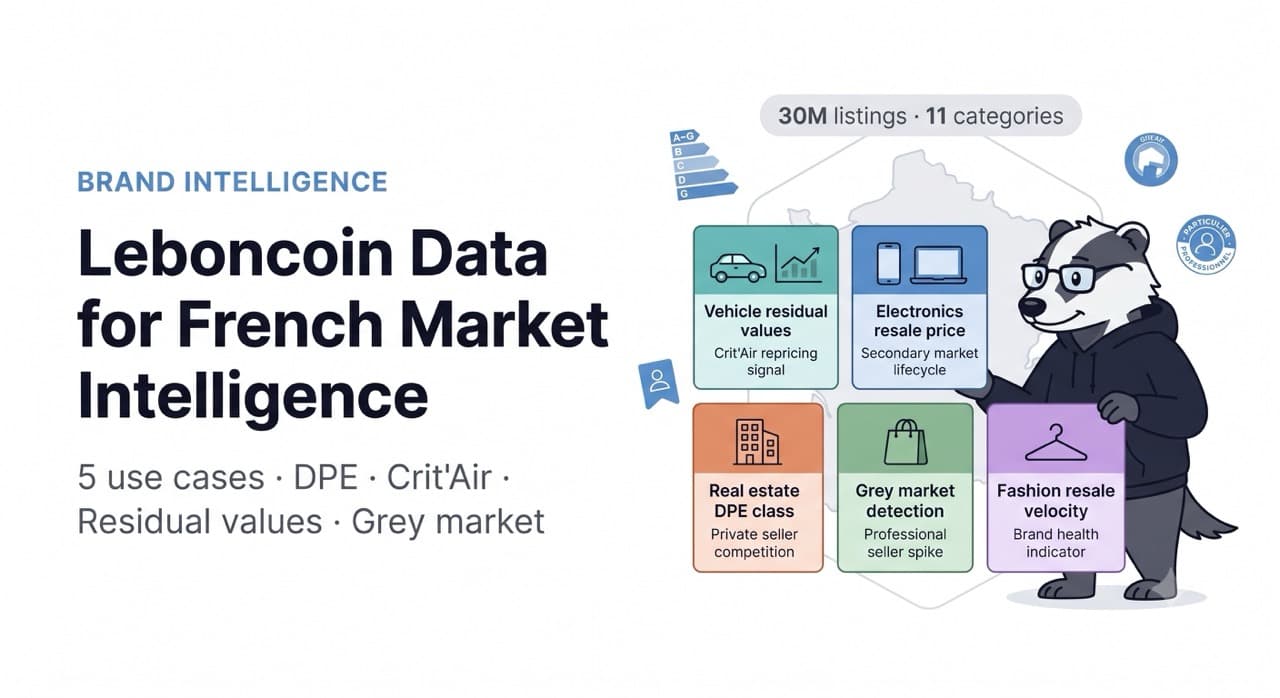
This guide covers the five specific brand intelligence use cases where Leboncoin data has demonstrated commercial value, and how ScrapeBadger's Leboncoin Scraper provides the systematic access that makes them practical.
What Leboncoin Actually Contains
Before the use cases, understand what the data fields are. Leboncoin listings are not uniform — the fields vary significantly by category, and the category-specific fields are where the commercial intelligence lives.
All listings: title, description, price, seller type (particulier/professionnel), GPS coordinates, city, département, postal code, listing publication date, listing URL, images.
Vehicle listings add: brand, model, year of first registration, mileage, fuel type (essence, diesel, hybride, électrique), gearbox (manual/automatic), engine power in CV, body type, colour, Crit'Air emission sticker rating, seller's other listings count, urgency indicators.
Real estate listings add: surface area in m², number of rooms, number of bedrooms, floor, DPE (Diagnostic de Performance Énergétique) energy class from A to G, floor area, whether it has outdoor space, orientation, condition.
Electronics and consumer goods add: product condition (neuf, très bon état, bon état, correct), brand, model reference, sometimes EAN/ISBN.
Jobs listings add: contract type (CDI, CDD, intérim, freelance), sector, experience level.
Three fields deserve specific attention because they are commercially significant beyond their surface definition.
Seller type (particulier vs professionnel). Every Leboncoin listing declares whether it is from a private individual or a commercial entity. This is not self-reported on a voluntary basis — professional sellers are required to register and are identified automatically when they exceed thresholds. The distinction is commercially meaningful: a wave of professional-seller listings for a specific product at below-retail prices indicates distributor or retailer stock clearance. A single professional seller posting 200 units of the same product in one week is a grey market signal, not a private seller signal.
Crit'Air rating. France's ZFE (Zone à Faibles Émissions) legislation requires all vehicles entering 14 major French urban zones to display a Crit'Air sticker indicating their emission level. Crit'Air 3, 4, and 5 vehicles are progressively being banned from more zones. Paris banned Crit'Air 4 and 5 vehicles from circulation in 2022; Crit'Air 3 bans have been extending across Lyon, Grenoble, Montpellier, Rouen, Strasbourg, Toulouse, Nice, and others through 2024–2026. The practical consequence: vehicles with high Crit'Air numbers are becoming harder to use in the areas where most buyers live, and this is actively depressing their Leboncoin asking prices and extending their time to sell. For automotive manufacturers and fleet managers, this makes Crit'Air a real pricing factor visible in Leboncoin data right now.
DPE energy class. France's energy performance regulations have been progressive since 2022: G-rated properties have been banned from new rental contracts since January 2025, F-rated properties follow in 2028, E-rated in 2034. Properties with F and G ratings are currently trading at discounts of 10–20% compared to equivalent properties with better DPE ratings in most French cities. This discount is directly visible in Leboncoin real estate listings if you can collect price and DPE data at scale — which is only possible systematically.
Five Brand Intelligence Use Cases
1. Consumer Electronics: Secondary Market as Product Lifecycle Signal
The secondary market price for a brand's product is the market's honest assessment of its value — more honest than retail because the buyer is not persuaded by advertising, shelf placement, or bundled trade-in offers. They are choosing between your used product and the competition's used product at a price they have determined.
When a smartphone appears on Leboncoin at 35% of its launch retail price six months after release, that is market information. When the same model appears at 55% of retail at the same point in time — and sells within two days at that price — that is a different and more positive signal. The sell-through velocity is as important as the price level.
Consumer electronics brands operating in France track this because it feeds decisions that are not typically connected to secondary market data: new product launch timing, trade-in programme valuation, refurbishment investment decisions, and battery replacement programme pricing all benefit from knowing where the secondary market has priced current-generation products.
The specific analysis that Leboncoin data enables: tracking the average asking price and listing count for specific models over time. When a model's listing count rises sharply — more units appearing in the used market — while the average asking price is flat or falling, it indicates a product reaching the end of its primary ownership cycle. When listing count rises but prices hold or rise, it indicates a product that retains value in the secondary market, which is a different story about product satisfaction and absence of a compelling upgrade.
Brands that compare this analysis across their own products and competitors' products in the same category — pulling both from Leboncoin simultaneously — see the relative secondary market positioning in a way that no official data source can replicate.
2. Automotive: Residual Values, Crit'Air Repricing, and Regional Arbitrage
Leboncoin is one of France's major automotive classified platforms — the French used car market reached €84.39 billion in 2026, growing at 11.56% CAGR, and Leboncoin is explicitly cited as a key platform alongside La Centrale and AutoScout24. New car registrations fell 7% year-on-year through April 2025 while used car transactions climbed 3.1%. The structural shift toward used vehicles is increasing the commercial relevance of the used car pricing data that Leboncoin hosts.
The automotive intelligence applications from Leboncoin data fall into three distinct use cases.
Residual value curves. The standard residual value methodology uses auction house data and fleet sales. Leboncoin's retail consumer listing data provides a complementary signal: what the private market is willing to ask and accept for a specific model at a specific age and mileage. Comparing Leboncoin-derived retail residual values against auction-derived trade residual values shows the spread between the two — a wide spread indicates a market where retail sellers are repricing faster than trade benchmarks have caught up, or vice versa.
Crit'Air repricing. The ZFE legislation is creating a two-tier used car market in France that no historical residual value model anticipated. A 2018 diesel with Crit'Air 3 rating is being repriced downward faster than the same year's petrol equivalent with Crit'Air 2, even at identical mileage and condition, because the addressable market for the diesel is shrinking as ZFE zones expand. This divergence is visible in Leboncoin listing data by filtering for fuel type and Crit'Air rating alongside price and date. For manufacturers whose fleet clients or dealer network have significant Crit'Air 3 and 4 vehicle exposure, this data is commercially significant for residual guarantee programmes and lease end valuations.
Regional arbitrage. Leboncoin's GPS and postal code data reveals significant geographic price variation for the same vehicle. A 2020 Renault Zoe with 45,000km listed in Paris suburbs consistently prices higher than the same specification listed in rural Brittany or Normandy, because the addressable buyer population for an electric vehicle is higher in urban areas with better charging infrastructure. For dealers managing multi-site inventory, this geographic pricing data informs transfer pricing between locations.
3. Retailers: Grey Market Detection and Stock Clearance Signals
When a consumer goods brand sees their product listed in bulk by professional sellers on Leboncoin at 30–40% below their recommended retail price, two things are happening: someone in their distribution chain has excess stock they cannot move at standard margins, and that stock is now competing with their own retail pricing in the French market.
This is the grey market signal. It appears consistently in several patterns: a distributor approaching year-end with overstock selling through a professional Leboncoin account, a retailer receiving discontinued stock they need to clear, or a parallel importer bringing product from a lower-price market.
The professional seller field on Leboncoin is the filter that makes this detectable. Private individuals selling one or two units of a product are normal secondary market activity. A professional seller listing fifty units of the same SKU at a consistent price point is a different signal — it indicates commercial inventory management rather than personal resale.
Tracking professional seller activity by product and SKU across time reveals the seasonality of grey market activity. Consumer electronics brands consistently see professional Leboncoin selling volumes spike in January (post-Christmas returns and overstock clearance) and in September (back-to-school product changeover). For inventory planning and MAP policy enforcement, knowing the geographic concentration and timing of professional-seller activity on Leboncoin is actionable commercial intelligence.
The secondary application is distributor health monitoring. A distributor whose Leboncoin selling volume rises sharply suggests they are struggling to clear through standard channels. For brands managing distributor relationships and payment terms, this is an early warning signal that is faster than any financial filing.
4. Real Estate Agencies: Private Seller Competition and DPE Repricing
Leboncoin became France's #1 real estate platform — ahead of SeLoger — for total listing volume, driven by its dominant position in private seller listings. Professional agencies dominate on SeLoger, PAP, and similar platforms. Leboncoin hosts both, with the private seller segment being its structural advantage.
For real estate agencies operating in specific French markets, monitoring Leboncoin's private seller listings is competitive intelligence in the most direct sense. Private sellers price their properties differently from professional agencies — they often price without access to comparable sold data, which means they sometimes undervalue significantly and sometimes overvalue significantly. The distribution of private seller pricing in a département tells an agency where their professional fee is competitive and where private sellers are currently undercutting it.
The DPE application is more specific and currently urgent. Since January 2025, G-rated properties cannot be listed on new rental contracts in France. Since F-rated properties follow in 2028, the market is already beginning to price in the F-class discount. Leboncoin's real estate listings include DPE class as a structured field. Filtering Leboncoin real estate listings by DPE class and tracking the price differential between C/D properties and E/F properties in the same city, same property type, and similar surface area produces the local DPE discount rate — the amount the market is currently applying for energy class in that specific market.
This DPE discount rate is not available from any official French real estate data source in real time. It requires collecting listing data, filtering by energy class, and computing the differential. For real estate agencies advising clients on renovation investment decisions — whether the cost of upgrading from F to C DPE is covered by the price uplift — the local DPE discount rate is the key input. Leboncoin is the most efficient source of that input because it is France's highest-volume real estate listing platform.
5. Fashion and Lifestyle Brands: Resale Velocity as Brand Health Indicator
Vinted dominates fashion resale in France. But Leboncoin's fashion and leisure categories carry significant volume, and their most commercially useful characteristic for brand intelligence is different from Vinted's: Leboncoin is a general marketplace where fashion competes for attention against every other category. The brands whose products hold value and move quickly in Leboncoin's fashion category are genuinely in demand. The brands whose products sit unsold at declining prices are providing a signal about brand loyalty and product satisfaction that no retailer would volunteer.
The specific metric is resale velocity relative to listing count. A fashion brand that sees 500 listings for their products in the French market and observes those listings averaging 8 days to go inactive (sold, expired, or removed) is performing very differently in the secondary market from a brand with 500 listings averaging 45 days to go inactive. The first brand's products have demand beyond the primary sale. The second brand's products are not generating secondary market enthusiasm.
For brands that are investing in sustainability and circular economy positioning, the secondary market data is not just commercial intelligence — it is evidence for the claims they make about product longevity. A product that moves in the secondary market at 50% of retail after two years of use is more credibly durable than one that moves at 10% of retail. Leboncoin's data provides the French market evidence for or against those claims.
The Private vs. Professional Distinction as a Cross-Category Signal
One commercial intelligence application that cuts across all five use cases is the monitoring of professional seller concentration versus private seller concentration for any product category over time.
When professional sellers dominate a Leboncoin category, it signals commercial infrastructure: dealers, distributors, and organised resellers have decided there is enough margin in this market to operate professionally. This is evidence that the category has scale and liquidity — a healthy secondary market.
When professional seller concentration in a category increases sharply over a short period, it signals incoming supply: commercial entities are accumulating and reselling stock in this category because they can source it at prices below what the Leboncoin market will currently bear. This is an early warning of downward price pressure.
The transition from private-seller-dominated to professional-seller-dominated markets in specific product categories is a commercial signal that no survey, no panel, and no retail data source surfaces in real time. Leboncoin's adType field — particulier or professionnel — makes it measurable.
Combining Leboncoin With Complementary Data Sources
Leboncoin's secondary market intelligence is most valuable when combined with primary market signals from complementary sources.
Google Trends for the same product categories and brand keywords shows search interest trajectory — whether consumer interest is growing, stable, or declining. When ScrapeBadger's Google Trends API shows declining search interest for a product category while Leboncoin listing volume is rising, the combination tells you: fewer new buyers entering the market while more previous buyers are exiting. That is a category in decline that is not yet visible in retail sales data.
Reddit French communities (r/france, r/bons_plans, r/frugalFrance, category-specific subreddits) provide the qualitative dimension. ScrapeBadger's Reddit Scraper surfaces community discussion about specific products, brands, and Leboncoin categories. When Leboncoin pricing data shows compression and Reddit discussion shows consistent complaints about a product's durability or alternatives, the two signals together are more actionable than either alone.
Google Maps business data for specific retail locations — using ScrapeBadger's Google Maps API — adds the physical retail context to Leboncoin's secondary market data. A neighbourhood where retail store ratings are declining while nearby Leboncoin listing volume for the same category is increasing tells a story about shifting consumer behaviour that neither dataset tells independently.
All of these run under the same ScrapeBadger API key, unified billing, and the same credit model with no charge for failed requests.
The Technical Challenge: DataDome
Leboncoin officially partners with DataDome for anti-bot protection — a fact confirmed by Leboncoin Group's own communications. DataDome evaluates every incoming request against TLS and browser fingerprints, IP reputation, and behavioural signals. Standard headless browsers and default request libraries are caught within one or two pages. French residential IP addresses are required — not European residential, not US residential, but French IPs specifically, because DataDome's behavioural baseline is calibrated against genuine French user traffic patterns.
This is why the approaches that work for other DataDome-protected sites require specific calibration for Leboncoin. The combination of DataDome, the French IP requirement, and the Next.js __NEXT_DATA__ embedded JSON structure (which is where the useful listing data lives, not in the HTML elements) means most general-purpose scrapers fail silently — they return what looks like a page response but contains either a challenge page or incomplete listing data.
ScrapeBadger's Leboncoin Scraper handles DataDome bypass with French residential proxy routing automatically. You query the endpoint with a category, location, and keyword. ScrapeBadger handles the French IP routing, DataDome bypass, and Next.js JSON extraction. You receive structured listing data. Zero credits for failed requests means the bypass failure rate does not inflate your costs.
Free trial at scrapebadger.com/leboncoin-scraper — 1,000 credits, no credit card required. Full documentation at docs.scrapebadger.com.
FAQ
Does Leboncoin have a public API?
No. Leboncoin has no public API for listing data. The platform has internal APIs powering its own mobile apps and website, but these are not documented, not officially accessible, and are protected by DataDome. Scraping is the only path to systematic Leboncoin data access.
What is the difference between monitoring Leboncoin and monitoring Vinted or SeLoger?
Vinted covers only fashion and second-hand clothing. SeLoger covers only real estate, and primarily professional agency listings. Leboncoin is the only French platform that spans real estate (private and professional), vehicles, electronics, furniture, fashion, jobs, and services in one data source. For brands that want to understand French consumer behaviour across multiple product categories, Leboncoin is uniquely positioned. The tradeoff is that SeLoger provides more complete professional real estate data, and Vinted provides more fashion resale volume — but neither provides the cross-category picture.
Is the DPE data mandatory and structured on all Leboncoin real estate listings?
DPE has been mandatory to display on all French real estate for sale and rental listings since September 2022 (for sales) and January 2021 (for rentals). Compliance is not 100% — some private sellers omit it despite the legal requirement — but coverage is high enough that DPE class is a reliable field for systematic analysis. The field is structured (A through G) rather than free text, which makes it filterable and quantifiable at scale.
Can Leboncoin data be used alongside data from other French platforms?
Yes, and the combination is often more useful than either source alone. Leboncoin's private seller data combined with SeLoger's professional agency data in the same city gives the full picture of real estate supply. Leboncoin's used vehicle data combined with La Centrale's pricing provides cross-platform residual value validation. ScrapeBadger's platform covers Leboncoin alongside Google Trends, Google Maps, and Reddit, enabling the multi-source analysis described in this article.
What makes professional sellers on Leboncoin detectable versus private individuals?
Every Leboncoin listing carries an adType field that distinguishes particulier (private individual) from professionnel (commercial entity). Professional sellers are required to register as such on the platform and display their commercial status visibly. This is enforced through French commercial law and Leboncoin's platform terms. The distinction is reliable as a data field, though some small professional sellers may operate under private accounts in violation of platform terms.

Written by
Domas Sakavickas
Dom Sakavickas is Co-founder of ScrapeBadger, building web scraping infrastructure for developers and data teams. He writes about the web data market, tool comparisons, and business use cases for scraping. ScrapeBadger is a web scraping API platform specialising in Twitter/X, Reddit and Google data, with dedicated scrapers also covering TikTok, YouTube, LinkedIn, Amazon, eBay, Zillow and 40+ more: with built-in anti-bot bypass and an MCP server for AI agents.
Ready to get started?
Join thousands of developers using ScrapeBadger for their data needs.