How to Track Your Brand's Visibility in Google AI Mode
 Domas Sakavickas
AI Summary: This practitioner's guide walks through how to measure how often your brand appears in Google AI Mode answers, starting with a manual method you can run today, and explains why AI engines surface whoever best answers the question on trusted pages rather than reading domain authority.
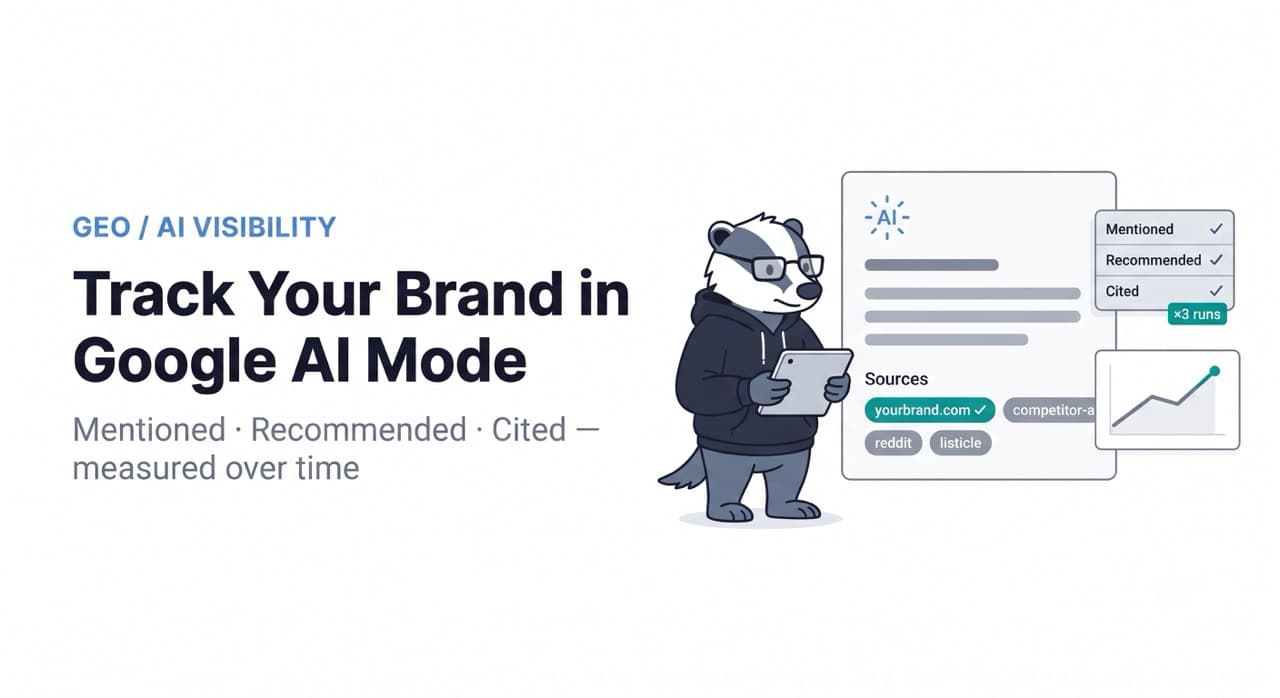
A marketer on r/DigitalMarketing put the problem plainly a few weeks ago: rankings and organic traffic are easy to track, but there's no clean way to measure how often your brand shows up when someone asks Google AI Mode a question. The thread filled with agency owners and in-house SEOs comparing notes, and one detail stood out. Some brands with weak domain authority were showing up in AI answers more consistently than bigger competitors — purely because of how their content was structured. As one commenter put it, engines don't read domain authority; they read whoever is actually answering the question on pages they already trust.
That is the whole game in one sentence, and it is why the old measurement stack doesn't work here. This guide is a practitioner's walkthrough of how to actually measure your brand's presence in Google AI Mode — starting with a manual method you can run this afternoon in a spreadsheet, then scaling it into something automated once the manual version proves its worth. It is deliberately not a pitch for a dashboard. Most of what matters you can do yourself, and understanding the mechanics first is what makes any tool you eventually buy worth the money.
Why This Is Different From Rank Tracking
Google AI Mode does not return ten blue links. It returns a synthesized answer that pulls from multiple sources, names a handful of them, and frequently resolves the question without the user clicking anywhere. The unit of visibility has shifted. It is no longer "what position does my URL hold" but "does the answer mention me, does it recommend me, and does it cite my page as a source." Those are three different things, and — this is the part most people miss — they move independently of each other.
Your existing tools are structurally blind to this. A rank tracker looks for your URL's position in a list; AI Mode has no such list. Search Console shows your own property's impressions and clicks, including some AI-surface data, but it never shows the full competitive picture — who else got named for a query, how you compare, or what the answer actually said about you. Analytics only records visits that happened, and AI Mode's defining trait is the visit that doesn't happen: you shaped the buyer's shortlist inside the answer, they never clicked, and your dashboard shows nothing. The visibility that matters most is the visibility your current stack cannot see.
One clarification before going further, because the terms get muddled constantly. AI Overviews are the summaries that appear above the normal blue links. AI Mode is the separate, dedicated conversational search experience where the answer is the result. Gemini is the standalone assistant, a different product entirely. This guide is about AI Mode specifically, though the method transfers cleanly to AI Overviews and to other answer engines like ChatGPT and Perplexity — and running more than one engine is something I'll come back to, because it matters.
Start Manual: The Method Before the Tool
The single best piece of advice from that Reddit thread was blunt: manual prompting with a system beats no system, and you do not need an expensive dashboard to do it properly. Before automating anything, run the method by hand. You will understand your own category better for it, and you will know exactly what to automate later instead of paying for features you don't need.
Here is the manual version, start to finish.
Build a fixed prompt panel. Write 20 to 30 questions a real buyer would actually type into AI Mode. Not your brand name — that is vanity, and it tells you nothing about how you get discovered. The questions that matter are the ones a prospect who has never heard of you would ask: "best [category] tool for [use case]," "[competitor] alternatives," "is [approach] worth it for [situation]," "how do I [the job your product does]." Mix category questions, comparison questions, and use-case questions. The word fixed is the important one. If the panel changes week to week, you cannot compare anything; the whole point is watching the same questions over time.
Run each prompt more than once. This is the step almost everyone skips, and it is the one that separates a real measurement from a screenshot. The same prompt, in the same engine, produces different answers on different runs. Run each prompt three times and record the result as a range, not a single figure. The variance is not noise to be smoothed away — it is itself the finding. A brand that appears in one run out of three is fragile; it is on the edge of the answer and could drop out any week. A brand that appears in three out of three is entrenched. Those are completely different competitive positions, and a single run would hide the difference entirely.
Score three levels separately. For each answer, record three distinct signals, because they mean different things and change at different speeds:
Mentioned — does your brand appear in the answer at all?
Recommended — does the answer actively endorse you, versus merely listing you among options?
Cited — does the answer link your page as one of its sources?
Being cited as a source is the deepest form of visibility, because it means your own content is feeding the answer. Being recommended without being cited means the model is drawing on its training or on third-party sources that speak well of you. Being mentioned but not recommended is a foothold, not a win. Tracking them separately turns a vague sense of "we're kind of in there" into a diagnosis you can act on.
Trace the sources. This is where measurement stops being an ego exercise and starts producing a to-do list. For every answer, look at which pages the engine actually pulled from. It is almost always a small, repeating set: a few listicles, a couple of directories or review sites, some Reddit threads, the occasional YouTube video or comparison page. Those specific pages are what earned the citation. That list — not a "share of voice" number — is the actual work. Most of it turns out to be ordinary SEO and PR pointed at a handful of very specific URLs.
Log everything with a timestamp. A single snapshot tells you where you stand today; the value is in the trend. Store every run — date, engine, prompt, the three scores, the sources — so that in a month you are looking at movement, not a one-off reading. Booleans trend; vibes do not. "We appeared in 30% of our prompts this month, up from 12%" is a number you can put in front of a CMO. "We feel more visible in AI" is not.
Done by hand for one brand, this is a spreadsheet and an hour a week. That is genuinely enough to start, and it will already tell you more than most of your competitors know about themselves.
Where It Breaks — and Why You Automate
The manual method has one failure point, and it is predictable: it does not survive scale. One brand, once a week, is fine. The moment you are running a fixed panel three times each across multiple engines, weekly, for several brands or several markets, the manual version collapses under its own repetition. Thirty prompts times three runs times two engines is 180 queries per cycle per brand, done consistently enough that the numbers stay comparable — and consistency is exactly what humans are bad at.
That is the point where automation earns its place, and notice what you are automating: not the thinking, just the collecting. The prompt design, the source diagnosis, the decisions about what to fix — those stay human. What you hand to a machine is the repetitive capture of answers and the parsing of each one into those same discrete signals you were recording by hand.
Mechanically, an automated version runs your fixed prompt panel through ScrapeBadger's Google AI scraping endpoints on a schedule, capturing each answer and its cited source URLs as structured data. A language model then reads each answer and classifies it against your brand and competitors: mentioned yes or no, recommended yes or no, cited yes or no, position in the answer, and the sentiment of how you were described. Every result lands in a table with a timestamp. Conceptually, one captured run looks like this:
prompt: "best web scraping API for social media"
engine: google_ai_mode
run: 2 of 3
captured_at: 2026-07-16
brand_mentioned: true
brand_recommended: true
brand_cited: true      (source: yourbrand.com/social-scraping)
position_in_answer: 1
competitors_present: [competitor-a, competitor-b]
sentiment: positive
Multiply that across your panel, your runs, and your engines, and the schedule does in the background what you proved by hand was worth doing. If you run it through ScrapeBadger's MCP server, an AI agent can handle the capture and the classification in a single loop — pull the answer, identify every brand in it, score the three signals, note the sources, write the row — without custom glue code between steps.
One caveat that the sharper voices in that Reddit thread all raised, and it is worth building into your setup from the start: the result reflects whichever engine you query. A model answering from its training data is telling you its memory of your brand; a live-search surface like AI Mode or Perplexity is telling you your current web visibility. Those are different signals. Run more than one engine, label each result by engine, and treat any single score as one data point among several rather than the truth.
Tracking Is Half the Job. Repair Is the Other Half.
Here is the distinction that separates teams who get value from this from teams who just accumulate dashboards: tracking tells you that a competitor won an answer; the useful work is figuring out why the answer trusted them instead of you, and fixing it. A screenshot of ChatGPT not mentioning you is not insight. The insight is in the sources behind the answer.
So for every prompt where you are missing and a competitor is present, go to the sources the answer used and tag the gap by source class, not by keyword. Was the deciding source a Reddit thread? A YouTube review? A listicle on a third-party site? A comparison page? A review or profile on a directory? Your own how-to guide that doesn't exist yet? The pattern across your missing prompts is your roadmap, and different patterns route to different owners. Missing from the listicles is an SEO and outreach job. Losing on Reddit and YouTube is a community and content job. Weak on comparison pages is a product-marketing job. Assign each gap to whoever owns that surface, give it a repair window, and re-run the same prompt afterward to see if the fix moved the answer.
The question to hold in your head is not "what is our AI rank." It is "which public proof surface would make this recommendation safer for the model to make." Models reward what they can parse and cite — clean structure, direct question-and-answer content, unambiguous information about who you are and what you do — over raw authority. That is why the low-DA brands in the Reddit thread were beating bigger names: they had built the pages that answer the question cleanly, on surfaces the engine already trusts. Measurement points you at those surfaces. The repair is ordinary marketing work, aimed with precision instead of guesswork.
The Honest Limitations
A measurement system is only trustworthy if you know where it is soft. AI Mode answers are not deterministic — the same query varies by run, by user, by region, by time. That is precisely why the multiple-runs rule exists; you are measuring a distribution, not a fixed truth, and the variance is data. Personalization and localization add more spread, so run from a consistent, neutral configuration to hold a stable baseline, and accept that you are measuring your category's baseline rather than every individual user's screen. And AI Mode itself is changing fast: Google is actively reworking how it surfaces answers and what it cites, so treat your setup as a living instrument, not a fixed dashboard. The instability is the reason to start now rather than later — the teams watching the surface as it shifts will adapt faster than the ones who look up in two years wondering where their pipeline went.
Start This Week
You do not need to buy anything to begin. Write your fixed panel of 20 to 30 buyer-intent prompts this week. Run each three times through AI Mode by hand, and record the three signals — mentioned, recommended, cited — plus the sources behind each answer, in a spreadsheet with today's date. That single session will tell you more about your real position in AI search than any vendor's overview page. When the manual version starts eating hours you don't have — more brands, more engines, more markets — automate the capture and the parsing, keep the thinking human, and let the schedule maintain the discipline you proved was worth maintaining.
The question is no longer only where you rank. It is whether you are in the answer, how firmly, and what you can point at to get there. That is measurable now, and the brands that start measuring while it is still hard will spend the next two years making decisions with data their competitors simply do not have.
The Google endpoint documentation is at docs.scrapebadger.com. Free trial at scrapebadger.com — 1,000 credits, no card.
Common Questions
Can't I just use Google Search Console for this? It shows your own property's impressions and clicks, including some AI-surface data, but it has two blind spots that matter here: it never shows who else was named for a query and how your presence compares, and it never shows what the answer actually said about you. The competitive and qualitative picture — the part you can act on — lives in the answers themselves, which is what this method captures.
How many prompts, and how often? Start with 20 to 30 buyer-intent prompts, run three times each, on a weekly cadence. AI Mode answers shift over days and weeks, so weekly captures real movement without redundant effort. The quality of the panel matters far more than the size — a focused set that mirrors how buyers actually ask beats a sprawling list of vanity terms.
Why run the same prompt several times? Because the same prompt produces different answers on different runs, and that variance is the signal. A brand that appears in one of three runs is fragile and could drop out; one that appears in three of three is entrenched. A single run hides that distinction entirely, which is why one-off screenshots are close to useless for tracking.
My brand doesn't appear at all — what now? Confirm your panel is testing buyer questions, not your brand name. Then look at the sources behind the prompts you're losing: they show you which pages and which types of pages the engine trusts for your category. That pattern is your to-do list. Usually the gap is either missing in-depth content that answers the question cleanly, or absence from the third-party surfaces — review sites, communities, listicles — the model leans on.
Does this work for ChatGPT and Perplexity too? Yes. The method is engine-agnostic: fixed panel, multiple runs, three signals, trace the sources, log over time. Just label every result by engine, because a training-data model reports its memory of your brand while a live-search engine reports your current web visibility — different signals worth tracking separately.
Is it allowed to track AI answers programmatically? Monitoring publicly visible answers for your own competitive research is a long-standing marketing practice, the same way brands have always watched search results. As with any scraping, collect only public data, run at reasonable rates, and check with your legal team for your specific situation.

Written by
Domas Sakavickas
Dom Sakavickas is Co-founder of ScrapeBadger, building web scraping infrastructure for developers and data teams. He writes about the web data market, tool comparisons, and business use cases for scraping. ScrapeBadger is a web scraping API platform specialising in Twitter/X, Reddit and Google data, with dedicated scrapers also covering TikTok, YouTube, LinkedIn, Amazon, eBay, Zillow and 40+ more: with built-in anti-bot bypass and an MCP server for AI agents.
Ready to get started?
Join thousands of developers using ScrapeBadger for their data needs.