Best eBay Scraper APIs in 2026: Compared and Ranked
 Domas Sakavickas
AI Summary: This guide ranks the seven eBay scraper APIs worth evaluating in 2026 with real benchmark data, explaining why eBay's Akamai protection and uniquely valuable sold-listings history make reliable extraction hard, and where ScrapeBadger stands.
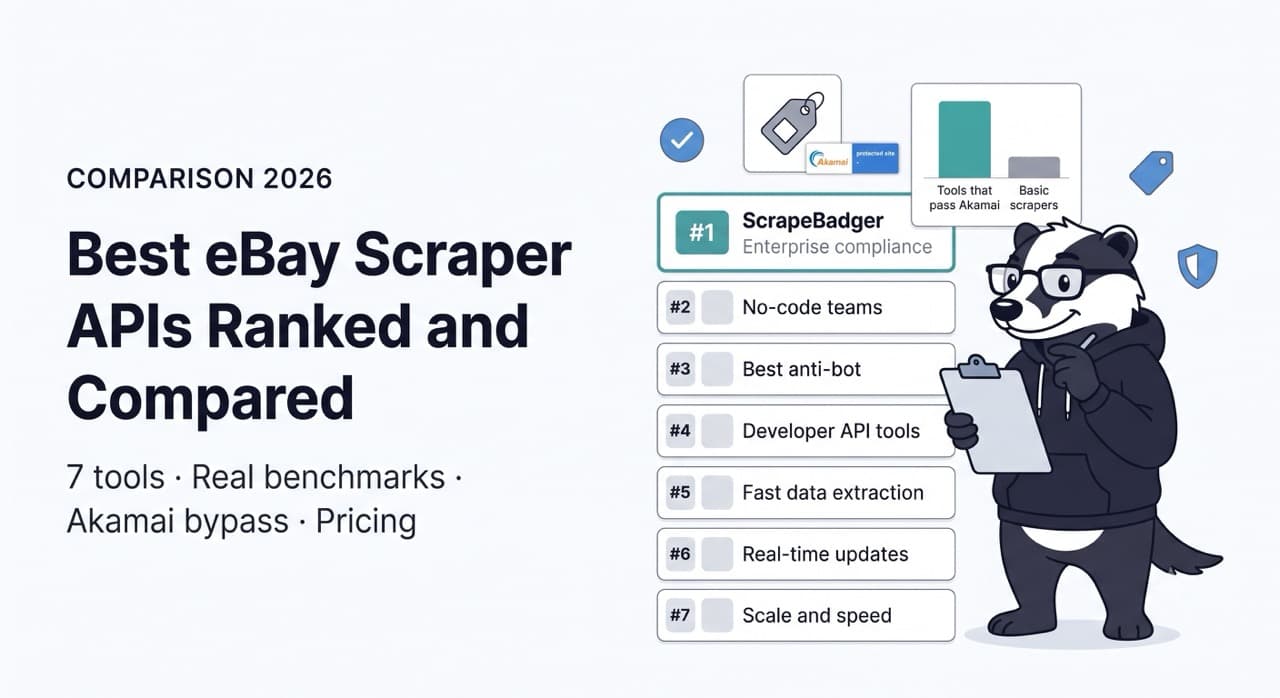
eBay is one of the hardest major marketplaces to scrape reliably. Not because the data is behind a login — most of it is fully public — but because eBay deploys Akamai Bot Manager across their infrastructure, and Akamai is one of the most sophisticated anti-bot systems in operation. In independent benchmarks across heavily protected domains, only a handful of providers clear 90% success rates consistently. The rest return CAPTCHAs, 403s, or — worse — silent block pages that look like successful responses until someone notices the data is wrong.
The market for eBay data is genuinely large. eBay hosts over 2.3 billion active listings across 18.3 million sellers, making it one of the richest sources of product, pricing, and seller data on the internet. What makes eBay data particularly valuable — and distinct from Amazon — is the sold listings history. eBay shows what buyers actually paid, not just what sellers are asking. A single price snapshot is meaningless in a market where pricing can change dramatically, but eBay's completed sales data gives you the ground truth that no other major marketplace exposes at this scale.
This guide covers the seven tools worth evaluating in 2026 — with real benchmark data, honest pricing, and a clear answer for which tool fits which situation. ScrapeBadger is on this list and we will explain where it stands.
Why eBay's Official API Doesn't Solve This
Before comparing scraping tools, it is worth understanding what eBay's official APIs actually cover — because for many use cases they are the wrong starting point and for others they are genuinely the right one.
eBay offers three main developer APIs: the Browse API for product search and listing retrieval, the Finding API for keyword and category-based search, and the Marketplace Insights API for sold listing data at limited scale.
eBay's Browse API documentation notes that search methods can return a maximum of 10,000 items in a result set, which is enough for many use cases but clearly not a full-market lens. For a seller monitoring pricing across a category with 200,000 active listings, that cap is a hard ceiling on what the official API can show.
The deeper problem is that the API was not designed to give you full marketplace visibility. The gaps appear when you need deeper pricing intelligence, richer listing data, historical tracking, or competitor monitoring. eBay's official APIs are strong for seller-side workflows and structured search access. Web scraping becomes useful when the goal shifts from store management to market intelligence.
The smarter setup for most teams is not API or scraping. It is API plus scraping. Use the API where structured, official access makes the most sense. Use scraping where the questions become more open-ended and competitive.
If you are managing your own eBay listings, updating inventory, or running standard operational workflows — the official API is the right tool. If you are monitoring competitor pricing across thousands of SKUs, tracking sold listing history for market research, or building a price intelligence product — you need a scraper.
What Makes eBay Specifically Difficult to Scrape
eBay's anti-bot stack is the main technical obstacle. eBay is among the sites commonly protected by Akamai Bot Manager. Akamai's Bot Manager works by collecting and analysing a 700-kilobyte obfuscated JavaScript payload (sensor_data) that monitors everything from mouse movement patterns to browser environment signals, generating a signed token that must accompany every subsequent request. As covered in the ScrapeBadger Akamai bypass guide, the sensor_data payload requires execution in a real browser environment — you cannot fake it with static headers.
The practical consequence: tools built on basic proxy rotation and request forgery fail on eBay at high rates. A tool that achieves 95% success on standard Cloudflare-protected sites may achieve 40–60% on eBay's Akamai-protected pages. The gap between headline success rates and eBay-specific success rates is where most teams get surprised after committing to a tool.
According to DataDome's 2025 Global Bot Security Report, verified bot traffic from AI crawlers reached 10.1% of all web traffic in August 2025. This signals that anti-bot systems are becoming more aggressive industry-wide. eBay, as a high-value scraping target, is consistently among the first sites to implement new detection layers.
The second difficulty is eBay's JavaScript rendering requirement. Product pages load key fields — sold count, watcher count, bid history on auction items, and some pricing information — via JavaScript after the initial page load. Scrapers that return raw HTML miss these fields entirely and return partial data that looks structurally correct but is missing commercially critical values.
The Seven Providers Worth Evaluating
1. ScrapeBadger — Best for Multi-Marketplace Intelligence
ScrapeBadger is not an eBay-only tool. It is a multi-product scraping platform covering general web scraping, Amazon, Reddit, Google, Vinted, and more — with eBay handled through their universal scraper infrastructure, which includes the Akamai bypass layer that eBay's bot detection requires.
The strongest case for ScrapeBadger on eBay is not any single feature in isolation — it is the combination of eBay coverage with the rest of the platform. Teams doing real e-commerce intelligence are rarely working with eBay data alone. The price a product sells for on eBay is most useful when you can compare it against the same product on Amazon, cross-reference against Google Shopping prices, and check Google Trends demand signals for the same category. Under ScrapeBadger, all of this runs under one API key with unified billing.
As detailed in the ScrapeBadger e-commerce scraping guide, eBay falls in the category of marketplace platforms with sophisticated anti-bot infrastructure — requiring residential proxies, proper session management, and Akamai bypass handling. ScrapeBadger's auto-escalation engine selects the right bypass method per target automatically, including eBay's Akamai layer, without configuration.
The no-charge-for-failed-requests policy matters specifically for eBay scraping at scale. As covered in the ScrapeBadger data quality article, a block page that returns HTTP 200 and gets charged as a successful request is a hidden cost that inflates effective cost-per-record significantly. ScrapeBadger validates content before billing — you pay only for successful data.
The MCP integration enables AI agents to access eBay data alongside every other data source in the platform, which is relevant for teams building product research agents, price monitoring workflows, and cross-marketplace arbitrage detection.
Where ScrapeBadger has limitations: No dedicated eBay endpoint suite with pre-parsed structured fields for every eBay-specific data point (like Bright Data's purpose-built eBay scraper with normalised JSON output). Teams that need highly specific eBay fields like bid history, watchers, and complete sold listing detail may find Bright Data's purpose-built approach returns cleaner data with less post-processing.
Best for: Teams combining eBay data with Amazon, Google, or other data sources in a single pipeline; AI agent workflows via MCP; developers who want one integration covering multiple e-commerce targets.
2. Bright Data — Best for Highest Reliability and Compliance
Bright Data is the market leader by infrastructure scale and independent benchmark performance. Bright Data achieved a 98.44% average success rate in Scrape.do's independent benchmark of 11 providers, the highest result of any tool tested. The platform combines dedicated pre-built scrapers for every major marketplace, a 400M+ IP residential proxy network, a managed cloud browser for JavaScript-heavy pages, and ready-to-use ecommerce datasets in a single platform.
The eCommerce Scraper API is the hub for Bright Data's retail coverage, with purpose-built scrapers for Amazon, Walmart, eBay, AliExpress, Etsy, Target, Best Buy, Shein, and Shopify stores, among others. Each scraper returns normalised JSON with the fields that retail teams actually use: product title, price, currency, discount, availability, images, ratings, seller, brand, and category, without any custom parser configuration.
Bright Data handles every major anti-bot system deployed on retail sites: Cloudflare, DataDome, PerimeterX, Akamai, and Imperva. The 98.44% benchmark success rate is the empirical proof of that capability at scale.
The pricing reality is the primary constraint. The platform serves 20,000+ customers including Fortune 500 companies, maintains a 99.99% uptime SLA, and is GDPR, CCPA, and ISO 27001 compliant — but Bright Data holds GDPR, CCPA, ISO 27001, and SOC 2 certifications, the most complete compliance posture of any provider in this comparison. Pay-as-you-go starts at $1.50 per 1,000 records, with the Web Scraper IDE beginning at $499/month. For most mid-market teams, the compliance posture justifies the cost only if enterprise procurement specifically requires those certifications.
Start a free trial of Bright Data to test the platform before committing.
Best for: Enterprise teams with formal compliance requirements (SOC 2, ISO 27001); high-volume production eBay monitoring pipelines where the 98.44% success rate is worth the cost premium; organisations where data engineering is a core function with dedicated resources.
3. Oxylabs — Best for Structured Ecommerce Endpoints
Oxylabs is Bright Data's main enterprise rival, with a dedicated E-Commerce Scraper API that returns pre-parsed structured JSON for eBay alongside Amazon, Walmart, and other major retailers.
The benchmark position is strong. In AIMultiple's benchmark of 1,700 URLs across major retail domains, Oxylabs achieved a 98.50% success rate, the highest result in that specific test. Proxyway's 2025 benchmark places them at 95.40% — strong, and more conservative than their best-case benchmark.
Oxylabs' specialised endpoints — specifically their E-Commerce Scraper API and SERP Scraper API — return pre-parsed JSON for major retailers and search engines. Their customer support and dedicated account managers are widely considered the best in the industry.
The pricing model is Oxylabs' most distinctive and divisive feature. Rather than billing per request, Oxylabs charges per gigabyte transferred, roughly $9.40/GB for the Web Unblocker. This model benefits teams with small numbers of large pages but can get expensive when scraping many small ones. Cost prediction requires knowing your target pages' average file sizes in advance, which is often not practical. The E-Commerce Scraper API entry tier starts at $49/month (Micro plan), but realistic production workloads for eBay monitoring typically require $399/month or above.
The cap problem: The $49/month entry plan comes with a fixed monthly result allowance. If your scraping volume spikes — a competitor runs a flash sale, you need to audit 50,000 SKUs in 48 hours — you'll hit your cap and face overage rates or a forced wait until reset.
Best for: Enterprise teams running large-scale eBay monitoring pipelines who need SLA-backed infrastructure; teams already using Oxylabs for Amazon or SERP scraping who want eBay added to the same account; workloads with predictable, steady-state volume where the bandwidth-based pricing model is calculable.
4. Apify — Best for Non-Technical Teams and No-Code Workflows
Apify is an app store for scrapers rather than a scraping API in the traditional sense. Apify is a full-stack web scraping and automation platform built around Actors — serverless cloud programs that scrape, automate, or act as AI agents — and a public marketplace of 31,000+ pre-built ones.
For eBay specifically, Apify has a dedicated eBay Items Scraper Actor that extracts product data by keyword or category. The Actor approach is genuinely accessible: configure inputs in a visual dashboard, click run, and download structured data. No API calls, no SDK installation, no code.
The caveats on Apify for eBay are worth understanding clearly before committing.
First, the maintenance risk. Because you often rely on community-maintained actors, the status codes of your requests can fluctuate if eBay updates its site structure. eBay updates its anti-bot configuration and frontend structure more often than most major marketplaces. An Actor that works well for six months can quietly degrade after a platform update, and the timeline for the maintainer to ship a fix is unpredictable.
Second, the pricing unpredictability. Apify prices by compute consumption: 1 Compute Unit = 1 GB of RAM running for 1 hour. You're buying platform capacity, not data delivery. The two-layer model — compute units plus any per-result fees on specific Actors — makes cost modelling genuinely difficult before you have historical run data. Run a 50-item test before scaling any Actor to understand your actual per-result cost.
The free plan includes monthly credits that cover validation runs on most Actors; paid plans kick in once you exceed free limits or use premium-priced Actors. Starter plan is $29/month.
Best for: Marketing teams and analysts who need eBay data without developer involvement; teams running batch collection jobs on a schedule; non-technical operators who need a visual UI rather than API documentation.
5. ScrapingBee — Best Simple API for Developer Teams
ScrapingBee takes the single-endpoint approach: one HTTP call handles proxy rotation, JavaScript rendering, and CAPTCHA management. It is the fastest path to a working eBay scraper for developers who want minimal setup.
Pricing: Free plan gives 1,000 credits on signup. Freelance: $49/month (250,000 credits). Startup: $99/month (1,000,000 credits). Business: $249/month (3,000,000 credits). The credit multiplier for JavaScript rendering costs 5 credits per request versus 1 for basic requests — significant for eBay, which requires JS rendering for complete product data.
Success rates on heavily bot-protected eBay pages are lower than enterprise-tier tools like Bright Data or Oxylabs. ScrapingBee is honest about this positioning — they are a developer convenience tool, not an enterprise anti-bot platform. For eBay specifically, the Akamai protection layer means success rates are lower than on standard Cloudflare targets.
The practical ceiling: ScrapingBee works well for eBay monitoring at moderate volume (tens of thousands of requests per month) where occasional failures are acceptable and developer time saved on setup outweighs the lower success rate. At hundreds of thousands of requests per month on an Akamai-protected target, the success rate gap becomes a significant operational cost.
Best for: Small teams and solo developers who want a simple API without proxy configuration or infrastructure management; prototyping and validation runs before committing to production infrastructure; teams with modest eBay monitoring needs where simplicity outweighs peak reliability.
6. Decodo — Best Entry-Level Pricing
Decodo (formerly Smartproxy) provides a general-purpose scraping API with competitive entry pricing. Decodo's Web Scraping API starts at $19/month for 38,000 requests on standard proxies (about $0.50 per 1K). Higher tiers at $49 and $99 push the rate ceiling to 50 req/s. Premium proxies and JavaScript rendering bill at roughly $1.00 per 1K. There's a free plan with 2,000 standard-proxy requests for testing, plus a 14-day money-back guarantee on paid plans.
For eBay specifically, the standard proxy tier will hit Akamai's bot detection. The premium proxy tier is necessary for reliable eBay results — which brings the effective cost to $1.00 per 1K, comparable to mid-tier competitors. Per-request pricing is easier to budget against than Oxylabs' GB-based model: you know what a 100K-request job costs before you run it.
Decodo does not have a dedicated eBay parser returning pre-structured JSON. You receive raw HTML that you parse yourself — add parsing maintenance overhead to your total cost of ownership calculation.
Best for: Teams with existing HTML parsing infrastructure who want affordable proxy access for eBay scraping; cost-sensitive projects where developer time for parsing is available; validation runs and prototyping before committing to higher-cost platforms.
7. Scrapfly — Best Mid-Market Anti-Bot Performance
Scrapfly focuses specifically on anti-bot bypass capability as its primary differentiator. Their API handles Cloudflare, DataDome, and PerimeterX with strong results, and their Akamai coverage for eBay is competitive at the mid-market tier.
Scrapfly's honest positioning: for heavily protected targets at scale, Zyte, Bright Data, and Oxylabs lead the market — but Scrapfly provides meaningfully better eBay success rates than entry-level tools like ScrapingBee or basic proxy-rotation APIs, at pricing below the enterprise tier.
Scrapfly charges per successful request with no charge for failures, and offers a JavaScript rendering mode for eBay's dynamic content requirements. Their free tier includes enough credits to validate performance on your specific eBay targets before committing.
Best for: Mid-market teams who find enterprise pricing unjustifiable but need better-than-entry-level eBay success rates; developers who want anti-bot-first infrastructure without the platform complexity of Bright Data or Oxylabs.
The Comparison Table
ScrapeBadger | Bright Data | Oxylabs | Apify | ScrapingBee | Decodo | Scrapfly | |
|---|---|---|---|---|---|---|---|
eBay success rate | Strong | 98.44% | 98.50% | ~95% (residential) | Lower on Akamai | Standard tier lower | Mid-market |
Akamai bypass | ✅ | ✅ | ✅ | Via proxies | Partial | Premium tier | ✅ |
Dedicated eBay parser | ❌ | ✅ | ✅ | ✅ Actor | ❌ | ❌ | ❌ |
JS rendering | ✅ | ✅ | ✅ | ✅ | ✅ (5x credits) | ✅ (premium) | ✅ |
Sold listings data | ✅ (via general scraper) | ✅ | ✅ | ✅ | ✅ | ✅ | ✅ |
Multi-marketplace | ✅ Amazon, Google, etc. | ✅ 437+ scrapers | ✅ | ✅ 31K+ actors | ❌ | ❌ | ❌ |
MCP integration | ✅ | ❌ | ❌ | ✅ | ❌ | ❌ | ❌ |
No-code UI | ❌ | ✅ | ❌ | ✅ | ❌ | ❌ | ❌ |
0 credits on failure | ✅ | ✅ | ✅ | ✅ | ✅ | ✅ | ✅ |
Enterprise compliance | ❌ | ✅ SOC 2, ISO 27001 | ✅ ISO 27001 | ❌ | ❌ | ❌ | ❌ |
Entry pricing | Pay-as-you-go from $10 | $499/month | $49/month | $29/month | $49/month | $19/month | Free tier |
Per-1K cost (effective) | Per request | $1.50 | $0.50–$9.40/GB | Variable | $1.00 (JS) | $0.50–$1.00 | Per request |
Best for | Multi-source pipelines | Enterprise compliance | Enterprise + SERP | No-code teams | Simple developer API | Budget entry | Mid-market anti-bot |
What the Benchmark Numbers Actually Mean for eBay
The success rates in the table above are mostly not eBay-specific — they are aggregated across multiple target sites. The gap between a provider's headline success rate and their eBay-specific success rate matters because eBay's Akamai Bot Manager is significantly more aggressive than standard Cloudflare targets.
The most important variable is not price. It is where you are scraping. A provider with a 99% success rate on Amazon may drop to 50% on Shein, G2, or Hyatt. If your targets sit behind Kasada, DataDome, or PerimeterX, you need a provider whose network can consistently generate peer-level trust signals: real residential IPs, browser fingerprint management, and automatic retry logic.
Akamai presents the same challenge. The providers that clear Akamai reliably — Bright Data, Oxylabs, and ScrapeBadger — share one characteristic: they execute sensor_data in a genuine browser environment rather than attempting to replicate the signature statically. Providers that handle Akamai through proxy rotation alone without browser execution will see their eBay success rates fall significantly below their headline numbers on other targets.
The practical test before committing to any provider for production eBay scraping: run 500 requests against your actual eBay target URLs — category pages, listing pages, and search results in the proportion your pipeline will use. The results on your specific targets are more reliable than any benchmark on different targets.
The eBay-Specific Data Types That Change the Tool Decision
Not all eBay scraping use cases are equal, and the right tool depends partly on which data types you need.
Active listing data (current price, seller, condition, shipping) — all seven providers cover this. The differentiator is success rate and ease of getting structured JSON without building your own parser.
Sold listing history — the data type unique to eBay that makes it valuable for market research and dropshipping validation. You get this by scraping eBay's completed listings filter rather than live listings. Every provider that handles active listings handles sold listings through the same mechanism — it is the same page structure with a filter parameter. No provider has a fundamentally different approach here.
Auction data (bid count, current bid, time remaining, bid history) — requires JavaScript rendering since auction countdown timers and live bid counts are dynamically updated. Providers without JS rendering return incomplete or stale auction data. This eliminates Decodo's standard proxy tier for auction monitoring and limits ScrapingBee due to their 5x credit cost for JS rendering.
Seller profile data (feedback score, feedback percentage, total transactions, seller ratings) — requires navigating to seller profile pages separately from listing pages. All seven providers handle this technically, though none have dedicated seller-profile parsers as specific as the ones ScrapeBadger offers for Amazon through the Amazon Scraper's seller endpoints.
Cross-marketplace price comparison — combining eBay data with Amazon and Google Shopping prices in the same pipeline. This is where ScrapeBadger's multi-product platform creates a genuine architectural advantage. As detailed in the ScrapeBadger guide to price scraping, getting accurate cross-marketplace prices requires country-matched proxies and consistent session management on each platform — something a single multi-product API handles more cleanly than stitching together separate vendors for each marketplace.
The Scenarios That Determine Your Choice
"I'm monitoring eBay pricing alongside Amazon and Google Shopping"
ScrapeBadger handles all three under one integration. Running separate vendors for eBay, Amazon, and SERP creates three billing relationships, three error modes to manage, and three response schema normalisation problems. For teams where eBay is one data source in a multi-marketplace intelligence stack, the single-platform approach is the correct architecture.
"My procurement team requires SOC 2 certification from data vendors"
Bright Data only. No other provider on this list holds both SOC 2 and ISO 27001. If your compliance requirements are non-negotiable, the cost is the cost.
"I need eBay data without writing any code"
Apify's eBay Items Scraper Actor. Configure in their visual UI, run on a schedule, download CSV or JSON. Accept the community maintenance risk and the pricing unpredictability as the trade-off for genuine no-code access.
"I need the highest possible eBay success rate for a production pipeline"
Bright Data (98.44% benchmark) or Oxylabs (98.50% in AIMultiple's test). The enterprise tier is the answer when success rate is the primary constraint and budget is secondary.
"I'm a developer who wants simple setup and reasonable eBay success rates"
ScrapingBee for simplicity, Scrapfly for better anti-bot performance. ScrapingBee is faster to integrate; Scrapfly performs better on Akamai-protected targets at the cost of slightly more configuration.
"I want to test before committing"
For under 10,000 requests per month, free tiers from ScraperAPI or Apify are adequate for occasional eBay data pulls and prototyping. ScrapeBadger gives you 1,000 credits with no credit card. Decodo has 2,000 standard requests free with a 14-day money-back on paid plans. Every serious provider on this list offers enough free access to validate performance on your specific eBay targets before committing budget.
FAQ
Does eBay block scrapers aggressively?
Yes. eBay deploys Akamai Bot Manager, which is among the most sophisticated anti-bot systems in production on any major e-commerce site. Basic scrapers using datacenter IPs and static headers fail immediately. Reliable eBay scraping requires residential proxies, proper TLS fingerprinting, and browser-level execution of Akamai's sensor_data payload. As detailed in the ScrapeBadger Akamai bypass guide, this requires infrastructure-level bypass — not something you can easily build and maintain in-house alongside a product.
Can I scrape eBay sold/completed listings?
Yes. eBay's completed listings are publicly visible without authentication — they appear when you apply the "Sold Items" filter on any search. Every scraping tool that handles active listings handles completed listings through the same mechanism. The completed listings filter is what makes eBay uniquely valuable for market research and dropshipping validation: it shows the actual transaction price, not just the asking price.
Is scraping eBay legal?
You can scrape eBay organic results if you're not accessing data behind login walls or personal data without consent. The landmark hiQ Labs v. LinkedIn ruling (affirmed 2022) confirmed that scraping publicly visible data does not violate the Computer Fraud and Abuse Act. eBay's Terms of Service prohibit automated access — a contractual restriction rather than a legal one. Commercial use of publicly visible eBay listing data for price monitoring, market research, and competitive intelligence is widely practised. Consult legal counsel for specific use cases, particularly those involving personal seller data or EU user data under GDPR.
How often should I scrape eBay for price monitoring?
It depends on the category. As covered in the ScrapeBadger guide to price scraping, tie frequency to volatility. Consumer electronics and high-competition categories can justify hourly runs during trading hours. Collectibles and vintage categories where prices move slowly need daily or weekly checks at most. The ScrapeBadger Amazon price intelligence article covers a tiering framework — top revenue SKUs monitored hourly, long tail monitored daily via batch search — that applies directly to eBay monitoring at scale.
What eBay data fields are hardest to collect reliably?
Bid history and live auction data require JavaScript rendering and increase scraping cost. Seller feedback breakdowns by category require navigating to seller profile pages separately from listing pages. International pricing across eBay's country-specific domains (eBay.de, eBay.co.uk, eBay.com.au) requires country-matched proxies to return locally accurate prices — without them, you may receive prices formatted for a different market. eBay's dynamic page elements including watcher counts and "X viewed in the last hour" indicators are loaded via JavaScript and require browser execution rather than simple HTTP requests.

Written by
Domas Sakavickas
Dom Sakavickas is Co-founder of ScrapeBadger, building web scraping infrastructure for developers and data teams. He writes about the web data market, tool comparisons, and business use cases for scraping. ScrapeBadger is a web scraping API platform specialising in Twitter/X, Reddit and Google data, with dedicated scrapers also covering TikTok, YouTube, LinkedIn, Amazon, eBay, Zillow and 40+ more: with built-in anti-bot bypass and an MCP server for AI agents.
Ready to get started?
Join thousands of developers using ScrapeBadger for their data needs.