Top 5 Web Scraping APIs Reddit Is Talking About in 2026
 Domas Sakavickas
Getting a scraper to work once is the easy part. Keeping it working is where the hours go. A retailer redesigns its product page, a React app starts loading prices after the first paint, a Cloudflare rule tightens overnight, and the proxy bill creeps up. That gap between "it ran on my laptop" and "it runs every night without me" is why most teams eventually pay for a web scraping API.
Choosing one is harder than it should be, because every vendor quotes a high success rate. So I started somewhere less polished: web scraping API Reddit threads, where developers are blunt about which tools broke on their targets and which ones they still run in production.
The threads set the criteria; official documentation and pricing pages supplied the facts.
One disclosure up front: this article is published by ScrapeBadger, and it is my top pick. Every claim about it links to documentation you can check, and the other four get a fair hearing.
What Web Scraping API Reddit Threads Have in Common
Five discussions gathered by our editorial team shaped this comparison.
In one r/webscraping thread asking for the best web scraping APIs at the moment, the original poster had used ScraperAPI, ScrapingBee and ScrapFly. They reported failures with the first two on certain targets where ScrapFly did better, then raised concerns about ScrapFly increasing its prices.
A feature list means little until an API succeeds on your own targets, and a good price-to-performance ratio can vanish with one pricing change.
A side-project thread on r/AskTechnology named ScraperAPI, ScrapingBee, Apify, ScrapingDog and ZenRows, and one developer worked through the economics of running their own scraper on rotating proxies.
In r/WebScrapingInsider, a production-focused discussion covered rate limits, structured output, observability and the difference between managed fetching and end-to-end extraction.
A separate e-commerce thread in the same community brought up Bright Data, Zyte, ScrapingBee, ScraperAPI and Scrape.do, and showed that performance and cost vary by target, Amazon and Walmart included.
And on r/ComplexWebScraping, developers disagreed about which providers hold up on difficult, JavaScript-heavy sites.
From those threads, I judged each API on five things:
Success on protected and JavaScript-heavy pages
Effective cost per successful result, not the headline price
Structured output you can use without writing a parser for every site
Production controls such as rate limits, retries and cost visibility
Fit for small projects as well as large pipelines
None of the threads crowned a winner. ScrapeBadger did not come up in the discussions we reviewed; it ranks first because its feature set answers the problems those developers described.
5 Web Scraping APIs Worth Considering in 2026
1. ScrapeBadger
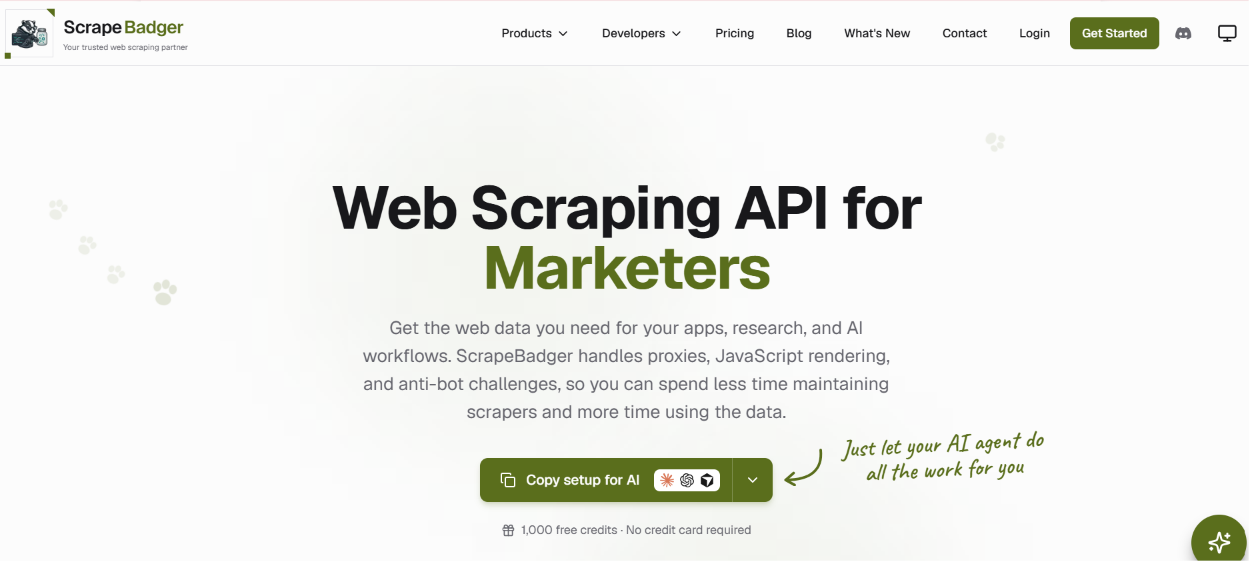
ScrapeBadger combines a general web scraping API, dedicated scrapers for sources like Google, Amazon, Reddit and Twitter/X, and an MCP server, all billed from one credit balance.
The design choice that matters most is how it picks an engine. By default, the scrape endpoint tries a fast HTTP request with a Chrome TLS fingerprint (1 credit) and moves to a headless stealth browser (5 credits) only when a page needs it.
Turn on escalation and a blocked request is retried with a stronger method, from plain HTTP up to a full browser, and you pay only for the method that succeeds. Failed requests cost nothing and retries are free.
A max_cost parameter rejects any request whose estimated cost exceeds your budget. That answers the e-commerce thread's point that an advertised price rarely reflects the real cost of a successful page.
Proxy handling is per request. You choose a tier (datacenter, residential, or premium residential and mobile), set a country with one parameter, and rotation happens automatically.
When a page is protected, an anti-bot solver layer handles systems such as Cloudflare, DataDome, Akamai and Kasada, and ScrapeBadger states that it solves reCAPTCHA, hCaptcha and Cloudflare Turnstile.
A separate detect endpoint tells you which protections a site runs before you spend credits on it.
The output options cover most downstream uses. You can return HTML, Markdown or plain text, capture a PNG screenshot, or use the extract endpoint to pull fields as JSON with CSS selectors, XPath or plain-language AI rules.
Markdown is far lighter than raw HTML for an LLM, JSON skips the parser, and a screenshot settles any doubt about what the page showed. For search data, the Google SERP API returns structured results ready to use.
For AI developers, the ScrapeBadger MCP server exposes these endpoints as typed tools in Claude, Cursor, Windsurf, VS Code with Copilot, ChatGPT and other MCP clients. An agent can then fetch a rendered page, extract prices and query Google mid-task, with no glue code.
New accounts get 1,000 free credits with no card. After that, pay-as-you-go credits start at 10(0.15 per 1,000 credits) and never expire, while subscriptions start at $49 a month.
There are trade-offs. ScrapeBadger is a younger name than the others here, proxy tiers add a surcharge on top of the engine cost, and the general scraper excludes Facebook, Instagram and LinkedIn (dedicated APIs cover those). Each response reports its exact charge, so real costs are easy to check.
Best for: developers who want rendering, anti-bot handling, structured output and AI-agent access in one API.
2. ScraperAPI
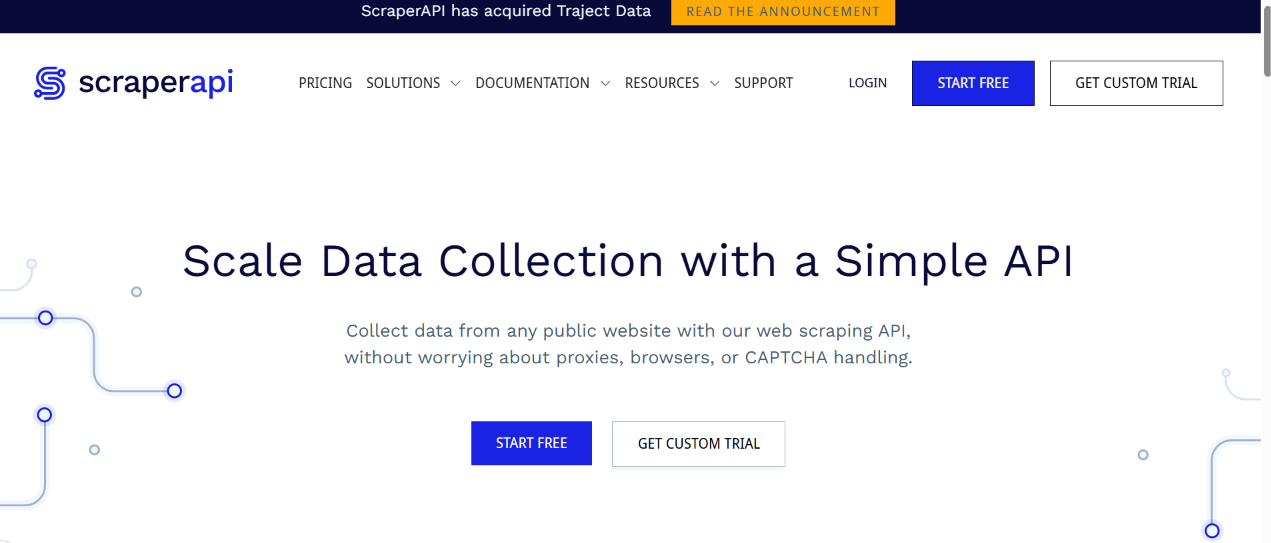
ScraperAPI is one of the most familiar names in these threads. Send a URL and it handles proxies, retries and headers, with render=true for JavaScript and premium tiers for harder sites. It can return Markdown or text for LLM work, offers structured data endpoints for a set of popular domains, and has an async jobs API for large batches.
The Hobby plan costs $49 a month for 100,000 credits, with a 7-day trial of 5,000 credits. Credits are not pages, though. According to ScraperAPI's credit cost documentation, an Amazon request costs 5 credits, Google costs 25, and JavaScript rendering adds 10. It only charges for successful requests, and the two cheapest plans limit geotargeting to the US and EU.
On Reddit, it appears in the side-project and e-commerce discussions, and the r/webscraping poster reported it failing on some of their targets.
That is one person's experience on specific sites, not a verdict.
Here is how ScraperAPI and ScrapeBadger compare in detail.
Best for: teams that already write their own parsers and want a mature proxy layer.
3. ScrapingBee
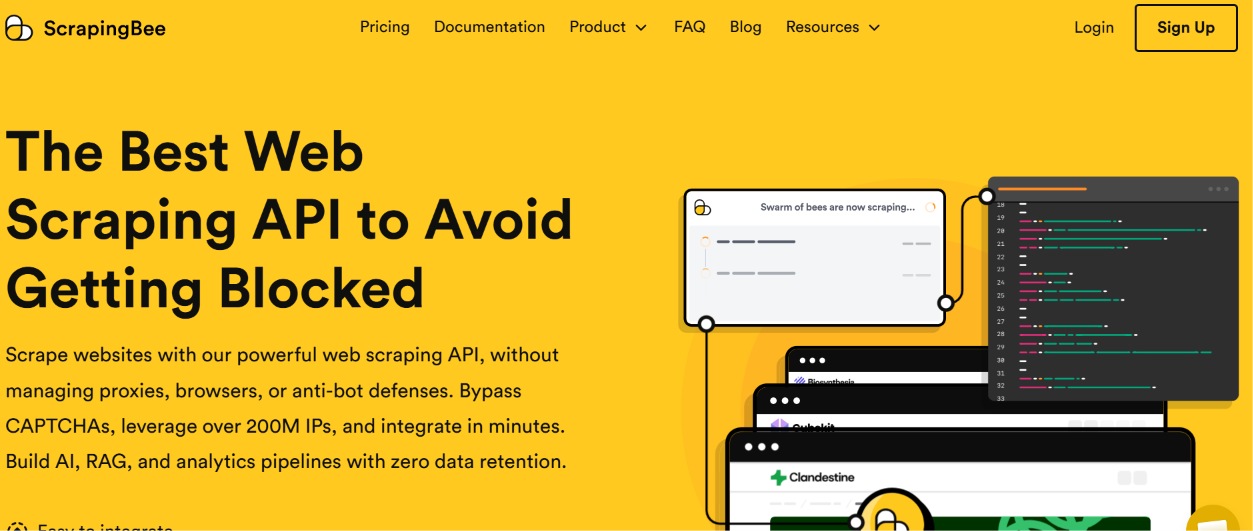
ScrapingBee's appeal is a simple API with a lot of options behind it: JavaScript scenarios for clicking and scrolling, screenshots, CSS extraction rules, a Google Search API and AI extraction described in plain English.
Its credit table is clear but climbs quickly. A request through classic proxies costs 1 credit without JavaScript and 5 with it, premium proxies cost 10 or 25, and stealth proxies cost 75. AI extraction adds 5 credits. The entry plan is $49 a month for 250,000 credits, and new users get 1,000 free credits.
It also appears in the side-project and e-commerce threads, and the same r/webscraping poster reported failures with it on certain targets. Test your hardest site on the free credits first, because a 75-credit stealth request changes the economics fast.
Our ScrapingBee alternative breakdown covers the pricing differences.
Best for: developers who want a straightforward API with good browser-automation controls.
4. Apify
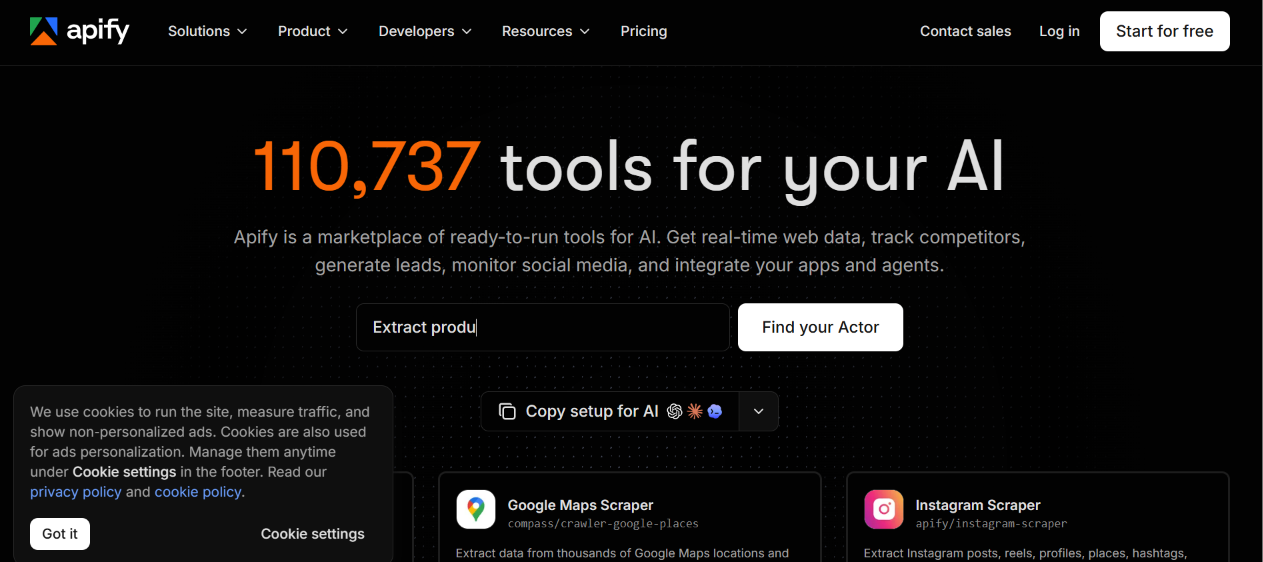
Apify works differently from the others. It is a platform for Actors: serverless scraping programs you call through an API, schedule and store results from. Its store lists tens of thousands of them, most built by community developers, and its open-source Crawlee library lets you build your own. There's an MCP server for AI agents too.
The free plan includes 5ofmonthlyusagewithnocard.Beyondthat,youpayforcomputeunits(0.20 each on the lower plans), residential proxy traffic ($8 per GB on the free plan), and sometimes a per-result or rental fee set by the Actor's author.
Developers mentioned it in the side-project and production threads. When a well-maintained Actor already exists for your target, it saves you building a scraper at all; the catch is that quality varies by author and costs are harder to predict than flat per-request credits.
Best for: teams that want prebuilt scrapers and workflow orchestration rather than a raw fetch API.
5. Bright Data
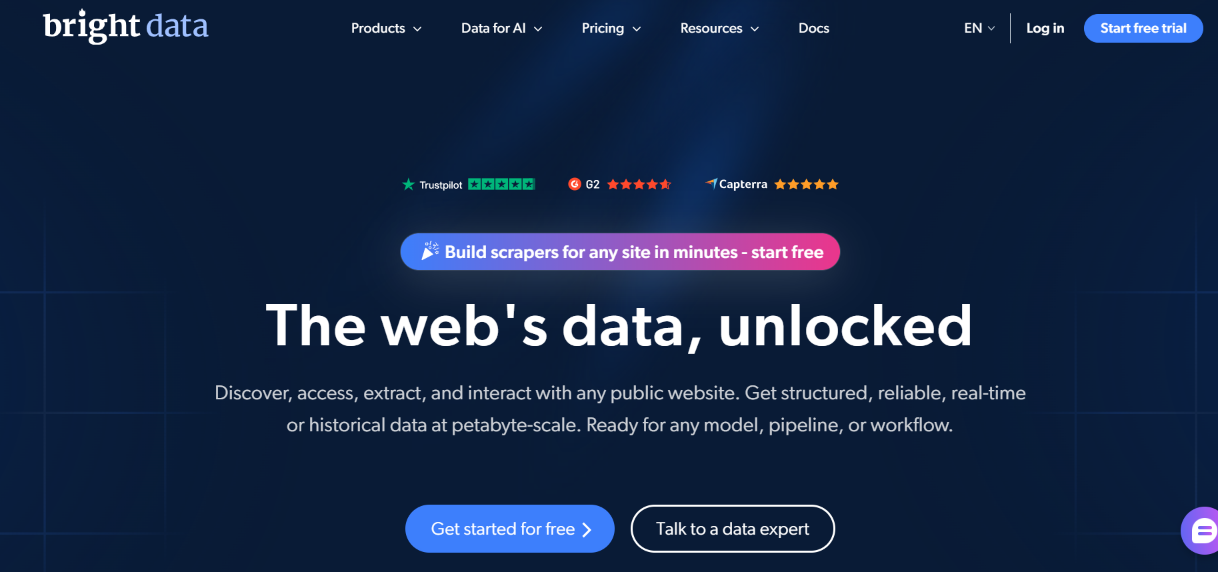
Bright Data is infrastructure at a different scale. It sells residential, datacenter, ISP and mobile proxies, plus Web Unlocker, a SERP API, a Browser API, prebuilt scraper APIs and ready-made datasets.
Web Unlocker has a free tier of 5,000 requests a month and then costs $1.50 per 1,000 successful requests on pay-as-you-go pricing. Residential proxies are billed per GB, with lower rates on monthly commitments.
It appears in the e-commerce and production discussions, and opinions on hard targets were mixed in r/ComplexWebScraping. That breadth is what large organisations pay for, since they can combine proxy types, unblocking and datasets under one vendor. For a side project, that many products and meters is usually overkill.
Best for: enterprise data teams with high volume, difficult targets and budget for it.
How to Choose the Right Web Scraping API
Start with your hardest target, not the vendor's benchmark. Then match the API to the job:
Small projects: look for free credits with no card and pay-as-you-go credits that don't expire, so a quiet month costs nothing.
SaaS applications: prioritise predictable per-request costs, free failed requests, clear rate limits and per-request budget caps.
E-commerce and price monitoring: measure the cost per successful product page on your real SKUs, and consider dedicated endpoints like an Amazon scraper API that return parsed fields.
JavaScript-heavy sites: prefer APIs that render only when needed, since many dynamic sites don't need a headless browser at all.
Large-scale scraping: check concurrency limits, proxy breadth and enterprise terms; this is where Bright Data and higher subscription tiers earn their price.
AI applications and data pipelines: you want Markdown output, JSON extraction and MCP support so agents can work with real-time web data.
Frequently Asked Questions
What is the best web scraping API according to Reddit?
There is no consensus pick. In the web scraping API Reddit discussions reviewed for this article, ScraperAPI, ScrapingBee, ScrapFly, Apify and Bright Data came up most, and developers repeatedly stressed testing on their own targets.
Which web scraping API is best for developers?
For one API covering rendering, anti-bot handling, structured output and MCP, ScrapeBadger is our pick. Apify suits teams that want prebuilt scrapers, and Bright Data suits enterprise volume.
Which scraping APIs support JavaScript rendering?
All five do. The difference is cost: ScrapeBadger's browser engine costs 5 credits, ScraperAPI adds 10 credits for rendering, ScrapingBee charges 5 credits with JavaScript on, Apify bills browser-based Actors by compute, and Bright Data sells a hosted Browser API.
How much does a web scraping API cost?
Entry plans for ScraperAPI and ScrapingBee start at $49 a month, while ScrapeBadger's pay-as-you-go credits start at $10. What matters is the credits consumed per successful page, which this web scraping cost guide breaks down by volume.
Is a web scraping API better than building your own scraper?
For most teams, yes. Running your own scraper means paying for proxies, maintaining browsers and fixing breakages yourself. Building in-house makes sense mainly at very high volume with dedicated engineering time.
Conclusion
If the Reddit threads agree on anything, it's that the right API keeps succeeding on your targets at a cost you can predict. ScraperAPI and ScrapingBee remain solid proxy layers for teams with their own parsers. Apify wins when someone has already built the scraper you need, and Bright Data suits enterprise volume.
ScrapeBadger earns the top spot by combining engine escalation, free failed requests, structured output and MCP access in one API. Point it at the site that gives you trouble, using the 1,000 free credits on signup.

Written by
Domas Sakavickas
Dom Sakavickas is Co-founder of ScrapeBadger, building web scraping infrastructure for developers and data teams. He writes about the web data market, tool comparisons, and business use cases for scraping. ScrapeBadger is a web scraping API platform specialising in Twitter/X, Reddit and Google data, with dedicated scrapers also covering TikTok, YouTube, LinkedIn, Amazon, eBay, Zillow and 40+ more: with built-in anti-bot bypass and an MCP server for AI agents.
Ready to get started?
Join thousands of developers using ScrapeBadger for their data needs.